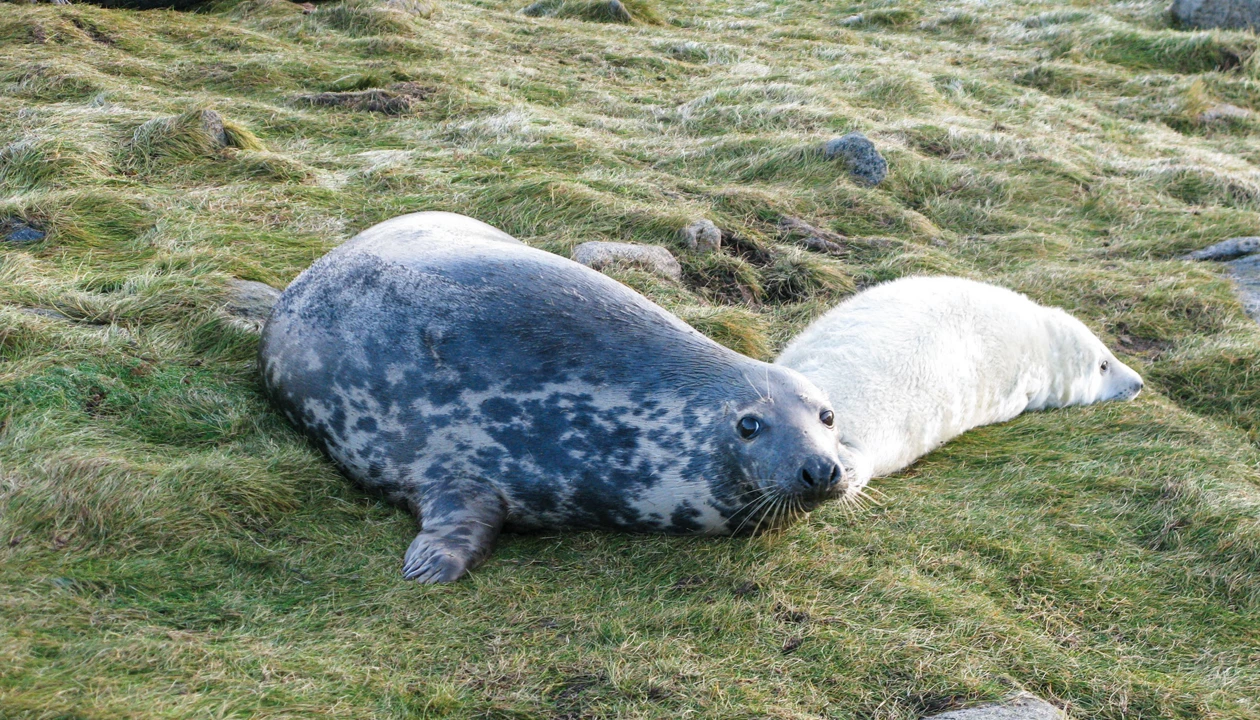
A new, in-depth analysis of the sugar chains in wild seal milk is challenging the paradigm that human breast milk is uniquely biochemically complex (Nat. Commun. 2025, DOI: 10.1038/s41467-025-66075-2).
“This is really the most diverse milk, biochemically speaking, that we have investigated so far,” says glycoscientist Daniel Bojar of the University of Gothenburg, who led the study. Bojar and his team found hundreds of unique sugar molecules, some of which could have health benefits for humans.
Baby mammals get more than nutrition from their mothers’ milk; it contains sugar chains that help infants establish a healthy microbiome and fend off pathogenic bacteria, supporting their developing immune systems. The complexities of human milk have been well studied. But detailed analyses of other species’ milk have largely been limited to domesticated animals or those living in zoos.animals or those living in zoos.
The new study is the most in-depth profile carried out to date on a nonhuman mammal living in the wild, says Bojar. A creature’s environment has a big influence on its immune system and microbiome, so studying animals in their natural habitat gives researchers the most accurate biochemical picture.
As mammals, “we all have to play with more or less the same [sugar] building blocks that we arrange in different manners,” Bojar says. Examining how various species assemble their milk oligosaccharides can help flesh out evolutionary relationships.
The researchers carried out the study on five female Atlantic gray seals on the Isle of May, in Scotland. They chose to focus on seals, Bojar says, because seals use mainly the fats in their milk rather than lactose for energy, so any sugars in the milk are there specifically for microbiome development.
The team collected milk samples from each seal at four points in their 17-day lactation period and analyzed them using several mass spectrometry techniques to identify which sugars are present and at what times.
Overall, the researchers identified 332 unique oligosaccharides, 166 of which had not previously been found in any species’ milk. This makes gray seals now the species with the second-highest number of characterized milk oligosaccharides, after humans. The largest oligosaccharide the researchers found contained 28 sugar units—10 more than the largest known human milk oligosaccharide—in a complex branching structure.
Despite seals’ relatively short lactation period compared with that of humans or cows, the researchers found that the milk oligosaccharide composition also undergoes characteristic changes over time. For example, α-gal (galactose-α-1,3-galactose) is more prevalent earlier than later in the lactation period, and later samples include more sulfated structures.
Chemical structure of a disaccharide molecule with two N-acetyl groups.

Researchers have found that LacdiNAc, one of hundreds of sugar motifs found in seal milk, regulates immune responses in human cells and helps curb harmful bacteria.
LacdiNAc, a disaccharide made up of N-acetylgalactosamine linked to N-acetylglucosamine, was a common motif in many of the molecules the team identified. The researchers found that LacdiNAc prevented three strains of pathogenic bacteria from forming biofilms. It also modulated immune activity in human white blood cells. These results hint that the compound—and others like it—could have therapeutic potential.
The study “has completely upended this idea that human milk was the pinnacle of complexity,” says Sabrina Spicer of Vanderbilt University, whose PhD research focused on the bioactive properties of human milk oligosaccharides and who was not involved in the study. Five seals on one island wouldn’t ordinarily be considered a great sample size, but the wealth of information the researchers milked from them is impressive, says Spicer.
Bojar says he and his team are going to continue exploring the structures and functions of milk glycans in as many understudied species as possible: “wherever, we don’t know anything, that that’s where we get the biggest gain.” But there’s also still things one could investigate about seals: for example, comparing how oligosaccharides vary between different gray seal populations, or between closely related seal species.
Chemical & Engineering News
ISSN 0009-2347
Copyright ©
2025 American Chemical Society