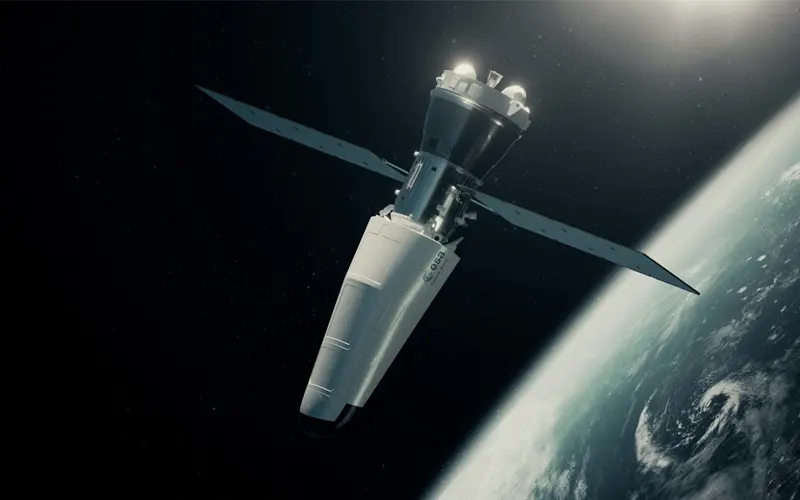
 Credit: ESA
The European Space Agency has announced that the inaugural flight of its reusable Space Rider vehicle is expected in 2028.
Space Rider is an eight-metre-long reusable spacecraft designed to carry technology demonstration and scientific payloads into orbit for up to two months before returning them to Earth. The spacecraft employs a steerable parafoil to enable precise landings for recovery, refurbishment, and reuse.
During a contract signing between ESA and the Portuguese Space Agency on 27 November to establish the Santa Maria Space Hub, ESA Director General Josef Aschbacher announced that the first Space Rider flight is planned for 2028. Serving as the programme’s designated landing site, Santa Maria will form a key part of the vehicle’s ground infrastructure.
Speaking to European Spaceflight following the announcement, Programme Manager Dante Galli added that the flight was expected in the first quarter of 2028. He explained that the next big milestone would be the final drop test, which is now planned for February or March next year due to anticipated adverse weather conditions. Originally scheduled to take place before the end of the year, this test will, unlike the previous tests that used a simple mass simulator, use a close approximation of the Space Rider Re-entry Module.
Moving ahead to the inaugural flight, all flight hardware has been manufactured and is currently awaiting integration or undergoing verification testing. The progress toward a flight-ready vehicle is, as a result, likely to come before the expected launch date in under three years. A factor in determining when the inaugural flight is expected to occur is also the availability of the Vega C launch vehicle, particularly the variant with the more powerful P160C booster, which has yet to be flown.
Although a demonstration mission, the inaugural flight of Space Rider will carry commercial payloads, with 18 customers having signed Memorandums of Understanding with ESA to secure space aboard the mission. These customers have been offered a discounted rate for the inaugural flight, and several have already expressed interest in booking additional missions, signalling a clear pathway toward the vehicle’s commercialisation.
ESA will act as the end-to-end operator for the first flight of Space Rider. However, once the vehicle has been recovered and refurbished, an element of the mission that will be funded with subscriptions from the ESA Ministerial Council meeting currently taking place in Bremen, the vehicle will be handed over to a commercial operator. While the exact pathway toward commercialisation has not yet been finalised, the agency is currently in discussions with two companies that could serve as the commercial operator of Space Rider.
Keep European Spaceflight Independent
Your donation will help European Spaceflight to continue digging into the stories others miss. Every euro keeps our reporting alive.