
Two guns linked to the IRA killing of three people have been either lost or destroyed by the British army and police, it has emerged
Police ombudsman Marie Anderson revealed a catalogue of investigative failings on the part of police after meeting with relatives of three people shot dead by the IRA more than 30 years ago.
In a report Ms Anderson also said her office is “unable to conclude definitively” on claims a gun used to kill two RUC officers and a civilian was previously taken from an IRA arms dump by Special Branch before being returned.
RUC officers Harold Beckett (47) and Gary Meyer (35) were shot dead by two gunmen close to Castle Street, in Belfast City Centre, in June 1990.
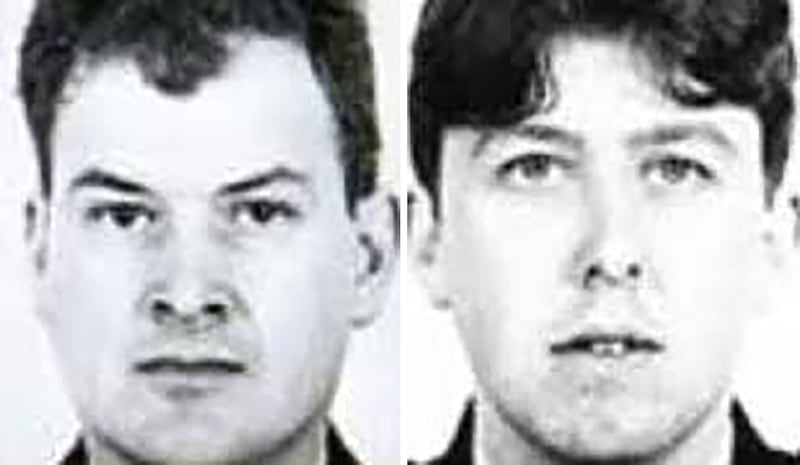 RUC constables Harry Beckett and Gary Meyer, who were murdered on June 30 1990.
PICTURE Police Remembrance Trust
RUC constables Harry Beckett and Gary Meyer, who were murdered on June 30 1990.
PICTURE Police Remembrance Trust


Both policemen were shot in the head, with Mr Meyer dying later in hospital.
Another man, civilian James Henry Babington (52) was shot dead in north Belfast in October 1989.
The IRA later apologised for killing the father-of-three after it emerged he was killed in a case of mistaken identity, with the intended target being a man linked to loyalist paramilitaries.
The Ombudsman launched investigations after two referrals from the PSNI, along with a complaint each from the families of Mr Beckett and Mr Babington.
The PSNI referrals were linked to statements made by two RUC staff members that the RUC’s Weapons and Explosives Research Centre (WERC), which was attached to Special Branch, tested guns secretly retrieved from paramilitary groups before returning them.
One statement was made by a former RUC officer and later reported as a part of a BBC Spotlight programme, while the other was made by a civilian staff member to the Stevens Inquiry, which examined collusion.
The former police officer had claimed that two handguns had been removed from an IRA arms dump by Special Branch and provided to WERC for testing and to establish their history.
The officer claimed these guns would then be returned to the hide, which would be placed under surveillance with a view to making arrests.
However, the policeman said the weapons were later used to kill two officers.
Although not named at the time, the BBC identified the two as Mr Beckett and Mr Meyer.
The ombudsman points out that the former WERC officer, who has since died, was based at the centre between 1980 – 1984, six years before Mr Beckett and Mr Meyer were shot dead.
The civilian WERC employee later told the Stevens Inquiry that in the early 1990s he was given two 9mm Browning pistols by Special Branch, which had been taken from an arms dump.
He claims he was told to deactivate one weapon, but not the other.
He also alleged that several days later he was given spent cases found at the scene after the killing of a police officer and found they matched the Browning he had been told not to deactivate.
 Kathryn Johnson with her Son Daniel and Solicitor Kevin Winters.
PICTURE COLM LENAGHAN
Mr Beckett’s daughter Kathryn Johnston later complained to the ombudsman.
Aged just 17 at the time of her father’s death, her mother also passed away less than six months later from what she described as a “broken heart”.
Mr Babington’s death, which has been linked forensically to the killing of the two RUC men, was also referred to the Police Ombudsman by his family.
Police Ombudsman Marie Anderson has now said the her “investigation has established that the weapons referred to in the statements by the former police officer and former WERC employee were not those used in the murders of Constable Beckett and Constable Meyer”.
“However, in light of the available evidence and intelligence, it has not been possible to conclude definitively on whether WERC had any involvement in the weapons which were used in their murders.”
Mrs Anderson revealed that investigators considered if the accounts provided by the WERC staff members could be linked to other IRA attacks.
“My investigators reviewed the murders of nine police officers and they have been unable to conclusively identify any police officer who was killed in the circumstances described.
“This meant it was not possible to examine any related police investigation to establish whether it was adversely affected by a failure to disseminate relevant intelligence concerning firearms or associated suspects.”
In her report the Police Ombudsman said it wasn’t clear if state agents were protected.
“The objective of the deactivation of weapons was clearly to save lives by thwarting the activities of terrorists,” she said.
“The stated aim of handing back ‘live’ weapons, which occurred as past ombudsman investigations and enquiries have established, was to protect the source of those weapons.
“However, this investigation was unable to establish whether any state agent was unlawfully afforded protection from scrutiny in relation to their potential involvement in these cases.”
She confirmed that police recovered both guns used to shoot the two police officers.
One, a Ruger revolver, was dropped by a gunmen as he fled the scene.
It had been stolen in February 1989 from the home of an RUC officer.
The second gun, a 9mm Browning pistol, was recovered in Belfast in October 1990 and matched cases found after the two police officers were shot dead.
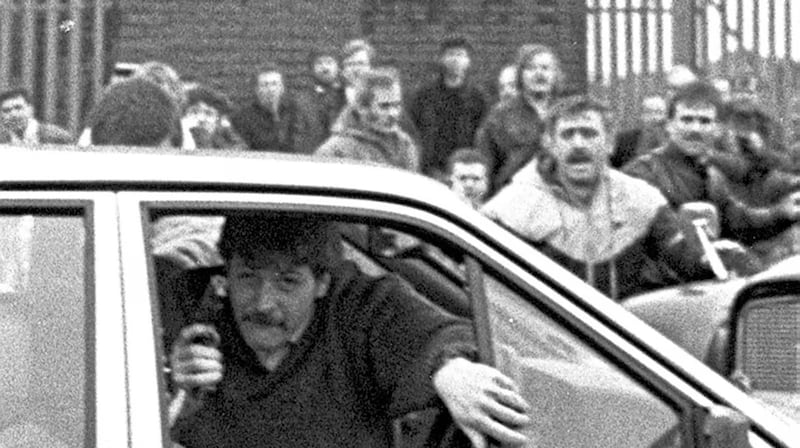 Corporal Derek Woods emerging from his car with his gun in hand after driving into the funeral of Caoimhín MacBrádaigh
The same gun was used to kill Mr Babington. It had been taken when the IRA killed undercover British soldiers Corporal Derek Wood and Corporal David Howes in west Belfast in March 1988 after they drove into the funeral of IRA man Caoimhín Mac Brádaigh in west Belfast.
It has now emerged this gun was handed back to the British army in 1996 and according to the ombudsman enquiries “confirmed that the location of the weapon is not known”.
The ombudsman has said “this weapon ought not to have been disposed of by police in this case”.
It has also emerged that a second gun linked to the Babington case has been destroyed.
A second Ruger, which had no previous history, was recovered by police in west Belfast in December 1989 and subsequently disposed of.
“The Police Ombudsman considers that this weapon, related to an unresolved murder, ought not to have been destroyed by police in this case,” Mrs Anderson said.
The ombudsman confirms that nine people were subsequently arrested although there are examples where Special Branch did not disseminate information to investigators.
Mrs Anderson said investigators can find no “rationale” as to why some suspects were “arrested and interviewed under criminal caution while others were not”.
She added there is no evidence that suspects named by witnesses were pursued by police.
“The investigation also identified a number of investigative failings, including missed forensic opportunities,” Mrs Anderson said.
This included a seized jacket with specks of dried human blood.
“It was not possible to obtain a blood grouping from it, and it could not, therefore, be linked to the murder of Mr Babington,” the ombudsman said.
“The forensic laboratory was subsequently told that the suspect had been eliminated from enquiries, and no further testing of the jacket was required.
“The jacket was destroyed. Police indicated that this person had been eliminated from the investigation despite intelligence linking him to the murder.
“My investigators have been unable to establish the rationale for this decision.”
The ombudsman concluded that the RUC investigation into the shooting of Mr Badington “was incomplete”.
In relation to the two police officers Mrs Anderson said while the investigation was “well resourced, well managed and conducted without any delay” adding “a significant number of arrests” were made.
Mrs Anderson added that also “identified failures in the non-dissemination of intelligence by Special Branch”.
The ombudsman believes “this intelligence could have been capable of supporting new and further lines of the enquiry for the SIO (Senior Investigating Officer), had he been made aware of them”.
She also said where intelligence and information naming individuals allegedly involved in the city centre ambush was passed to the RUC investigation team, limited action was taken.
“This investigation has been unable to establish the reason for this,” she added.
Mrs Anderson has also revealed that information provided by the British army was also ignored.
“Members of the military came forward to report that a person had told them that he witnessed the murders and knew the gunmen by name,” the ombudsman’s office said.
“They also provided a photograph.
“This did not result in any new lines of enquiry. “
The ombudsman said the “information highlighted a person that potentially had very significant information pertaining to the identity of the gunmen”.
“It is not known why the SIO did not generate any enquiries emanating from this intelligence,” said Mrs Anderson.
According to the ombudsman she “identified further missed investigative opportunities”.
She said this included plans to arrest two people, which could not take place because “the area had been designated out of bounds”.
“The police records of the investigation do not provide a rationale for why there was no further attempt to speak to or arrest these individuals,” the report adds.
Mrs Anderson said the investigation into the two police officers was not complaint with Article Two of the European Convention on Human Rights, which protects the right to life.
“I am of the view that the investigative failings in this case are so significant that it was incapable of leading to the apprehension and prosecution of the perpetrators, and therefore, was not Article 2 compliant,” Mrs Anderson said.
Ms Johnston said she felt relief.
“It’s been 35 years of asking for then truth and of fighting for the truth and to have parts of my complaint upheld and validated by the ombudsman, it’s a sense of relief,” she said.
She also spoke of her “huge sense of disappointment….in my father’s employers, the police, because, to hear from the Police Ombudsman that the investigation into this murder was not done correctly and there’s many issues surrounding that.
“It’s hard to take, the whole thing.”
 Solicitor Kevin Winters with Kathryn Johnson
PICTURE COLM LENAGHAN
Solicitor Kevin Winters, of KRW Law, said: “The ombudsman indicated she was unable to investigate allegations of agent involvement because of resourcing issues and equally is prevented by legislation from doing so.
For that to happen the next of kin have been told they have no recourse other than to engage with ICRIR.
“Unfortunately, that puts these complainants in an impossible catch-22 position given the current Article 2 deficit underpinning ICRIR (Independent Commission for Reconciliation and Information Recovery).”