tetro unfolds triangular timber roofline for house in brazil
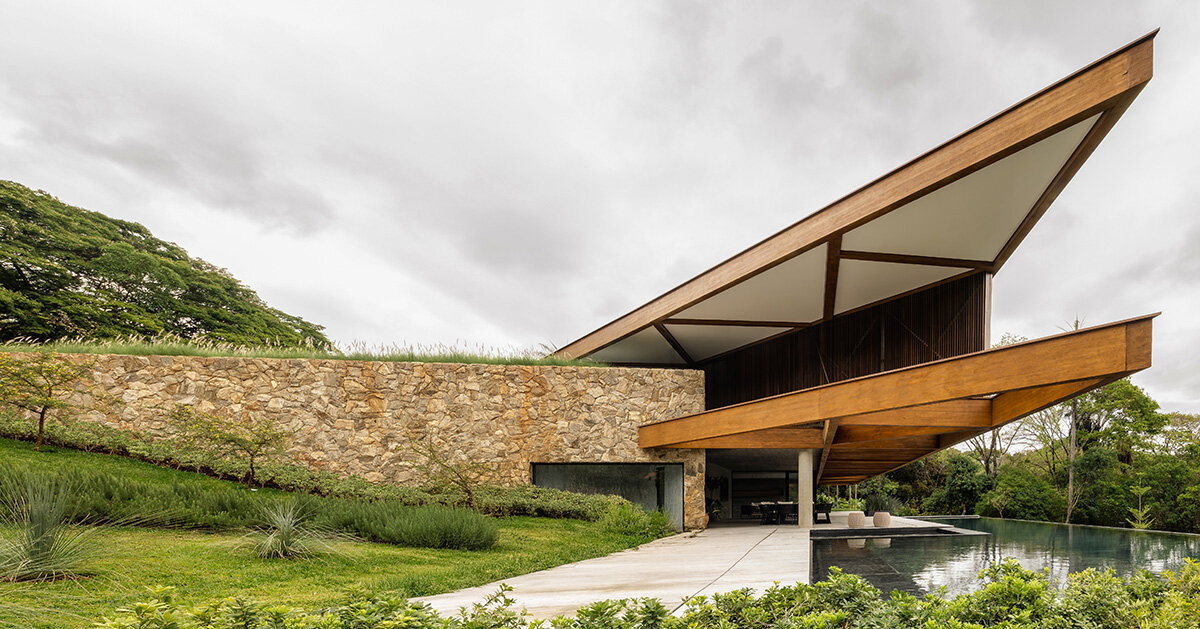
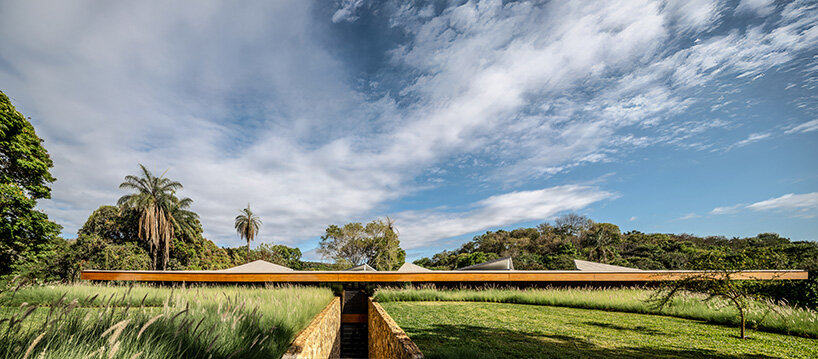
TETRO completes Casa Tangram in Lagoa Santa, Brazil, situating the 1,450-square-meter residence at the highest point of its 5,000-square-meter lakeside plot so it reads from the street as a thin, horizontal line. Conceived by architects Carlos Maia, Débora Mendes, and Igor Macedo, the project uses topography, massing, and material weight to create a sense of disappearance through retaining walls, stone embankments, and the built volume itself, which form a visual shield so that, once inside, the city recedes entirely and the house turns its body toward trees, grass, and water.
The dwelling is organized around a triangular form that lends the project its name. The architects extend it into a glued-laminated timber roof made from a sequence of folded, triangular planes. This roof becomes the main spatial device of the project, acting as a protective canopy toward the street and compressing the facade into a discreet profile, while toward the lake it opens completely.
Zenithal openings slice through the timber geometry, introducing controlled daylight into living spaces and the upper-floor circulation. The structure itself is hybrid, with timber roofs and porches paired with exposed concrete slabs and walls. The stone retaining walls anchoring the house to the slope act as structural armature and landscape threshold, reinforcing the sense of the home being partially carved from the terrain.
all images by Manuel Sá
embedded programs shape an inhabited landscape
Casa Tangram’s structural system is paired with the gentle contours of its setting, behaving as a passage, protected on one side, open on the other, filtering movement from street to lake. By stretching its roofline along the horizon and unfolding its triangular planes toward the water, the Brazilian team at TETRO shapes a home that recalibrates domestic space around light, topography, and an uninterrupted relationship with the natural world.
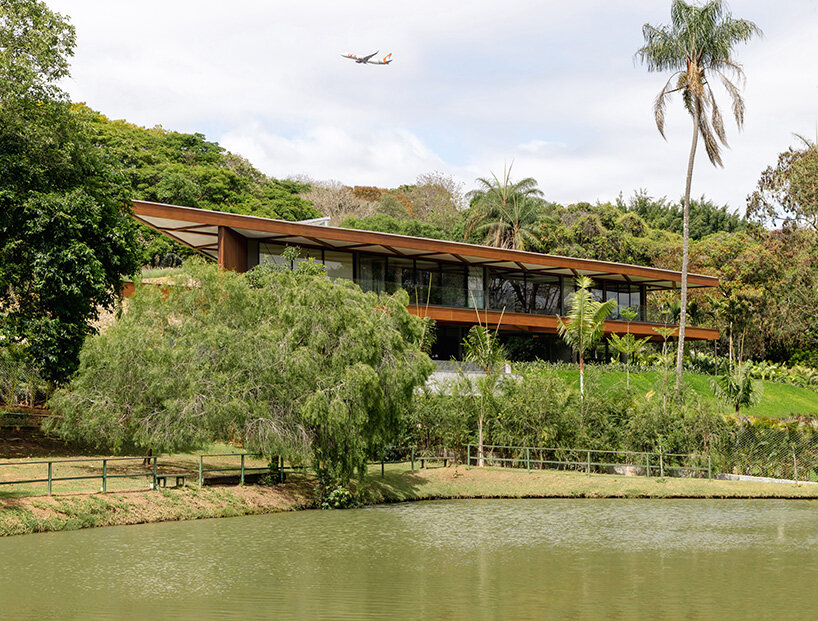
The lower level concentrates the social life of the house: the living room, kitchen, gourmet area, wine cellar, and swimming pool all face the lake through floor-to-ceiling glazing and outward-drifting terraces. A portion of this program is tucked into the retaining wall, where the auxiliary kitchen, bathroom, and wine cellar are embedded, transforming the interface between architecture and earth into a thick, occupiable zone. Here, the pool’s water visually merges with the lake, blurring distinctions between built edges and the wider natural environment.
Above, the private wing gathers a family room and five bedrooms, the master suite, two children’s rooms, and two guest rooms. Every space opens toward the view, sheltered by the roof’s generous eave and insulated by distance from the street below.
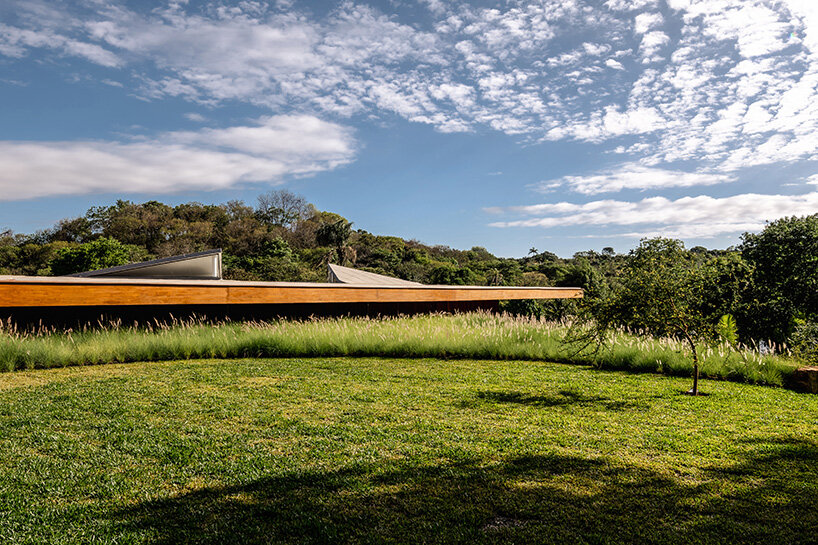
TETRO completes Casa Tangram in Lagoa Santa, Brazil
the residence reads from the street as a thin, horizontal line
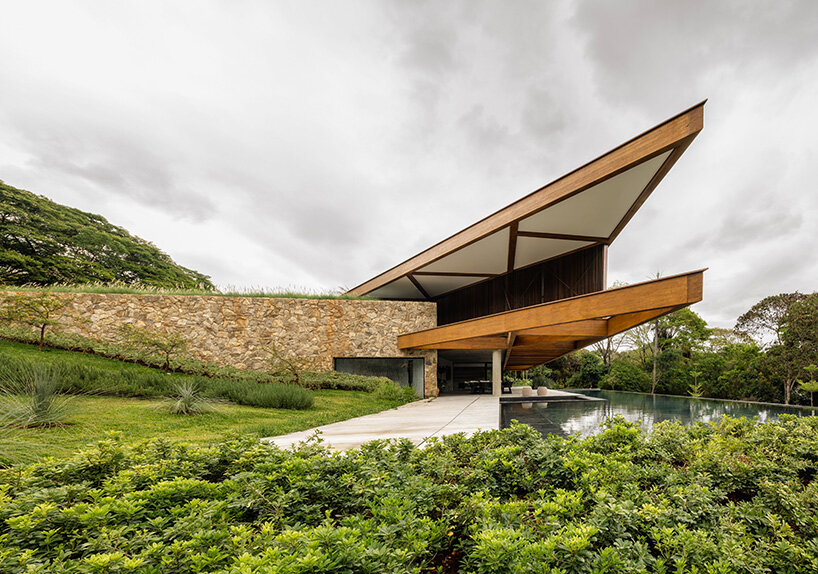
the architects situated the 1,450-square-meter residence at the highest point of its 5,000-square-meter lakeside plot
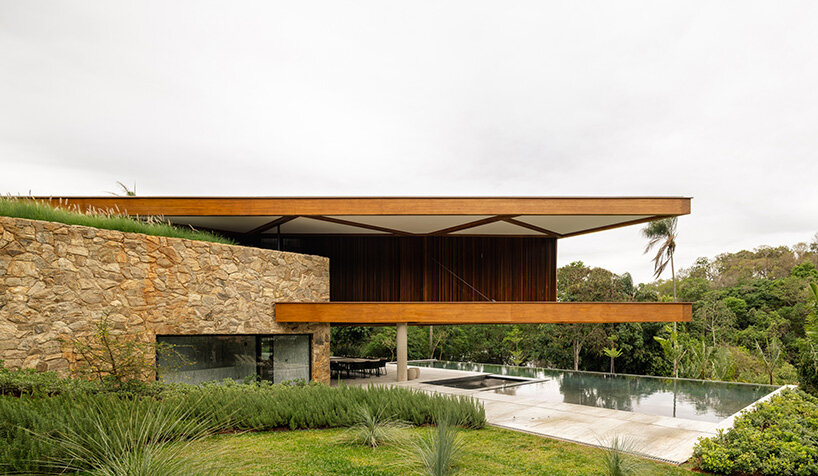
the project uses topography, massing, and material weight to create a sense of disappearance
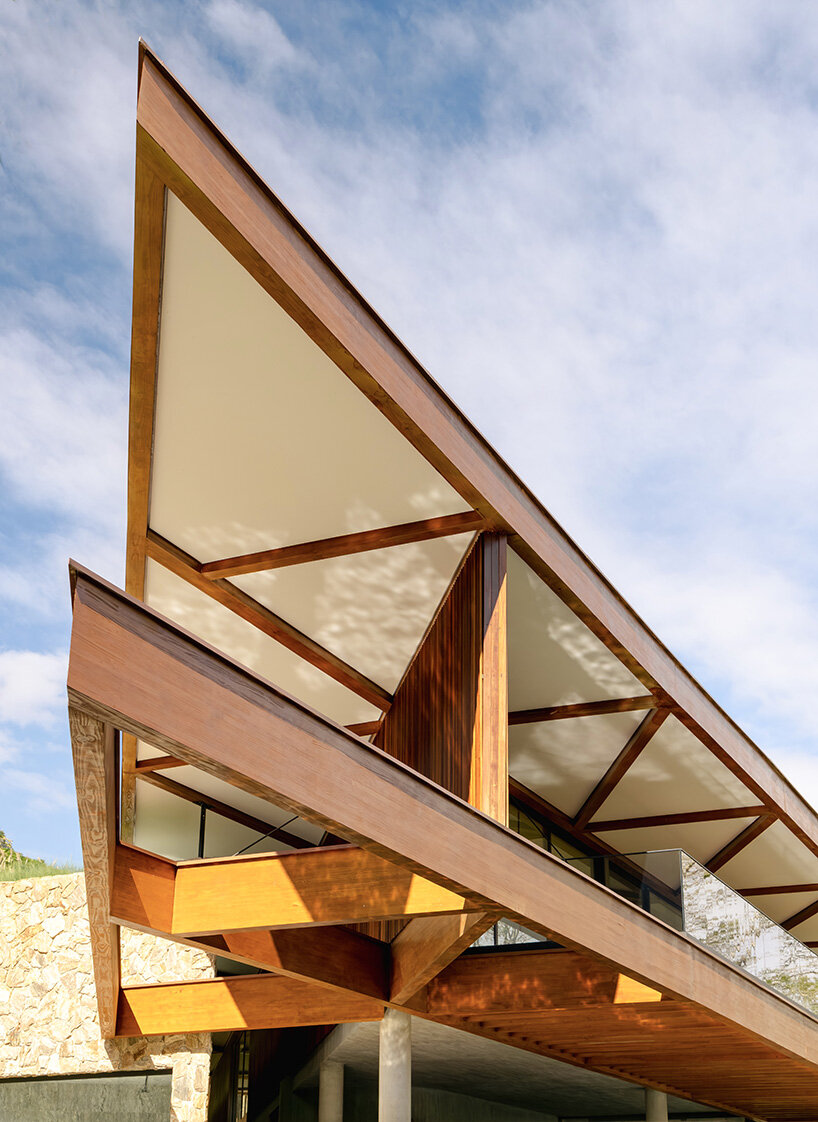
the dwelling is organized around a triangular form that lends the project its name
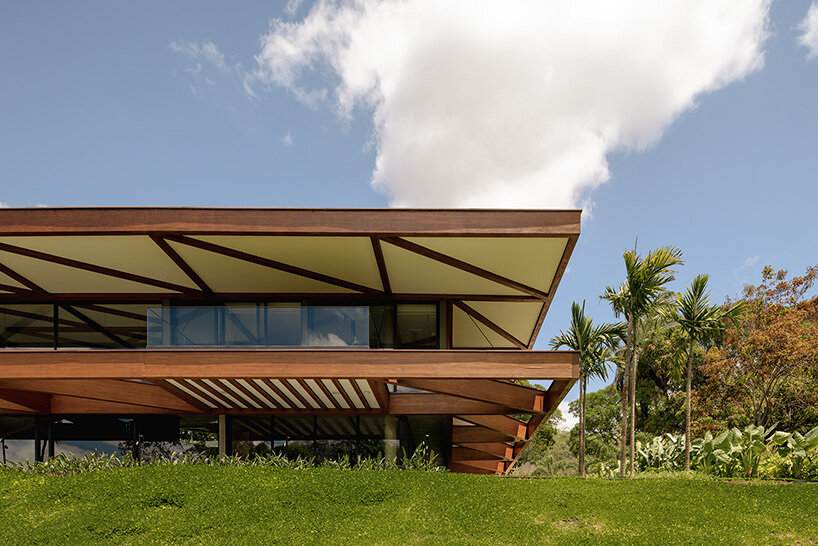
a glued-laminated timber roof made from a sequence of folded, triangular planes