This article is an on-site version of The AI Shift newsletter. Premium subscribers can sign up here to get the newsletter delivered every Thursday. Standard subscribers can upgrade to Premium here, or explore all FT newsletters
Hello, and welcome back to The AI Shift, our newsletter about AI and the world of work.
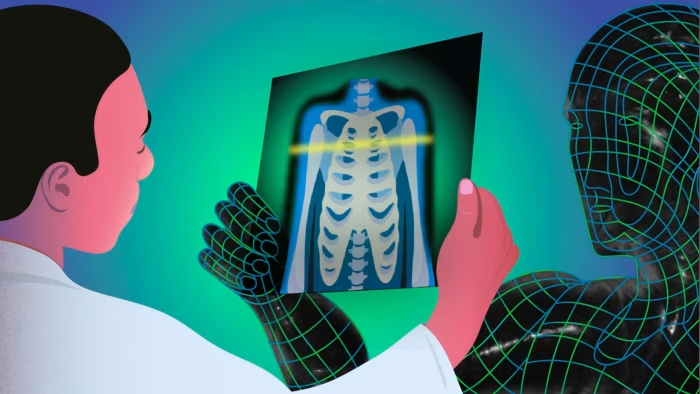
This week we ask: why are there still so many radiologists? Back in 2016, Geoffrey Hinton, often described as the “godfather of AI”, said they were already on borrowed time. “I think if you work as a radiologist, you’re like the coyote that’s already over the edge of the cliff but hasn’t yet looked down,” he told his audience. “People should stop training radiologists now. It’s just completely obvious that within five years deep learning is going to do better than radiologists . . . It might be ten years, but we’ve got plenty of radiologists already.”
So how has that prediction turned out, and what can we learn from it? Over to John for a look at the data.
John writes
I think it’s useful here to tease apart the different predictions that were explicit or implicit in Hinton’s remarks and look at how each stacks up.
There are two main claims: that AI would be outperforming radiologists by the early to mid 2020s, and that as a result demand for radiologists was roughly at its peak in 2016.
If we start with the first, and we take Hinton as referring to deep learning models’ capacity to detect and interpret tell-tale patterns in X-rays and other medical images, then you could argue that for some conditions he was proved right within a year, let alone five or ten. As early as 2017, CheXNet — a specialist algorithm trained to detect pneumonia from chest X-rays — was shown to outperform practising radiologists with decades of experience. Since then such tools have rapidly matured from experimental to regulator-approved and are now used by healthcare providers in many high-income countries, as chronicled in this excellent deep-dive by Deena Mousa in Works in Progress magazine. Last year the UK’s National Health Service adopted an AI diagnostic tool for use across its radiology departments after a 2023 trial helped to detect lung cancers at an earlier stage and cut the time from initial scan to treatment.
But there’s a catch, which brings us on to Hinton’s second prediction. While he didn’t directly claim radiologist employment was about to decline, he did imply that these advances in pattern detection and interpretation meant demand for radiologists’ skills and services had peaked. This does not appear to have been the case. In his native UK, the total number of radiologists employed by the NHS has climbed by more than 40 per cent since 2016. In Canada, where he is currently based, the number of new radiologists taking up residencies has been trending upwards and reached a record high this year. And in the US, where we have so far seen the strongest evidence of AI job displacement in other sectors, last year’s 1,378 new radiologist recruits represented a 20 per cent increase since Hinton’s remarks, while pay for the specialty has grown more rapidly than most others.
That’s because almost all of the AI tools in use by healthcare providers today are being used by radiologists, not instead of them. The tools keep getting better, and now match or outperform experienced radiologists even after factoring in false positives or negatives, but the fact that both human and AI remain fallible means it makes far more sense to pair them up than for one to replace the other. Two pairs of eyes can come to a quicker and more accurate judgment, one spotting or correcting something the other missed. And in high-stakes settings where the costs of a mistake can be astronomical, the downside risk from an error by a fully autonomous AI radiologist is huge.
Sarah writes
In order to expand on what you’ve found, John, I spoke to a radiologist about what AI in her profession looks like on the ground. Amaka Offiah, who is a consultant paediatric radiologist and a professor in paediatric musculoskeletal imaging at the University of Sheffield in the UK, reinforced what your reporting shows. She told me radiologists in the UK now use AI for all sorts of tasks, from helping to detect and measure lung nodules in CT scans which can be signs of cancer, to AI-enabled MRI scanners which can cut the time of a scan, so you can “get that patient on the table and off the table quicker.” A survey last year by the Royal College of Radiologists (where Offiah is vice-president for clinical radiology) found that 69 per cent of radiology departments were using AI in clinical practice, up from 54 per cent in 2023.
But the survey also found something striking: only 6 per cent of clinical directors said AI tools had reduced their workload, 37 per cent reported an increase in workload, and the rest reported no change. When I asked Offiah what explained those results (which are, after all, the precise opposite of what Hinton predicted) she gave me a number of reasons.
Some were the sorts of teething issues that one might expect to get better over time, such as trouble integrating AI with existing IT infrastructure. Others were more fundamental. AI tools create new tasks and responsibilities, such as “post-deployment monitoring”, which involves “auditing to make sure [the tool] is still performing at the level of accuracy [that was] on the tin,” as she put it. In addition, by speeding up some parts of the workflow, AI can lead to more work and bottlenecks elsewhere (those with good memories will recall we found the same issue in software development in a previous edition of this newsletter). If AI speeds up the rate at which you can do MRI scans, for example, it means more images for radiologists to report on.
As for reading the images, although there are many AI tools now available and more being trialled for certain tasks, there aren’t plentiful training datasets for every type of patient and every type of problem. A model trained on adult X-rays, for example, won’t be reliable for children. Offiah, a paediatric radiologist, says getting robust data on children is hard, both because of ethical approvals and consent from parents, and also because they change so much as they grow. “Everybody thinks children are small adults, but they’re not — it’s quite a different physiology,” she said. “I’m diagnosing X-rays of an 8 week old foetus, right up to 17 year olds.”
The other difference between AI and human radiologists, she said, is that the latter will notice things they’re not necessarily looking for. “Lots of AI is trained for simple and single tasks — it might be looking at the nodule in the lung, but it hasn’t necessarily been trained to recognise the bone metastasis in the humerus, which you can see on the same CT scan.”
And finally, of course, radiologists do a lot more than just interpret images. They also decide what imaging is needed, and they combine the images with their judgment, experience, and knowledge of the patient’s history to diagnose and monitor the progress of treatment, usually via discussion with other doctors in multidisciplinary teams.
Put all that together with the context of an ageing population and growing demand for imaging of all kinds, and you can see why Offiah and the Royal College of Radiologists are concerned about a shortage of radiologists, not their displacement.
“AI will assist radiologists, but will not replace them,” she said, in a prediction of her own. “I could even dare to say: will never replace them.”
So what have we learned?
I find this a fascinating demonstration of why even if AI really can do some of the most high-value parts of someone’s job, it doesn’t mean displacement (even of those few tasks let alone the job as a whole) is inevitable. Though I also can’t help noticing a parallel to driverless cars, which were simply too risky to ever go fully autonomous until they weren’t.
Sarah
I don’t want to be too unfair to Hinton, who is hardly the only person to have made big predictions in this space, but I think the story of radiologists should be a reminder to technologists not to make sweeping assertions about the future of professions they don’t intimately understand. If we had indeed stopped training radiologists in 2016, we’d be in a real mess today.
Recommended reading
-
A fascinating podcast episode on how AI is changing warfare (Sarah)
-
I want to re-up Deena Mousa’s thorough interrogation of the AI radiologist question for Works in Progress, which digs into some of the issues I touched on here in more detail (John)
Recommended newsletters for you
The Lex Newsletter — Lex, our investment column, breaks down the week’s key themes, with analysis by award-winning writers. Sign up here
Working It — Everything you need to get ahead at work, in your inbox every Wednesday. Sign up here