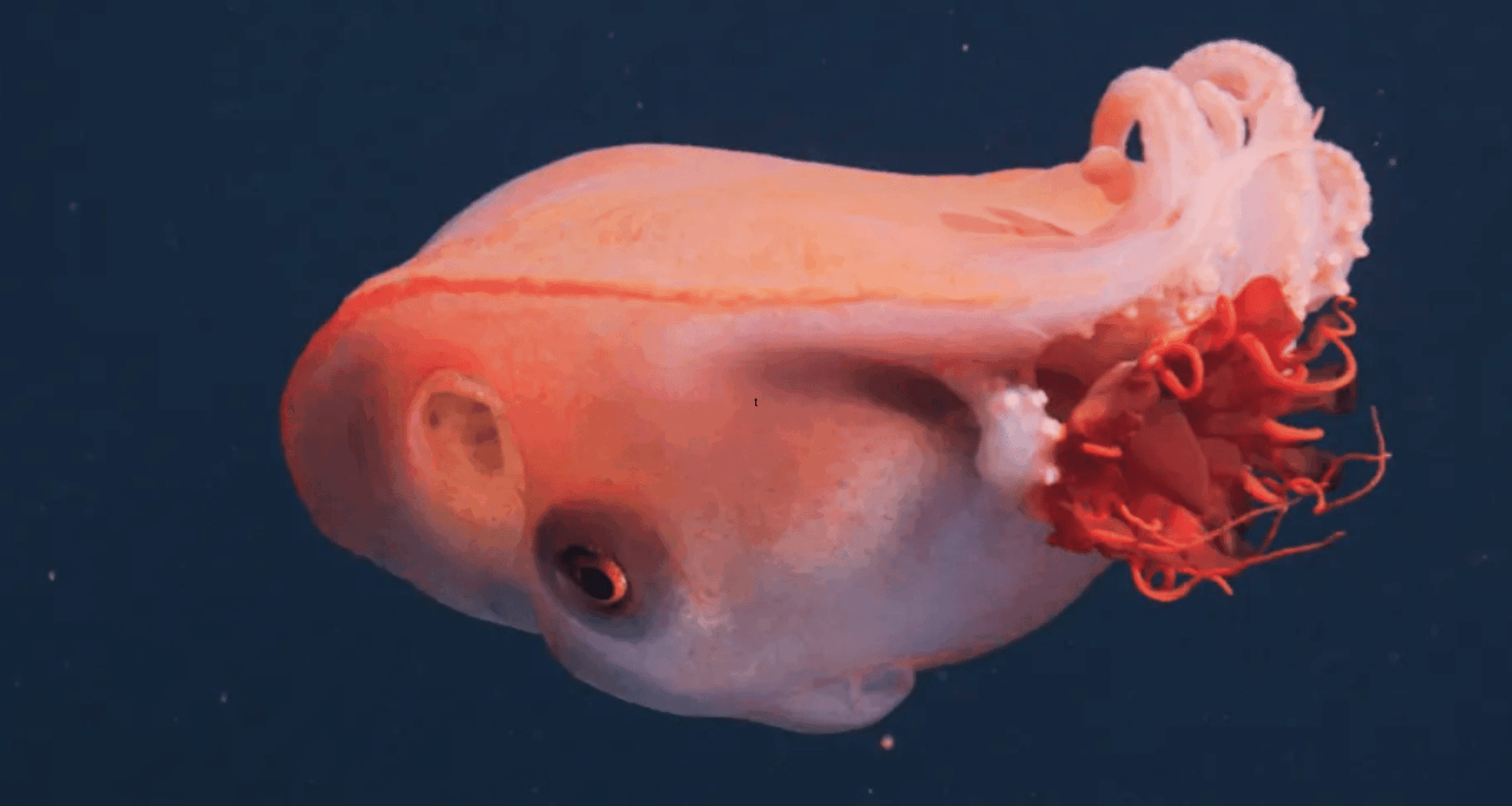
A rare and astonishing discovery in the deep sea has left scientists in awe. A team from the Monterey Bay Aquarium and Research Institute (MBARI) recently captured footage of an octopus displaying an unusual behavior, rarely witnessed by humans. This sighting marks the fourth time in 40 years that the elusive “seven-arm octopus” has been observed alive, providing an unprecedented glimpse into one of the ocean’s most mysterious creatures.
The Seven-Arm Octopus: A Strange Yet Fascinating Creature
The seven-arm octopus, scientifically known as Haliphron atlanticus, is not quite as straightforward as its name might suggest. While the animal typically has eight arms, a unique and bizarre behavior sets it apart from other octopuses. During mating, the male octopus sheds one of its arms, a specialized appendage known as the hectocotylus, which is used to transfer sperm. This arm is often tucked beneath the octopus’s body, making it appear as though it only has seven arms, an oddity that has fascinated marine biologists for decades. This remarkable display of biology is only part of what makes Haliphron atlanticus one of the ocean’s strangest creatures.
The recent footage captured by MBARI scientists adds new layers of understanding to this enigmatic species. While these octopuses are capable of reaching impressive sizes — weighing up to 75 kilograms (165 pounds) — their appearances are fleeting. Sightings of the animal in the wild are exceedingly rare, and live encounters are even rarer. The most recent sighting occurred during an exploration of Monterey Bay, at a depth of about 700 meters (2,300 feet), where the research team was able to observe the octopus in its natural habitat.
The Unique Behavior of the Male Seven-Arm Octopus
One of the key features of the seven-arm octopus is the behavior of the males during mating. Unlike other cephalopods, the male Haliphron atlanticus uses its hectocotylus to transfer sperm, a process that results in the temporary loss of one of its arms. This arm, while absent during mating, is not entirely lost but instead acts as a tool in the reproductive process. The hectocotylus is typically hidden beneath one of the male’s eyes, giving the impression that the animal only has seven arms. This peculiar reproductive strategy is one of the reasons why this octopus has gained so much attention from researchers over the years.
Despite their somewhat awkward appearance, these octopuses are incredibly adept predators. Their diet mainly consists of gelatinous creatures, including jellies and other soft-bodied animals, which they capture with remarkable precision. The most recent footage captured by MBARI scientists highlighted this aspect of their behavior, revealing a seven-arm octopus clutching a crimson red helmet jelly (Periphylla periphylla), a creature that inhabits the deep-sea ecosystem.
MBARI’s Remarkable Observation and the Importance of Deep-Sea Research
The latest sighting by MBARI represents a significant milestone in the study of deep-sea creatures. Using advanced technology, including a specially designed 4K camera developed by MBARI engineers for deep-sea exploration, the research team was able to capture incredibly detailed footage of the octopus. This provided them with an unprecedented opportunity to observe its appearance and behavior in real-time.
“Using a 4K camera specially developed by MBARI engineers for deep-sea exploration, the team collected detailed observations of the animal’s appearance and behavior,” MBARI wrote on YouTube.
Deep-sea exploration, despite its challenges, has proven to be a treasure trove of scientific discovery. The ocean’s depths are still largely uncharted, and each new discovery adds another layer to our understanding of marine ecosystems. The seven-arm octopus is a prime example of how the deep sea continues to surprise and captivate researchers. This rare sighting has provided valuable insights not only into the behavior of this elusive species but also into the complex and often surprising relationships that exist within deep-sea food webs.
A Deeper Look into Deep-Sea Food Webs
The deep-sea food web is an intricate and largely mysterious system, where creatures must adapt to extreme conditions and unique survival strategies. The seven-arm octopus is one of many species that has evolved to thrive in this challenging environment. The octopus’s feeding habits provide a fascinating example of how deep-sea animals interact with one another.
In this particular sighting, the seven-arm octopus was seen clutching a crimson red helmet jelly, an unusual prey item that highlights the octopus’s role within the deep-sea food chain. This new observation underscores the complexity of deep-sea ecosystems and their often surprising connections.
“This new sighting underscores the complexity of deep-sea food webs and their surprising connections,” MBARI explained, noting the role of creatures like the seven-arm octopus in maintaining the balance of life at these extreme depths.
While deep-sea ecosystems are often isolated from surface-level influences, they are far from simple. The interactions between predator and prey, as well as the creatures’ relationships with their environment, form an intricate web of survival. As scientists continue to explore these depths, they are uncovering new layers of ecological interdependence, offering a glimpse into a world that remains largely hidden from human eyes.