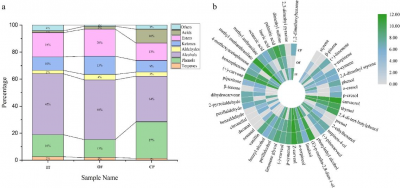
They identified 47 key volatiles and assessed their sensory contributions using OAV, ACI, and omission tests. Non-targeted metabolomics further revealed key flavonoids responsible for taste, offering new insights into how citrus peel and fermented tea components synergistically shape the unique flavor of citrus Pu-erh tea.
Citrus Pu-erh tea, a fermented blend of Pu-erh tea and dried citrus peel, has a rich history dating back to the Tang Dynasty. The distinctive flavor of citrus Pu-erh tea is a harmonious blend of sweet, floral, fruity, and earthy notes. Previous studies suggested that both volatile compounds from citrus and transformed tea metabolites shape its flavor, but systematic, integrated analyses of its aroma and taste components have been lacking. Due to this gap, a deeper investigation into the chemical underpinnings of its flavor is essential for improving product quality and informing flavor pairing.
A study (DOI: 10.48130/bpr-0024-0001) published in Beverage Plant Research on 01 March 2024 by Tao Feng’s team, University of Shanghai Institute of Technology, helps to have a clearer picture of what makes citrus Pu-erh tea so distinctive.
To unravel the flavor complexity of CPT, researchers employed an integrated sensory–chemical approach combining solvent-assisted flavor evaporation (SAFE) with GC-MS-Olfactometry and non-targeted metabolomics. Sensory evaluation and E-tongue analysis were used to compare three CPT components—the whole product (CP), IT, and OF. SAFE-GC-MS-O identified 47 key volatiles, while UHPLC-MS/MS profiled 2,743 metabolites, including flavonoids critical to taste. Sensory tests revealed distinct aroma profiles: CP was rich in phenolic, fatty, and minty notes; IT emphasized roasted, musty, and herbal tones; and OF featured floral, fruity, and woody attributes. E-tongue data showed IT had the strongest taste intensities, while CP’s sweetness was enhanced by synergistic effects between IT and OF. Quantitative aroma evaluation using odor activity value (OAV) and aroma character impact value (ACI) confirmed linalool, β-ionone, methyl anthranilate, and vanillin as major contributors. Further aroma recombination and omission experiments validated the role of these volatiles in defining each component’s unique scent profile. Principal component analysis (PLSR) linked key compounds to sensory descriptors, with octanoic acid strongly tied to fatty notes and p-cymene to mustiness. Non-volatile profiling highlighted 14 taste-impact metabolites, primarily flavonoids such as neohesperidin (sweet), leucopelargonidin (astringent), and catechins (bitter). Notably, amino acids like tryptophan and tyrosine contributed to umami and mellow tastes. Overall, the study demonstrated that both volatile and non-volatile compounds from citrus peel and Pu-erh tea jointly shape the distinctive flavor of CPT, with the flavor wheel offering a visual framework for understanding and potentially optimizing this unique tea product.
These findings provide a scientific basis for improving citrus Pu-erh tea formulations and tailoring sensory attributes to consumer preferences. The developed flavor wheel can serve as a reference tool for producers and flavorists to refine and innovate citrus tea products. Future research may explore how fermentation duration, citrus maturity, or microbial interactions further modulate flavor. The study also opens avenues for flavor pairing with other foods or beverages, enhancing culinary applications of this traditional tea.
###
References
DOI
Original Source URL
https://doi.org/10.48130/bpr-0024-0001
Funding information
The support of the Key Laboratory of cigarette flavoring Technology in Tobacco Industry (TX2018001), Shanghai Gaofeng & Gaoyuan Project for University Academic Program Development (1021GN203004005) and Royal Society of New Zealand Catalyst Seeding Fund (21-AUT-005-CSG).
About Beverage Plant Research
Beverage Plant Research (e-ISSN 2769-2108) is the official journal of Tea Research Institute, Chinese Academy of Agricultural Sciences and China Tea Science Society. Beverage Plant Research is an open-access, online-only journal published by Maximum Academic Press. Beverage Plant Research publishes original research, methods, reviews, editorials, and perspectives that advance the biology, chemistry, processing, and health functions of tea and other important beverage plants.