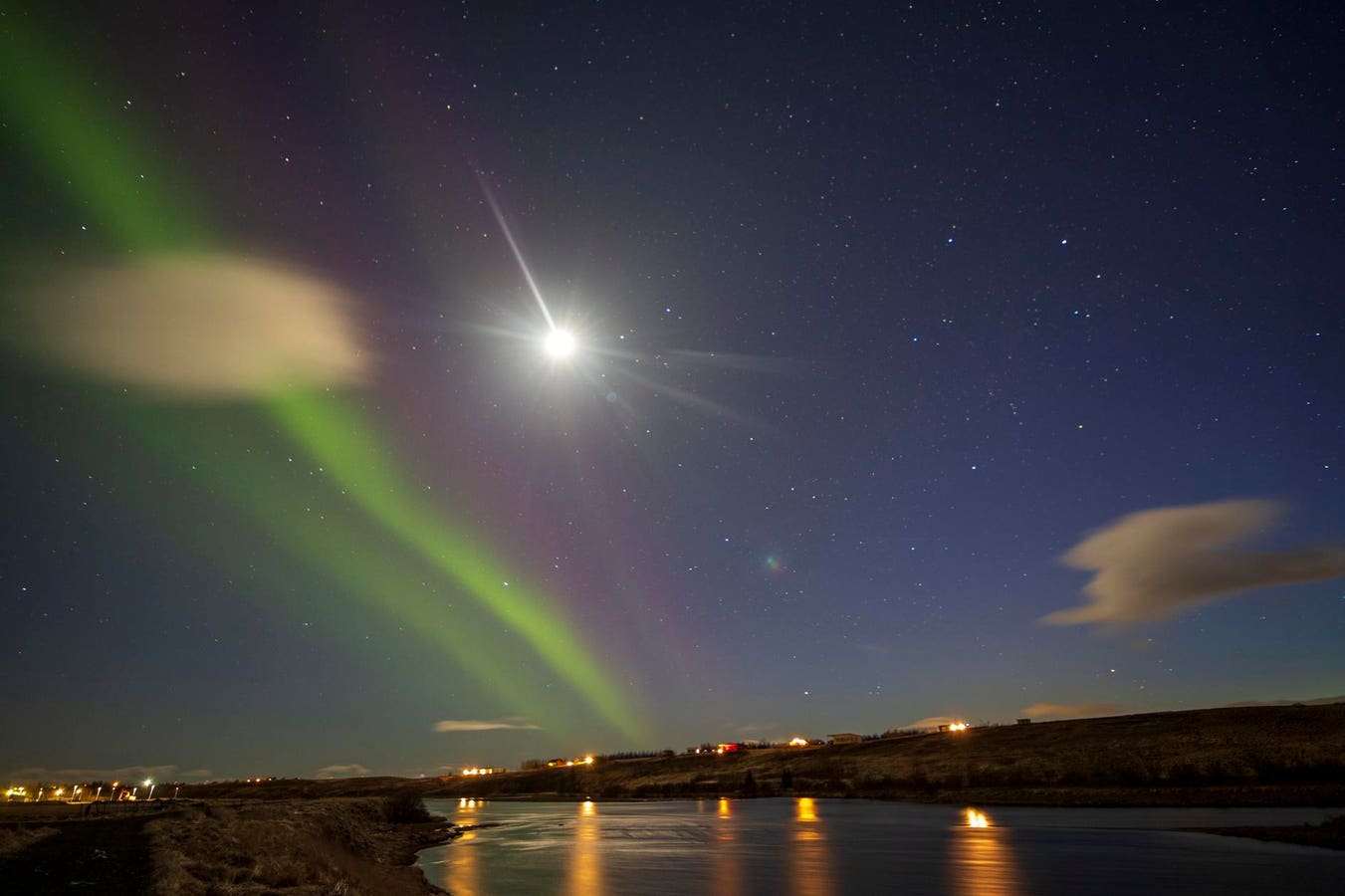
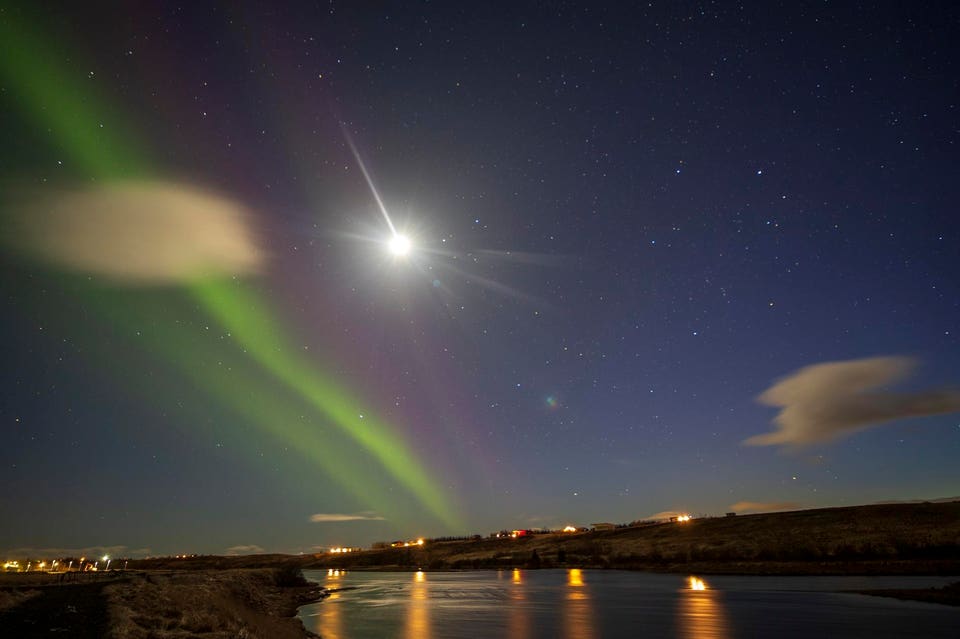
The moon and Jupiter will form a striking conjunction on Sunday, December 7, lighting up the eastern sky a couple of hours after dark.
getty
Two of the brightest objects in the night sky — the moon and Jupiter — will shine just a few degrees from each other after dark on Sunday, Dec. 7, the same night as a faint aurora is forecast for northern U.S. states.
Where And When To Look
Look to the eastern sky a few hours after sunset on Sunday, Dec. 7, 2025. Around 8:00-9:00 p.m. local time across North America, the 85%-illuminated waning gibbous moon will rise close to Jupiter, the solar system’s largest planet. The two will form a bright triangle with the star Pollux in the constellation Gemini — close to where Geminid meteors are now possible. The conjunction will be visible for much of the night as the pair climbs higher into the sky.
Jupiter will shine brilliantly at magnitude –2.6, outshining all stars and second only to the moon in brightness, leading some to dub it the “Christmas Star.”
ForbesNorthern Lights Forecast: Where Aurora May Be Seen On Sunday NightBy Jamie CarterLatest Northern Lights Forecast
It’s possible that northern U.S. states will see Northern Lights overnight on Sunday, Dec. 7, through Monday, Dec. 8, according to a forecast by space weather experts at NOAA. In the wake of a coronal mass ejection on the sun last week, a G1-rated geomagnetic storm made sightings possible low on the northern horizon.
U.S. states with a chance of seeing faint aurora on the northern horizon include Alaska and (northerly parts of) Washington, Idaho, Montana, Wyoming, North Dakota, South Dakota, Minnesota, Wisconsin, Michigan, New York and Maine.
It’s all the result of a coronal mass ejection that left the sun on Dec. 4 after an M6-rated solar flare. A CME is a cloud of charged particles that travels across the solar system and interacts with Earth’s magnetic field. Another solar flare, this time rated M8.1, exploded on the sun on Dec. 6. That will likely mean a G3-rated geomagnetic storm overnight on Monday, Dec. 8, through Tuesday, Dec. 9, according to the latest forecasts.
Forbes2025’s Best Meteor Shower Begins Today — When To See It At Its BestBy Jamie CarterWhen To See The Geminid Meteor Shower
The Geminid meteor shower began on Thursday, Dec. 4 and continues through Wednesday, Dec. 17, 2025. Skywatchers can see Geminids on any clear night, but there’s a much better chance on the peak night on Saturday, Dec. 13 and Sunday, Dec. 14, according to the American Meteor Society.
The Geminids are caused by 3200 Phaethon, a rocky object that orbits the sun every 524 days, making the Geminids one of the only major showers not caused by a traditional comet.
ForbesWhat To Know About The Bright ‘Christmas Star’ In The Southeast SkyBy Jamie CarterWhat’s Next In The Night Sky
This is just the start of December’s celestial highlights. On Dec. 13–14, the Geminid meteor shower peaks, offering a spectacular chance to see up to 150 shooting stars per hour. Later in the month, the Ursid meteor shower will peak on the night of the Dec. 21 solstice. The Quadrantid meteor shower will peak overnight on Jan. 3-4, 2026, ending winter’s “shooting star” season.
Wishing you clear skies and wide eyes.