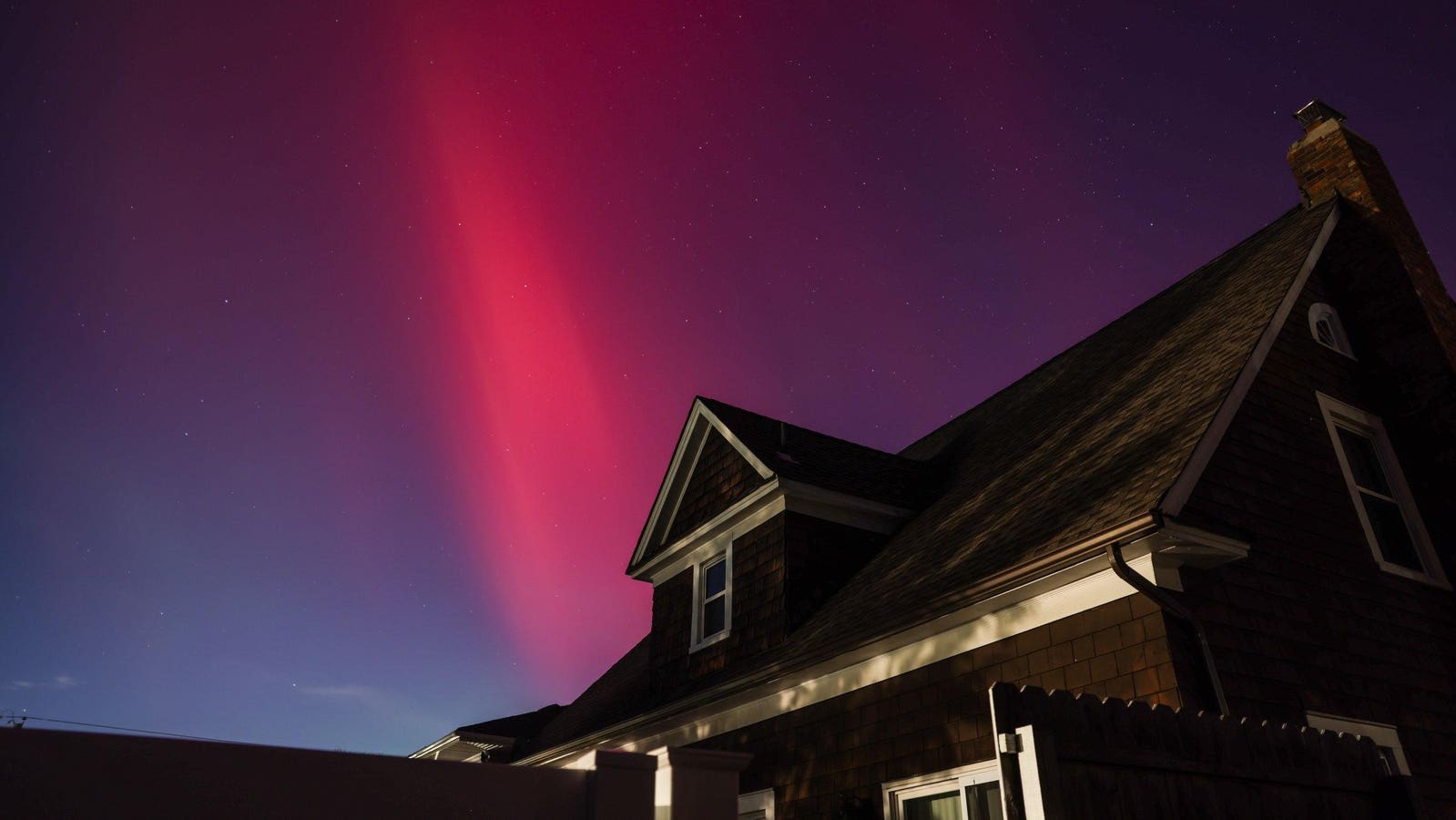
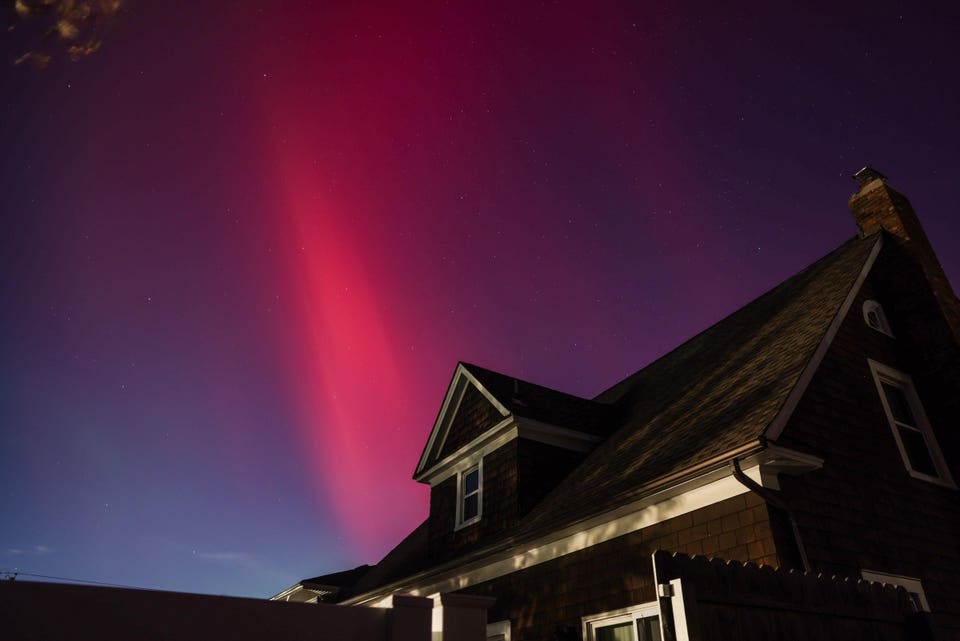
Patchogue, N.Y.: The northern lights seen above Patchogue, New York on Nov. 12, 2025. (Photo by Steve Pfost/Newsday RM via Getty Images)
Newsday via Getty Images
The Northern Lights may be visible in northern skies across 14 northern U.S. states and Canada overnight on Monday, Dec. 7, through Tuesday, Dec. 8, according to a forecast from the National Oceanic and Atmospheric Administration’s Space Weather Prediction Center.
NOAA put out a special alert on Sunday, Dec. 7, for a G3-rated geomagnetic storm. It comes after a series of solar flares from a large group of sunspots facing Earth caused a coronal mass ejection on Dec. 4. A CME is a cloud of charged particles that travels across the solar system and interacts with Earth’s magnetic field.
A full-halo coronal mass ejection (CME), associated with an M8.1 flare from Region 4299 at 20:39 UTC on 06 December, is expected to impact Earth early to midday on 09 December, potentially causing periods of G3 (Strong) geomagnetic storming.
NOAANorthern Lights Forecast: What To Expect
The latest forecast calls for a G3-rated geomagnetic storm, most likely in the early hours of Tuesday, Dec. 8, in North America.
According to NOAA, the CME is anticipated to cause elevated geomagnetic activity, which could cause G3 “strong” storm levels. Whether it actually causes aurora will depend, notes NOAA, on the orientation of the embedded magnetic field. Aurora-chasers frequently use the Kp index to predict the intensity of a geomagnetic storm, but for aurora displays, the interplanetary magnetic field’s Bz component is more important because it determines how easily solar energy enters Earth’s magnetosphere. When Bz points north, Earth’s field resists it; when Bz swings south, the two fields connect, allowing plasma to stream in. A sustained southward Bz of −5 nT or stronger usually signals an imminent display of aurora.
To check visibility in real time, use NOAA’s 30-minute aurora forecast, or download apps such as Aurora Now, My Aurora Forecast or Glendale Aurora for up-to-the-minute alerts and live solar wind data — and that critical data on the Bz.
NOAA’s aurora viewlines for overnight on Monday, Dec. 8 through Tuesday, Dec. 9, 2025.
NOAANorthern Lights Forecast: Where And When
NOAA’s latest aurora viewlines indicate that aurora displays are a possibility in northern U.S. states and Canada, with 22 U.S. states having a chance.
U.S. states that may see aurora include Alaska, Washington, Oregon, Idaho, Montana, Wyoming, North Dakota, South Dakota, Nebraska, Minnesota, Iowa, Wisconsin, Illinois, Michigan, Indiana, Ohio, Pennsylvania, New York, Massachusetts, Vermont, New Hampshire and Maine.
“The aurora may become visible over many of the northern states and some of the lower Midwest to Oregon,” according to NOAA.
For the best views, locate a dark place using the Dark Sky Place Finder and a light pollution map. The darker the northern sky, the more vibrant the display.
Northern Lights Forecast: How To Photograph Aurora
A mirrorless or DSLR camera is ideal (ISO 1600, 2-10 seconds, f2.8), though newer smartphones are increasingly capable of stunning results. If your smartphone has a Night Mode or Pro Mode, you can capture a beautiful aurora photo with these steps:
- Use your main lens, not the ultra-wide, for sharper results.
- Stabilize the camera using a tripod or rest it on a firm surface such as a car roof, wall, or post.
- Shoot in RAW format if available, as it allows easier post-editing.
- Expect long exposures between five and ten seconds. Even faint glows that look grayish to the eye often appear vividly green, purple or red in photos.
Wishing you clear skies and wide eyes.