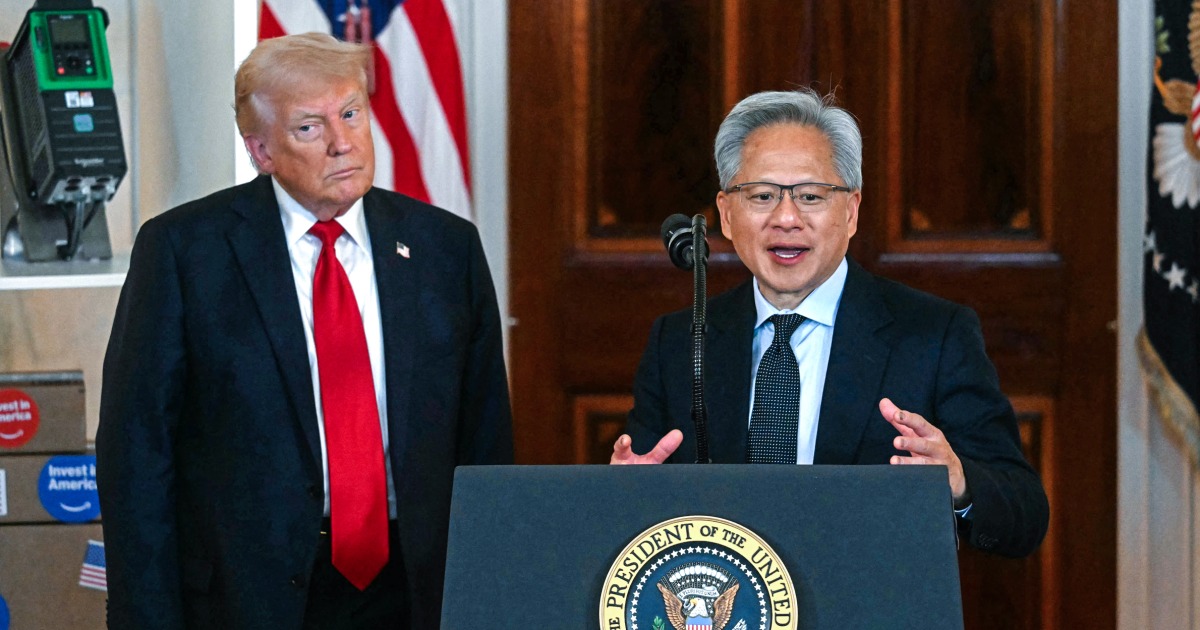
President Donald Trump said Monday that he has informed Chinese President Xi Jinping that “the United States will allow NVIDIA to ship its H200 products to approved customers in China.”
Nvidia’s H200 is a generation behind its latest Blackwell chip, which is considered among the most advanced and high-powered AI chips available anywhere.
Trump said the Blackwell chip would not be part of the deal.
Still, the move could be worth billions of dollars for Nvidia, the world’s most valuable company. Nvidia says it has more than $500 billion worth of orders for its best artificial intelligence chips to fulfill this year and next — and that’s before any buyers in China are factored in.
Trump said he will also allow Intel, AMD “and other great American companies” to sell similar chips to customers in China. “The Department of Commerce is finalizing the details,” he said.
Monday’s announcement would end what was effectively a ban on sales of AI chips from U.S. companies to China.
Trump wrote on Truth Social that the U.S. government would take a 25% cut of sales of the approved chips, up from a previously announced 15%.
However, it remains to be seen whether China will allow imports of the chips. After the U.S. said it would allow an even older generation of Nvidia chip, known as the H20, to be sold in China, Xi’s government essentially said it did not want them.
In his social media post, Trump said: “President Xi responded positively!”
Nvidia said in a statement, “We applaud President Trump’s decision to allow America’s chip industry to compete to support high paying jobs and manufacturing in America.”
“Offering H200 to approved commercial customers, vetted by the Department of Commerce, strikes a thoughtful balance that is great for America,” the company said.
For months, Nvidia CEO Jensen Huang has been lobbying the White House to permit Nvidia to sell some chips to customers in China.
But Trump’s approval does not mean the issue is a done deal in Washington.
A bipartisan group of lawmakers in Congress has expressed serious concerns about allowing Chinese customers to buy American AI chips.
Huang visited Republican senators on Capitol Hill last week to discuss artificial intelligence-related policies.
Sen. John Kennedy, R-La., did not attend the meeting because, he said, he did not consider Huang to be “an objective, credible source about whether we should be selling chips to China.”
Kennedy said Huang wants to sell to Chinese customers for financial gain. Others, like Sen. Mike Rounds, R-S.D., said it was a “healthy discussion to have.”
Republican Sen. Pete Ricketts of Nebraska said in a statement last week that “denying Beijing access to these AI chips is essential to our national security.”
Democrats have also expressed concerns. Ricketts joined Sen. Chris Coons of Delaware to introduce a “Safe Chips Act.”
Huang said on Yahoo Finance in August, “Just as the American dollar is the world standard that economies are built on, we want the American tech stack for the world’s technology and industries to be built on, and that includes China.”
AMD did not immediately respond to a request for comment. Intel declined to comment.
Export controls on China would be eased just as relations between Washington and Beijing are thawing.
China recently started accelerating its purchases of American soybeans, and it gave the green light to exports of many rare earth minerals to American buyers.
Speaking at a White House event with farmers earlier Monday, Trump said he believed China might buy even more soybeans than it had originally agreed to.
Within minutes after Trump’s post, Nvidia shares rose nearly 3% in after-hours trading.