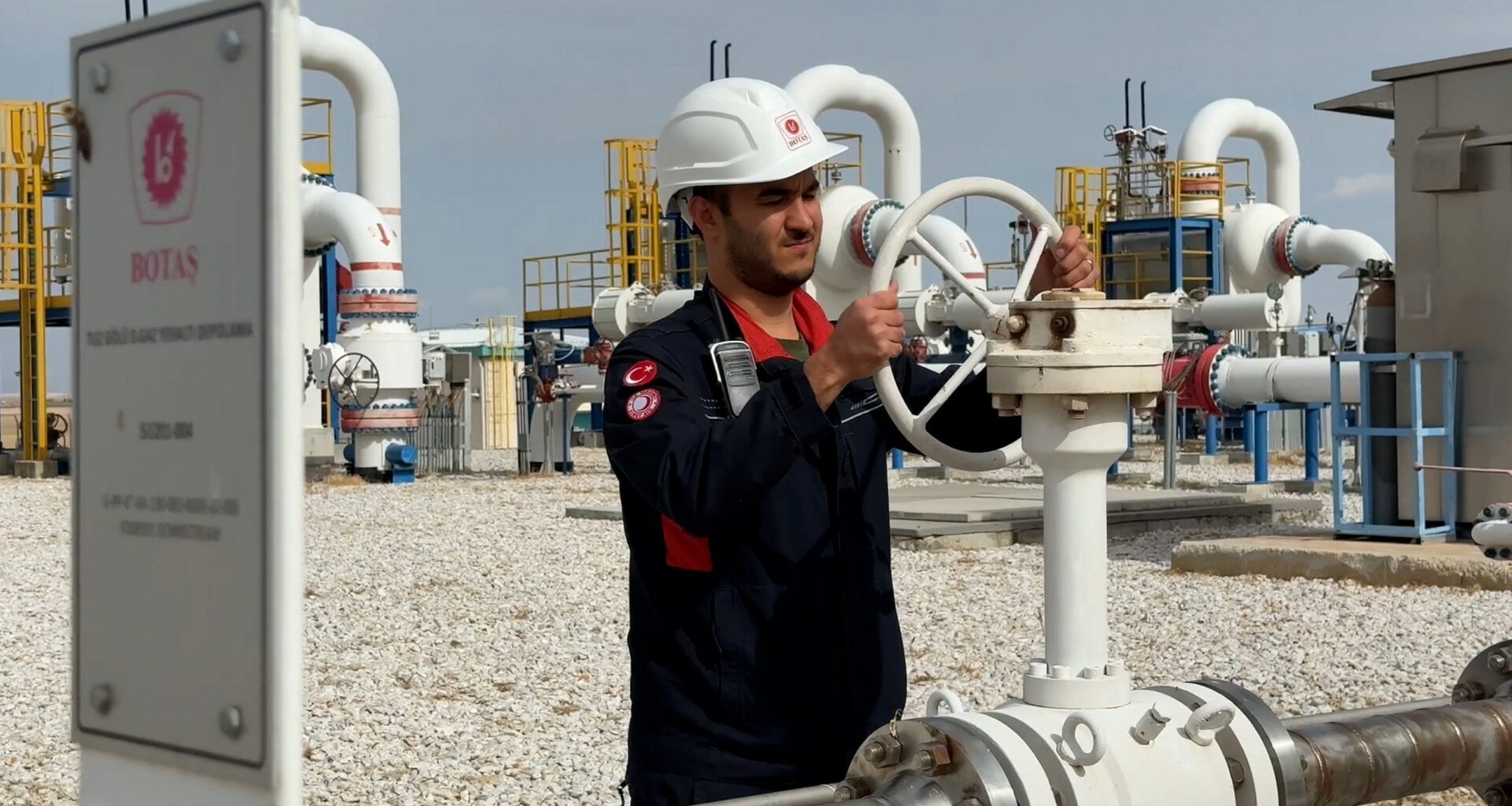
Türkiye now has the ability to supply up to 80 billion cubic meters (bcm) of natural gas per year, thanks to its expanded infrastructure, and is already positioned to trade more than 10 bcm, Energy and Natural Resources Minister Alparslan Bayraktar said on Tuesday.
Türkiye is Europe’s fourth-largest gas market, and its annual consumption is projected to reach about 60 bcm this year, driven by higher residential and industrial consumption as well as a rise in gas-fired power generation, Bayraktar told the Türkiye Energy Summit in Istanbul.
Türkiye imports most of its energy and has been working to reduce its major bill and boost supply security by developing domestic resources and expanding international partnerships in oil and gas exploration. It imported around 50 bcm of gas last year, with Russia being the largest supplier.
It’s currently producing gas from its vast Black Sea reserve and has reached an output enough to supply roughly 4 million households. That is expected to double next year as part of the second phase, Bayraktar said.
By 2028, Türkiye aims to produce up to 45 million cubic meters per day to meet the needs of 16 million-17 million homes, he noted.
The Sakarya Gas Field in the Black Sea is estimated to contain 710 bcm of gas. The reserve was gradually discovered between 2020 and 2022. It will meet approximately 30% of the nation’s annual gas needs once the production reaches total capacity. In mid-May, Türkiye announced the discovery of a new reserve of 75 bcm in the Black Sea.
“Black Sea gas is now one of our most important national projects,” said Bayraktar.
Türkiye is also producing oil from the major reserve in the southeastern Gabar region, where the minister says output has reached 80,000 barrels per day. “Gabar is reducing our oil imports by at least $2 billion. These are very vital issues for us, for our economy,” Bayraktar said.
Türkiye’s fleet of drilling and seismic vessels has grown into the world’s fourth largest.
Bayraktar said Türkiye plans six deep-water Black Sea drilling operations in the near future, supported by the arrival of the country’s fifth drilling vessel, which is expected to be fully operational in early 2026.
New exploration rounds will target western, central and eastern zones of the Black Sea, he added. “Only after these wells can we talk about potential new discoveries.”
‘Silent revolution’
Bayraktar said nearly 22 bcm of gas import contracts due to expire at year-end were extended for an additional year, covering flows via the TurkStream and Blue Stream pipelines.
“There is no risk to Türkiye’s supply security,” he said.
State energy company BOTAŞ has an over 20,000-kilometer (over 12,427-mile) transmission line network, while the distribution side has grown through the private sector, according to Bayraktar.
“This is one of Türkiye’s silent revolutions. To date, over 220,000 kilometers of natural gas distribution lines have been constructed,” he noted.
On gas storage, Bayraktar said the country’s capacity currently stands at 6.3 bcm, a figure the minister said must reach at least 20% of national consumption by the 2030s.
Daily regasification capacity, now 161 million cubic meters, is targeted to rise to 200 million cubic meters, backed by the possible addition of two new floating storage and regasification units (FSRUs).
“All of this will expand Türkiye’s export capabilities. To be able to ensure this, it’s crucial to purchase and store gas at the right time and the right price. But we also need to move a little faster on storage,” said Bayraktar.
Türkiye has reached an infrastructure capacity to supply 70 bcm-80 bcm of gas annually, according to Bayraktar. “We are at a point where we can trade over 10 billion cubic meters of natural gas.”
Electricity subsidy threshold likely to fall again
Bayraktar signaled that households may again face a lower threshold requiring them to purchase electricity at unsubsidized market rates.
The last-resort supply tariff (SKTT) limit was reduced to 4,000 kWh per year from 5,000 kWh, bringing high-consumption households into the market-price regime as of early 2026. Around 2.5 million households, or 6% of all residential users, consume above this level.
“We could reduce this threshold by another step in 2026,” Bayraktar said, though he did not specify the new level. He noted the average Turkish household consumes 2,400 kWh annually.
Türkiye spent about TL 1 trillion, roughly $30 billion, on natural gas and electricity subsidies in 2023 and 2024, he added. A similar tiered system is being considered for natural gas.
Talks on 2 new nuclear plants
Bayraktar said construction of Türkiye’s first nuclear power plant, Akkuyu, reached $10.6 billion in local-content value as of the first quarter of this year, with the overall project now at 56% domestic share.
The first reactor was delayed due to pandemic-related disruptions and equipment delivery issues, he said, but Ankara aims to commission it as soon as possible.
Türkiye is also advancing plans for additional nuclear capacity, including small modular reactors, Bayraktar said.
It plans to build two additional nuclear power plants, including one in the Black Sea province of Sinop, for which Bayraktar said talks continue with several countries, including South Korea, with which Ankara has signed a memorandum of understanding.
“We aim to reach a certain point by working intensively with them for the next six months,” he noted.
The third facility is planned for the Thrace region, and Bayraktar said discussions continue with China, while U.S. companies have also expressed interest.
“Sinop and Thrace could potentially be developed through three- or four-country consortia,” Bayraktar said.