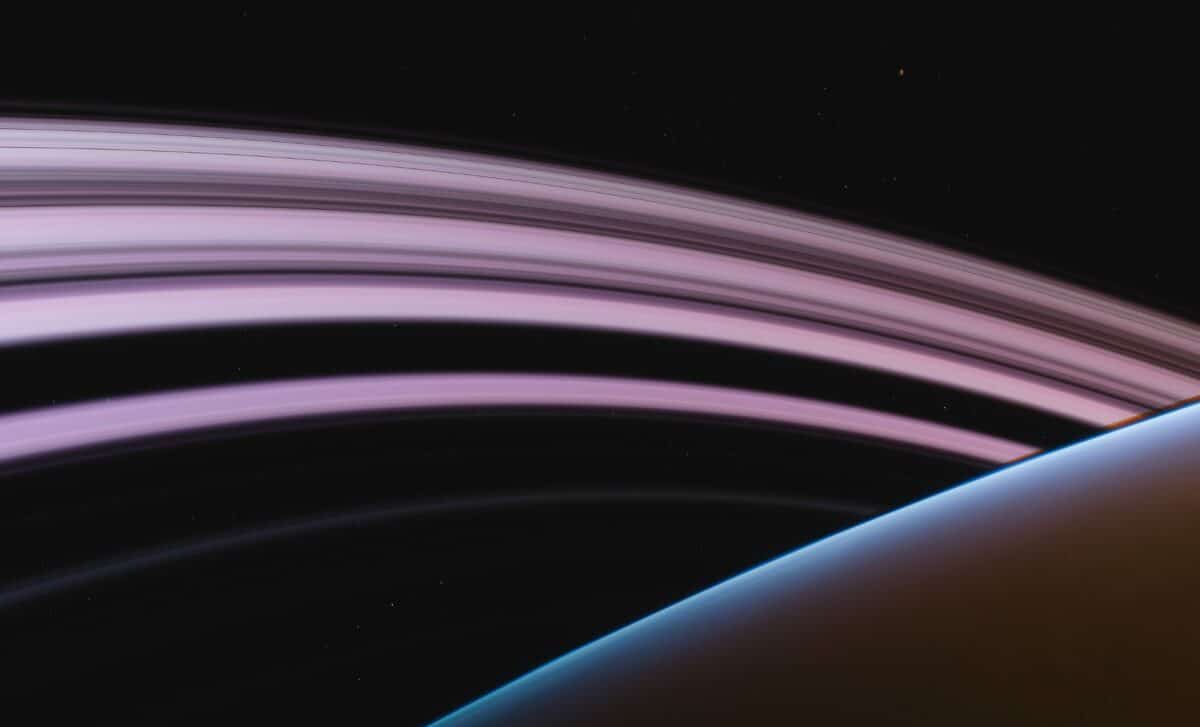
New data from NASA’s Cassini spacecraft reveals that Saturn’s iconic rings extend far beyond the thin plane we’ve long observed through telescopes. During its final orbits in 2017, Cassini discovered a hidden “halo” of dust particles reaching up to three times the planet’s radius.
Saturn’s rings have fascinated astronomers for centuries, but Cassini’s close observations have provided unprecedented detail. This groundbreaking discovery, published in The Planetary Science Journal, comes from the spacecraft’s Grand Finale Orbits (GFOs). During these orbits, Cassini collected dust samples above and below the rings using its Cosmic Dust Analyzer (CDA). The data has now revealed that the particles composing Saturn’s rings extend much farther than previously thought.
The Hidden Halo: Cassini’s Discovery
In 2017, Cassini completed a series of final orbits that passed above and below Saturn’s ring plane. During these orbits, the spacecraft collected a total of 1,690 dust spectra, which were analyzed by scientists. Among these, 155 spectra were identified as mineral particles, predominantly silicates.
The team found that these particles extended far beyond the visible rings, forming a “halo” that reached up to three Saturnian radii (RS) above and below the ring plane. The latest research shows that the gas giant’s rings are far more expansive than previously thought, with dust particles scattered throughout a much larger region of space.
The composition of these particles was also key to understanding their origin. Analysis revealed that the mineral dust grains in the halo closely resembled those found within the rings themselves, containing high amounts of magnesium and calcium, and low levels of iron. These similarities strongly suggest that the dust particles in the halo were ejected from Saturn’s main rings, rather than being captured from elsewhere in the solar system.
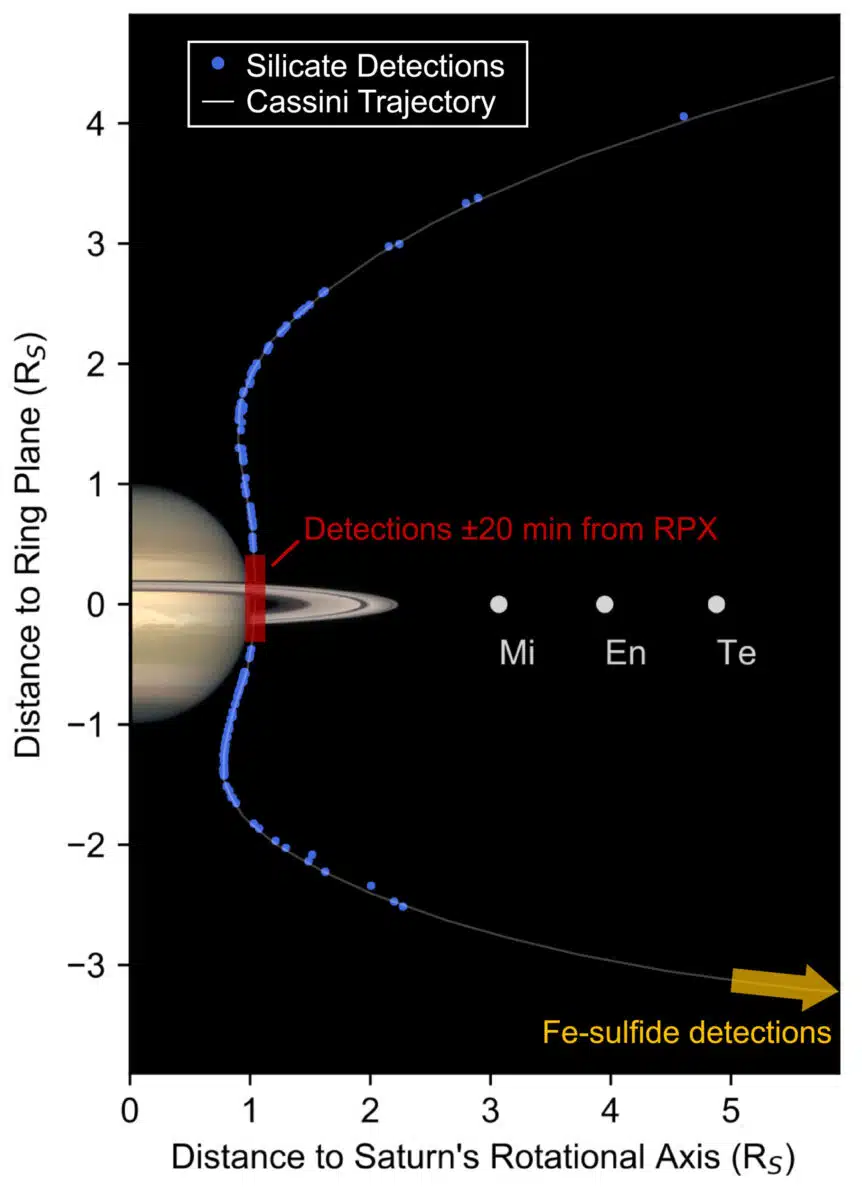 Locations where silicate particles (blue) were detected in relation to Saturn’s rotational axis and ring plane. Credit: The Planetary Science Journal
How Do the Particles Reach Such Distances?
The study, titled “A Dust Halo from Saturn’s Main Rings Extending Several Saturnian Radii above the Ring Plane” also delved into how these particles were able to reach such vast distances from the rings of the sixth planet. The most likely explanation is that micrometeoroid impacts are responsible for propelling the dust particles outward. When micrometeoroids strike Saturn’s rings at high velocities, they can eject small particles into space.
“Most ejected particles are expected to either recollide with the main rings or fall into Saturn, and only a small fraction are assumed to escape successfully from the rings,” the researchers said.
These particles, which must be smaller than 20 nanometers in size, can travel outward from the rings at speeds greater than 25 km/s, allowing them to spread across large distances.
The study suggests that while most of these particles either fall back into the giant planet’s rings or are absorbed into the planet’s atmosphere, a small fraction manages to escape, forming the extended dust halo observed by Cassini. This process of particle ejection due to micrometeoroid impacts is crucial for understanding the dynamics of Saturn’s ring system and its constant reshaping over time.
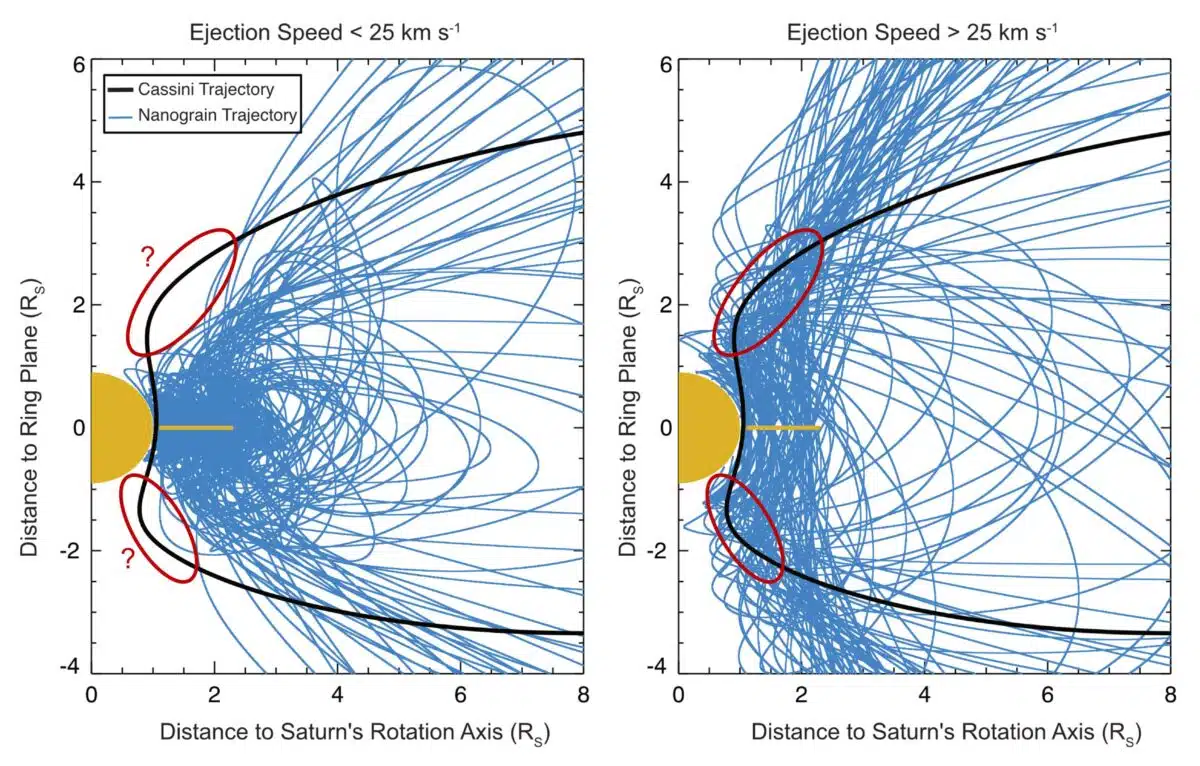 Trajectories of dust particles ejected from Saturn’s rings, showing differing behaviors based on ejection speeds. Credit: The Planetary Science Journal