
Corals are among the most vital organisms in the ocean. They shelter biodiversity, provide food, and act as natural barriers that protect coastlines from storms and tsunamis. Yet, scientists continue to discover surprising new roles for these marine architects. According to new research, corals also help regulate the climate—but only in times of global crisis.
A recent study published in Proceedings of the National Academy of Sciences found that the rise and fall of shallow-water corals directly influence how quickly the planet recovers from major shifts in carbon dioxide (CO2) levels.
Researchers from Université Grenoble Alpes and the University of Sydney combined plate tectonic reconstructions with climate and biodiversity simulations. Their conclusion was striking: “Coral reefs don’t just respond to climate change—they actively contribute to the planet’s recovery,” explained lead author Tristan Salles.
When corals suffer, the planet fights back
By studying Earth’s ancient climate cycles, the team identified two very different scenarios:
• When continents are extensive and coral reefs thrive, carbonate builds up in shallow seas, limiting chemical exchanges with the deep ocean. This weakens the so-called biological pump—the process by which marine life absorbs carbon—and slows Earth’s recovery after major climate disruptions.
• But when coral reefs collapse, whether due to tectonic shifts or falling sea levels, calcium and alkalinity increase in the oceans. The burial of carbonate shifts to deeper waters, stimulating nanoplankton growth and accelerating climate recovery.
In short, when corals are in distress—as they are today—they trigger a natural repair mechanism. Rather than being passive victims of environmental change, corals act as “active modulators,” according to the University of Sydney’s summary of the study.
Corals can “alter the oceanic biological pump, and by extension, the climate itself and its ability to recover from global disturbances.” In times of planetary upheaval—whether geological or climatic—corals serve as powerful stabilizers.
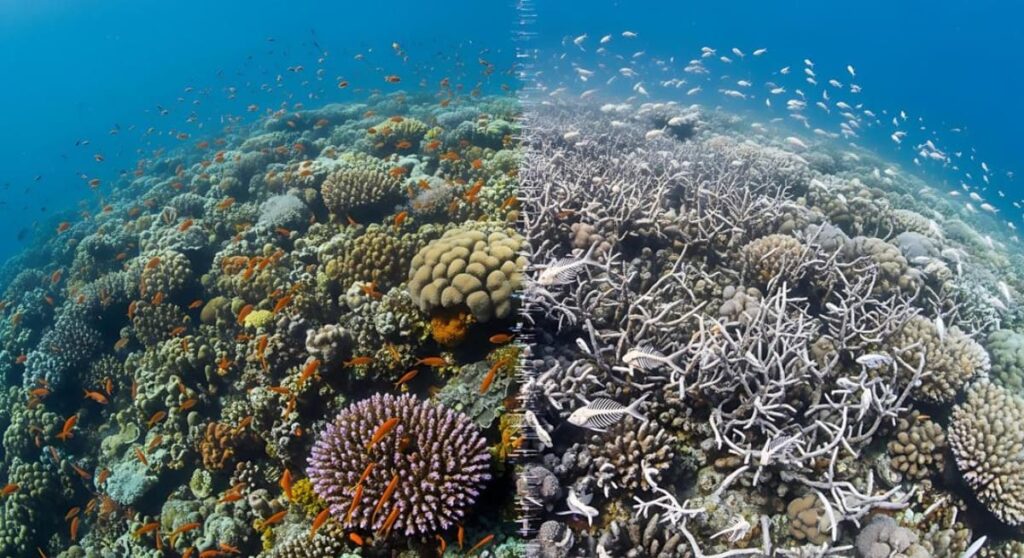
Corals are suffering from bleaching linked to climate change, and it is precisely when they are suffering that they trigger a climate stabilization mechanism. © Naturalpict, Adobe Stock
Recovery that takes millennia, not decades
Does that mean corals could save us from the effects of today’s global warming? Unfortunately, not in the short term. The University of Sydney points out that corals depend on other marine organisms to play their full role: “The same organisms that drive deep-sea carbonate burial—plankton and other calcifying species—are themselves under threat from ocean acidification and rising CO2 emissions.”
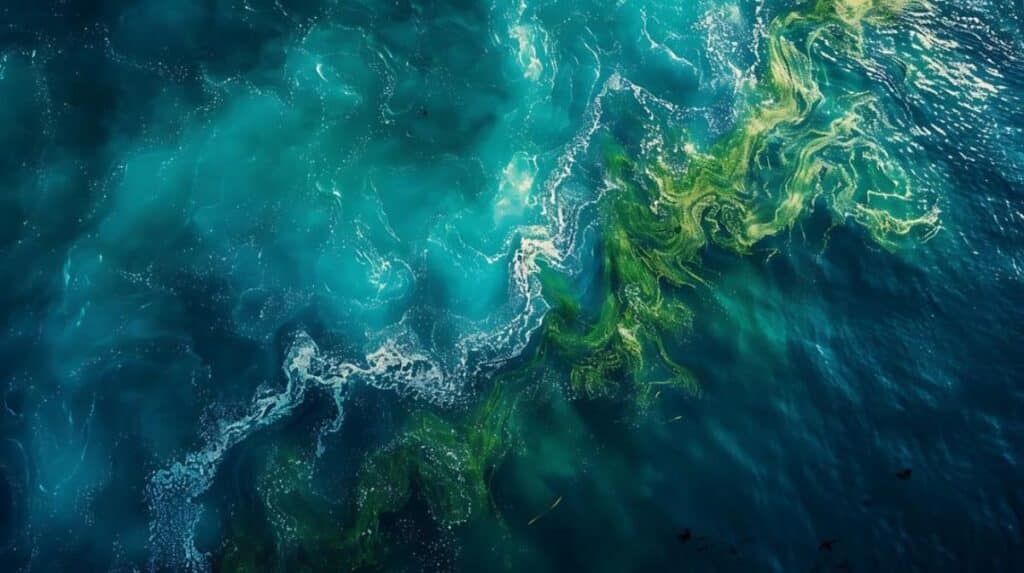
Corals cannot stabilize the climate without the help of plankton, another organism affected by climate change. © Thavesak, Adobe Stock
There is, however, a glimmer of hope—though on a geological scale rather than a human one. “Looking back over the past 250 million years, we know Earth’s systems eventually recover from massive carbon disruptions like the one we’re in now,” the researchers conclude. “But that recovery won’t happen in our lifetime. Our study shows that true planetary restoration takes thousands, even hundreds of thousands, of years.”

Karine Durand
Specialist for extreme weather and environment
A specialist in extreme weather phenomena and environmental issues, this journalist and TV host has been explaining climate topics since 2009. With over 15 years of experience in both French and American media, she is also an international speaker.
Trained in communication and environmental sciences, primarily in the United States, she shares her passion for vast natural landscapes and the impacts of climate change through her work on biodiversity and land management.