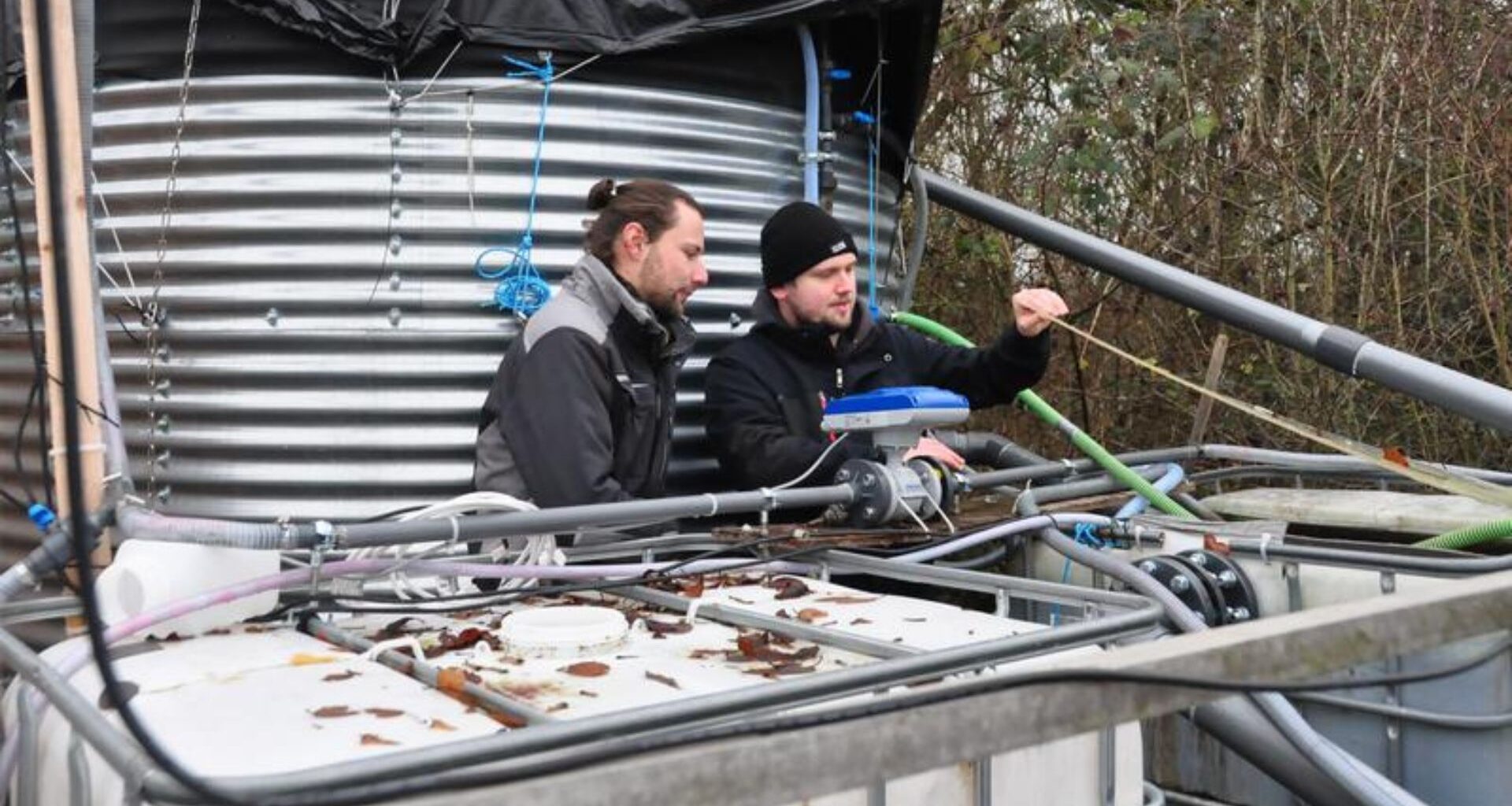
A research team in central Germany is testing a compact wastewater treatment plant designed to operate entirely on solar power.
Built for disaster and emergency settings, the system relies on a reactor, floating foam cubes, and microorganisms to clean polluted water.
Led by Prof. Dr.-Ing. Markus Röhricht at the Technical University of Central Hesse (THM), the project has moved from laboratory research to real-world trials.
Since September, the pilot plant has been running at a wastewater treatment facility in the town of Lollar.
The project, called EnsAK, has received €242,500 in funding from the Federal Ministry for Research, Technology, and Space.
It will run for two years. Industry partners Saygin & Stein and EMW filtertechnik GmbH are involved, alongside the Lollar-Staufenberg Zweckverband, which operates local wastewater infrastructure.
How the reactor works
The small treatment plant was installed in Lollar within a few days by Saygin & Stein.
Engineers designed it to function under crisis conditions, where infrastructure is damaged or power supplies are limited.
THM student Louis Müller manages the plant on-site. He visits every two days and more often if problems arise.
Müller studies for a master’s degree in Climate Protection, Environmental and Safety Engineering.
“The pre-treated wastewater from the treatment plant flows into the reactor. It has already been cleaned of coarse dirt in the screening building and passed through a grit and grease trap,” Müller explains.
Inside the reactor, foam cubes move continuously through the wastewater.
Microorganisms grow on the cube surfaces and form a regenerating biofilm.
As the biofilm degrades, sludge settles in a secondary clarifier.
After treatment, the water can be discharged into a river. In Lollar, it undergoes one additional treatment step.
Performance and testing
According to Röhricht, the pilot plant already meets strict German standards.
“With our experimental wastewater treatment plant, we can already comply with the strict limit for organic pollutant load that applies to large wastewater treatment plants in Germany.”
The system reduces chemical oxygen demand by 90 percent.
It also removes 60 to 70 percent of nitrogen, a key contributor to waterway over-fertilization.
Researchers test the treated water regularly.
Teams collect samples on Sundays, Tuesdays, and Thursdays. Each sample represents a full twelve-hour operating cycle.
The laboratory then analyzes the composite samples at THM.
Improving efficiency further
Parallel laboratory experiments aim to improve efficiency.
The team wants to reduce wastewater residence time from 16 hours to about ten hours.
Researchers also hope to cut down the number of foam cubes.
The cubes currently fill about 30 percent of the reactor volume.
Biotechnology student Nicolas Jost is studying alternative cube materials.
His work compares fine-pored and coarse-pored structures. He is also testing higher wastewater loads.
Jost will base his master’s thesis on these experiments.
The pilot plant will operate for a full year. Researchers want to measure performance across seasonal temperature changes.
Once optimized, the system could deploy quickly in regions affected by wars, natural disasters, or humanitarian crises, where clean water access becomes critical.