
When NASA’s OSIRIS-REx mission returned its samples from the asteroid Bennu in late 2023, it revealed a surprising find: molecules associated with life, like amino acids and nucleobases, were present in the dust and rock. While the discovery seemed to support the theory that asteroids may have delivered life’s building blocks to Earth, the near-equal mix of “left-handed” and “right-handed” amino acids raised an unexpected challenge.
Traditional Biosignatures May Not Be Enough
For years, scientists have relied on biosignatures, distinctive markers of biological processes, such as certain amino acids or left-handed molecules, to identify life. But the discovery from Bennu complicates this approach. While organic molecules such as amino acids are essential to life as we know it, they are not exclusive to biological processes. In fact, these same molecules can form through complex geochemical processes, a fact that may prevent traditional biosignature approaches from reliably distinguishing between life and nonlife.
“Nonliving materials can produce rich, organized mixtures of organic molecules,” Amirali Aghazadeh, a computational scientist focused on biological signatures, explains, “then the traditional signs we use to recognize biology may no longer be enough.”
The Bennu sample illustrates this point, as it contained organic molecules commonly associated with life on Earth, but nothing in the sample was alive. This raises critical questions for the search for life on other planets. If we are to correctly interpret future samples from Mars, Europa, or beyond, a new method of distinguishing life from nonlife is needed.
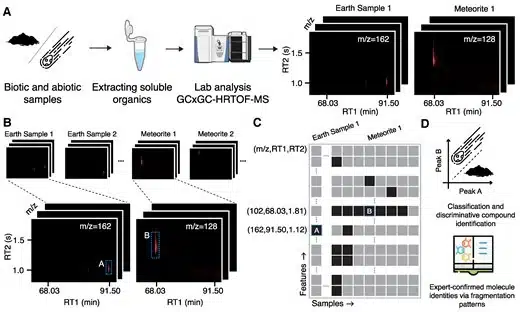 The LifeTracer workflow for collecting, curating, and analyzing mass spectrometry data, along with developing a machine learning model for sample classification. Credit PNAS Nexus
LifeTracer: A New Way to Detect Life
To tackle these challenges, Aghazadeh and his team developed LifeTracer, a machine learning tool designed to detect patterns in complex chemical mixtures that might point to biological origins. Unlike traditional methods, LifeTracer looks at the overall distribution of chemical signatures. This allows the model to distinguish between abiotic and biotic samples, even when the individual molecules are similar.
The key to LifeTracer’s success lies in how it analyzes the data. Instead of trying to reconstruct individual molecular structures, which can be difficult with large, complex samples, LifeTracer uses machine learning to spot patterns in the chemical fragments that are present. By organizing these fragments into a matrix based on their mass and chemical properties, the tool can then identify subtle differences between organic material formed by biological processes and that formed through nonbiological processes.
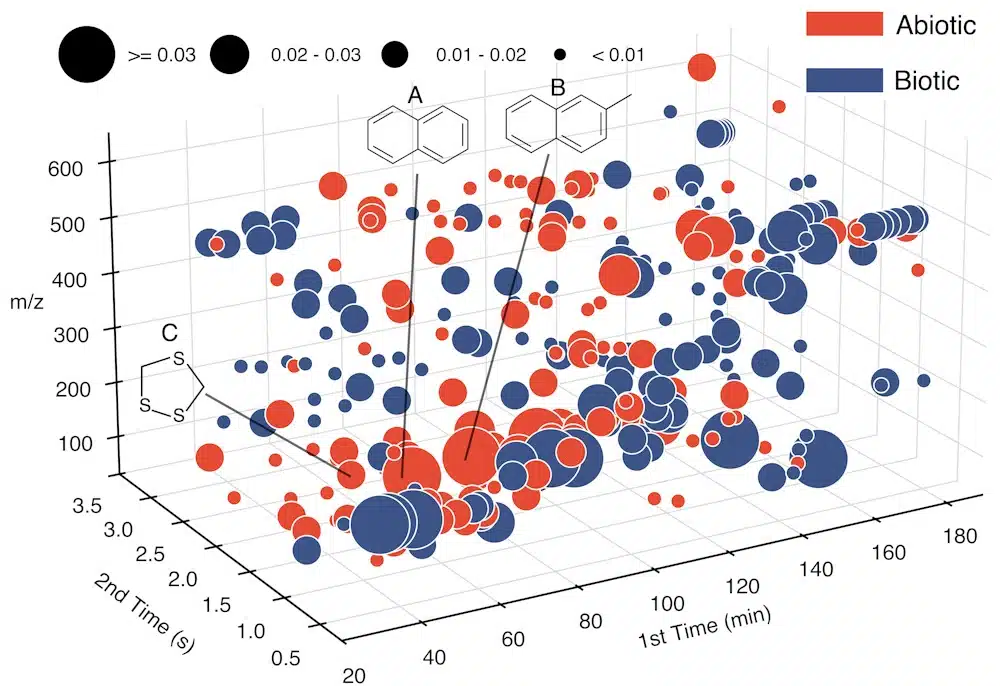 This figure showcases the compounds identified by LifeTracer, emphasizing the molecular fragments that best distinguish abiotic samples from biotic ones. Credit: PNAS Nexus
In a study published in PNAS Nexus, the team demonstrated that LifeTracer could accurately differentiate between meteorites containing abiotic molecules and terrestrial samples with biological remnants. The tool’s ability to identify patterns, rather than focusing on specific compounds, makes it particularly useful for analyzing the complex mixtures that are expected from future space missions.
Rethinking Life’s Chemical Signatures
As scientists gear up to explore Mars, its moons, and icy worlds like Europa and Enceladus, the need for better tools to detect life is becoming more urgent by the day. With each mission, the question looms larger: How do we spot life if it doesn’t look like anything we’re familiar with? As mentioned in The Conversation, LifeTracer could be a game-changer when it comes to deciphering the samples that will return from these far-flung worlds.
The tricky part is that life elsewhere might not follow Earth’s molecular rulebook. Life here on Earth is built on certain amino acids, lipids, and other organic molecules. But when it comes to extraterrestrial life, all bets are off.
That’s where LifeTracer stands out. It’s designed to focus on the overall patterns in a sample, rather than assuming life must be made of the same building blocks we’re used to. It’s a shift that could expand the scope of what we consider to be potential signs of life.