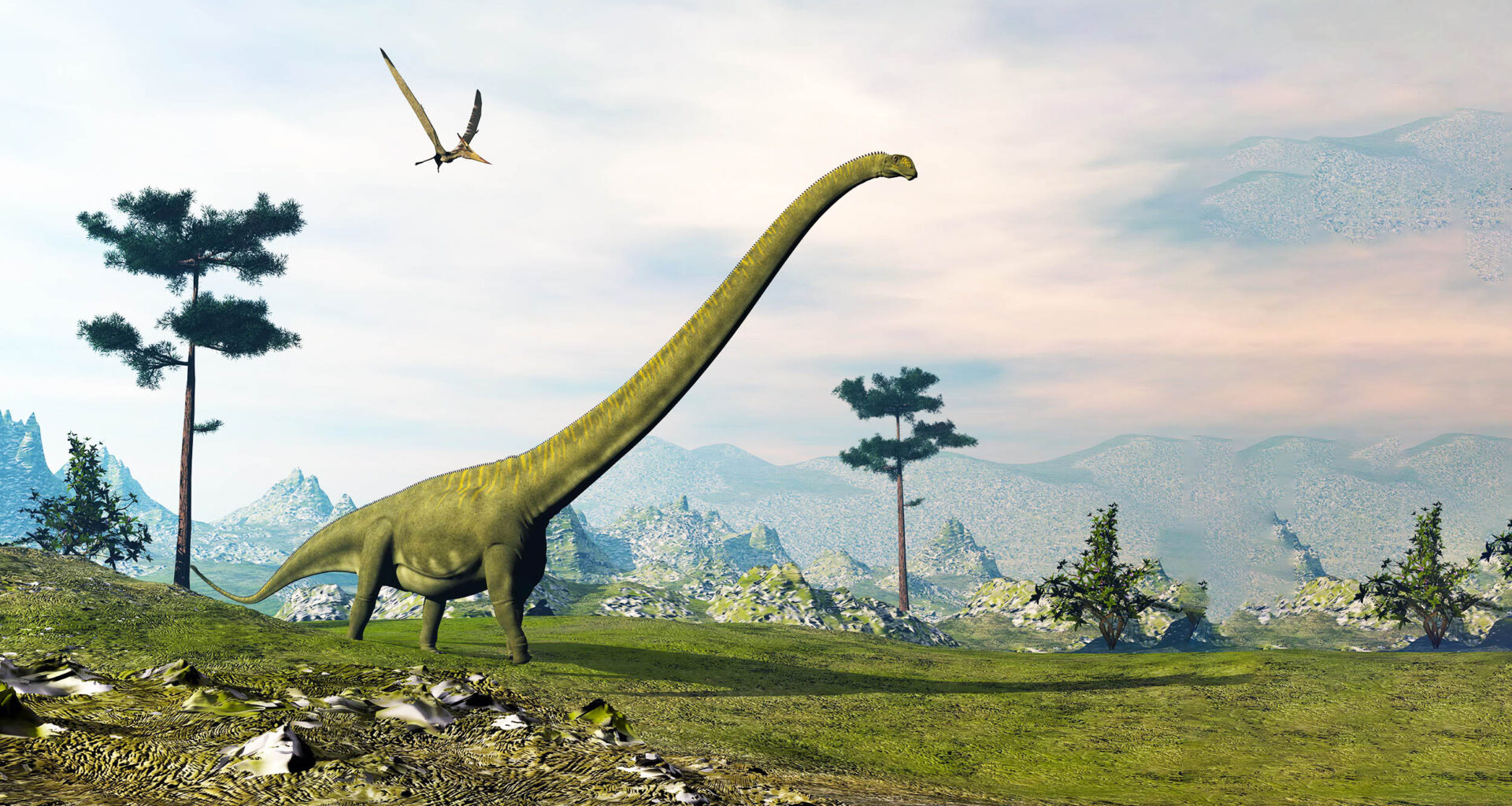
Researchers in southwest China have identified a new plant-eating dinosaur species with an extraordinary neck.
The animal, named Mamenchisaurus sanjiangensis, lived roughly 160 million years ago during the late Jurassic Period, and reshapes how paleontologists view East Asian dinosaur ecosystems.

The work was led by Hui Dai, a paleontologist at the Institute of Paleontology in southwest China.
His research focuses on Jurassic sauropod evolution and on how long-necked dinosaurs spread and diversified across East Asia.
In a new study, the team described neck, back, hip, tail, and hind limb bones from the Upper Shaximiao Formation near Chongqing.
Those bones lay in mudstones near a shallow lake, indicating deposition during the Oxfordian, a Late Jurassic stage about 160 million years ago.
Comparisons with better-known Mamenchisaurus skeletons suggest M. sanjiangensis was a huge animal, likely tens of feet long and weighing many tons.
Naming Mamenchisaurus sanjiangensis
The species name, sanjiangensis, refers to the Hechuan District of Chongqing, where three rivers meet near the fossil site.
Geologically, the layers belong to the early part of the Late Jurassic, near the transition between Middle and Late intervals.
Using measurements of the bones, the authors classified the animal as a mamenchisaurid, a long-necked sauropod lineage that is common in Jurassic East Asia.
Results from phylogenetic analysis, a method using shared traits to reconstruct ancestry, place Finding Mamenchisaurus sanjiangensis among relatives including M. hochuanensis and M. youngi.
Five fused sacral vertebrae form a platform for the hips, suggesting a sturdy connection between spine and pelvis that helped carry enormous weight.
Inside the neck and back vertebrae, the bone had a camellate structure with many small, air-filled chambers. This honeycomb pattern lightened the skeleton without sacrificing strength.
The femur is unusually wide for its length, hinting at powerful hind limbs that stabilized the enormous torso as the animal walked.
At the front of the tail, curved neural spines and bony ridges suggest strong muscle attachments. The massive tail likely helped with balance during movement.
Long-necked clan of Mamenchisaurus
Dinosaurs in the genus Mamenchisaurus belong to the sauropod group. These were large, long-necked, plant-eating dinosaurs that dominated Jurassic and Cretaceous ecosystems worldwide.
A reanalysis of Mamenchisaurus sinocanadorum suggested its neck stretched about 49.5 feet (15 meters) – the longest dinosaur neck ever measured.
Mamenchisaurus sanjiangensis fits within this long-necked clan, reinforcing the idea that East Asia hosted several lineages of neck specialists during Jurassic time.
Anatomical details show similarities with neosauropods, later evolving sauropods that spread worldwide, hinting that mamenchisaurids and these relatives sometimes occupied overlapping ecological roles.
The Sichuan Basin in southwestern China is a region rich in dinosaurs, with Jurassic rocks yielding abundant sauropod skeletons and tracks.
That research shows that during the Middle and Late Jurassic, dinosaurs from the Mamenchisauridae family dominated the basin’s fauna, especially in the Upper Shaximiao and Suining formations.
Adding Mamenchisaurus sanjiangensis from the Upper Shaximiao and Tongnanlong zhimingi from the Suining Formation reveals a more diverse sauropod community than previously recognized.
“Late Jurassic sedimentary units of China preserve rich sauropod records, and most of them are dominated by mamenchisaurids,” said Dr. Dai.
East Asia was different
For decades, paleontologists discussed the East Asian Isolation hypothesis, the idea that Jurassic East Asia was geographically isolated from other continents.
Newly described neosauropods from China and mamenchisaurids from Africa now show that many dinosaur lineages ranged widely, softening claims of strict East Asian isolation.
Comprehensive reviews of sauropod fossils indicate that animals achieved global distribution by the Middle Jurassic, with diversity peaking in the Late Jurassic.
Mamenchisaurus sanjiangensis and Tongnanlong zhimingi show that East Asia followed a boom in sauropod diversity, while keeping a distinctive set of species.
Long necks and evolution
The researchers argue that mamenchisaurids developed neck and body features similar to neosauropods, increasing competition where herbivores overlapped in time and space.
Detailed biomechanical work suggests that sauropods supported massive bodies by using air-filled vertebrae and limb bones. In this way, they reduced skeletal weight while maintaining strength.
The camellate internal structure of bones in Mamenchisaurus sanjiangensis fits that pattern, hinting at a balance between extreme size and reasonable agility across its habitat.
Long-necked sauropods could browse over wide areas while staying stationary, cutting the energy cost of moving heavy bodies between scattered tree patches.
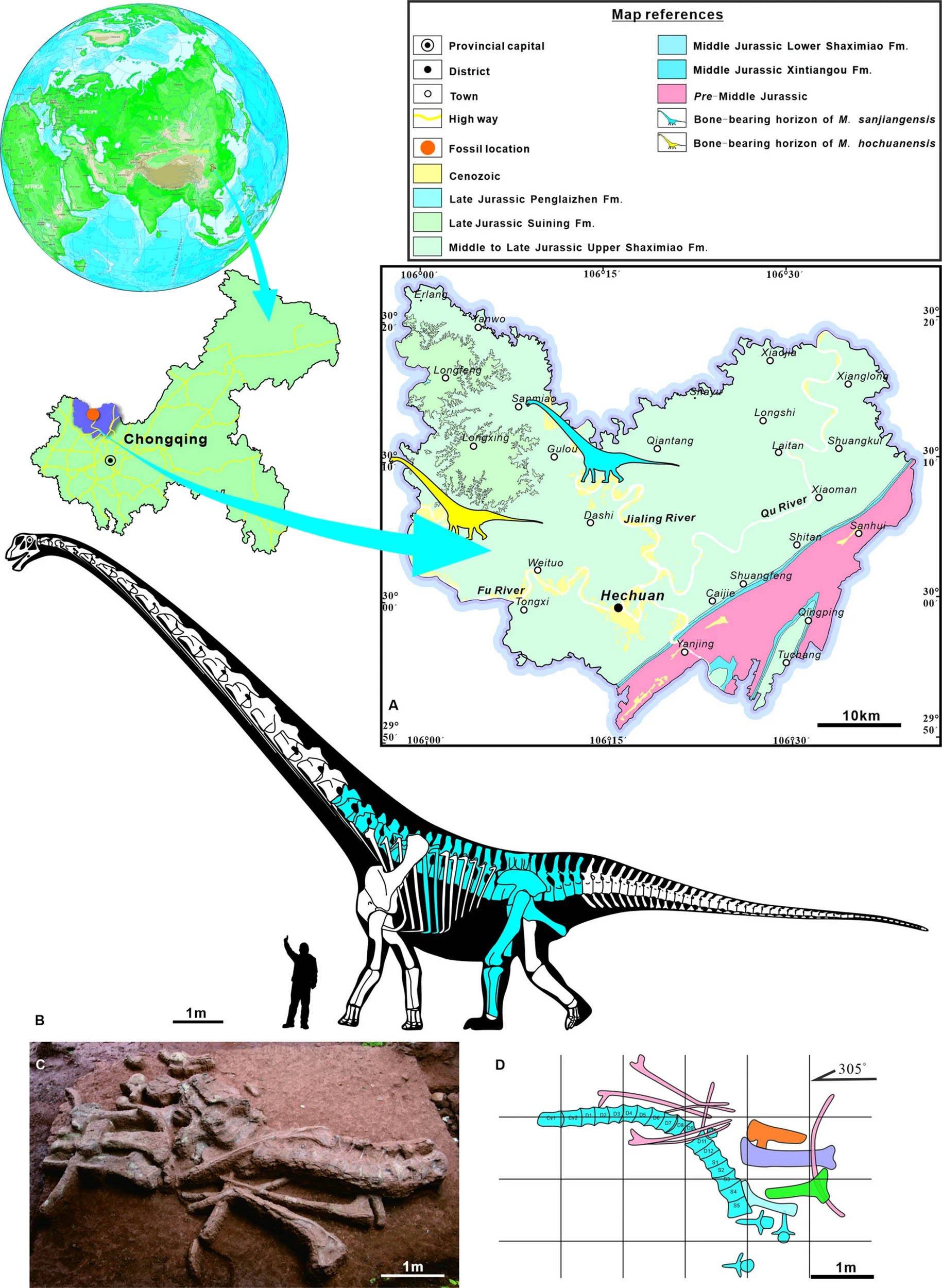 Geographic and geological setting of the palaeontological site. (A) geological map of Hochuan (Chongqing, China); (B) Type specimen of Mamenchisaurus sanjiangensis sp. nov. in the field; (C) the field map of the elements; (D) the compose of the elements. Credit: Scientific Reports. Click image to enlarge.Digging fossils out of purple mudstones
Field crews uncovered the bones from purplish-red mudstones in the Upper Shaximiao Formation, where erosion in Chongqing had exposed the fossilized skeleton.
Paleontologists mapped each bone in place before encasing it in a protective plaster jacket, a methodical process that preserves how the dinosaur originally lay.
So far Mamenchisaurus sanjiangensis is known from this single partial skeleton, which means estimates of its size and neck length still carry uncertainty.
According to Dai and colleagues, reexamining museum specimens from East Asia will help clarify relationships and close remaining gaps in the family tree.
Lessons from Mamenchisaurus sanjiangensis
“Sauropod dinosaur diversity reached an apparent peak in the Late Jurassic,” said Dr. Dai, summarizing the broader backdrop for Mamenchisaurus sanjiangensis.
Because the fossil comes from the early Oxfordian stage, an under-sampled slice of time, it helps fill gaps in East Asian sauropod records.
Its combination of old and new traits hints at a transition from Middle Jurassic sauropod communities to Late Jurassic faunas in East Asia.
Together with other recent finds, the new species suggests that mamenchisaurids remained important in East Asian ecosystems late into the Jurassic Period.
Many Mamenchisaurus species and related genera are still known from fragmentary material, so refining their relationships will require revisiting classic specimens using updated methods.
Finding more complete necks from Chongqing would reveal whether Mamenchisaurus sanjiangensis matched the extreme neck proportions of relatives or followed a different design.
High-resolution scans and comparative studies of vertebrae may show how bone, air spaces, and tissues interacted in supporting a long neck.
For now, the partial skeleton from Hechuan shows that careful fieldwork and collaborative study can still reveal surprising details about familiar dinosaur groups.
The study is published in Nature.
—–
Like what you read? Subscribe to our newsletter for engaging articles, exclusive content, and the latest updates.
Check us out on EarthSnap, a free app brought to you by Eric Ralls and Earth.com.
—–