Support CleanTechnica’s work through a Substack subscription or on Stripe.
Covert cryogenic depots, geopolitical complications,
and the logistics behind Christmas Eve
DISCLAIMER: This article is satire. While it references real companies and locations, SLEIGH operations, reindeer biogas systems, and covert retail refueling networks do not exist. Santa’s actual propulsion system remains classified. None of the information in this article was sourced from NORAD.
In part one of this three-part series, CleanTechnica discussed the tyranny of the rocket equation making single-tank global delivery impossible. We divulged classified information about Santa’s SLEIGH and how a network of covert cryogenic depots are embedded within civilian retail infrastructure across six continents. Each facility represents a unique convergence of aerospace engineering, local logistics expertise, and geopolitical negotiation.
Documents obtained by CleanTechnica reveal the complete network specifications, operational quirks, and several incidents that nearly derailed Christmas Eve deliveries.
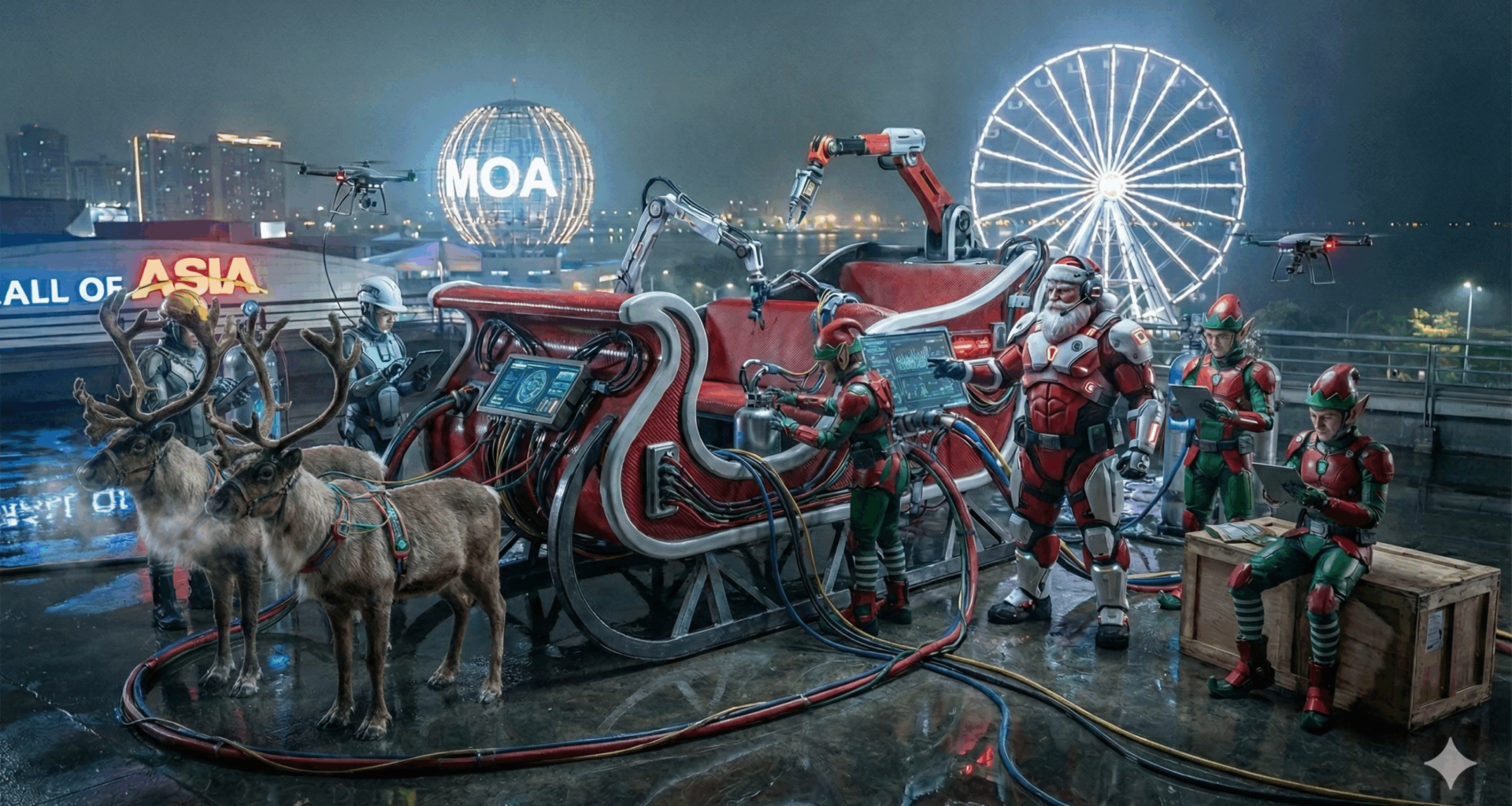
Asia-Pacific Primary Hub: SM Mall of Asia (Manila, Philippines)
Surface area: 407,000 square meters
Refueling time: 22 seconds (network fastest)
Ground crew: Elf Division 63
This facility’s liquefaction plant, disguised as HVAC infrastructure, operates on year-round solar power to pre-position fuel stocks. Coastal positioning enables direct Pacific trajectory insertion, though sea-level air density and 78% humidity require enriched fuel mixture.
The Asia-Pacific hub was the first of the quick pitstops built offshore from the North Pole facility. Records show that as early as 1901, after Spain ceded control of the Philippines to the Americans, it has been located there. When the US built the Clark Air Base and the Subic Naval Base, the Asia-Pacific Hub was already being built after initial prototyping in the tadpole-shaped island of Corregidor where Fort Mills, which primarily served as naval defense, was also a landing pad for the SLEIGH at Battery Cheney, which retracted into its own silo. The bases closed in 1991 due to the disruption of the Mt. Pinatubo eruption. Another important trivia point: Leonardo Salvador Sarao, the Filipino inventor who fashioned the jeepney from discarded Willys Jeeps, was also chosen to design the flamboyant SLEIGH Mark-IV. One can see the design DNA from the colorful jeepney.
Elf Division 63 maintains the fastest turnaround time in the entire network—a point of considerable pride.
“We run drills every week,” explains one source. “Twenty-two seconds or we buy the next round at the Christmas party.”
Geopolitical note: The Philippine hub was originally intended to serve the entire Asia-Pacific region. That changed in 2017 when Chinese incursions into the West Philippine Sea increased and the administration of President Duterte allowed the entry of Chinese offshore gambling to the country.
Asia-Pacific Secondary Hub: Alibaba Logistics Center (Hangzhou, China)
Commissioned: 2018
Refueling time: 26 seconds
Ground crew: Elf Division 88
The newest addition to the network was commissioned following what NPED officials describe only as “airspace complications and territorial differences.”
Documents suggest the facility became operational after a 2018 incident in which SLEIGH’s flight path through the Taiwan Strait triggered air defense alerts from multiple nations. The diplomatic fallout required three months of negotiations and resulted in the bifurcation of Asia-Pacific operations.
However, investigation uncovered a secondary motivation: Alibaba convinced the Chinese Communist Party’s Central Committee Ministry of Commerce to open the internally controlled hub to increase distribution of Alibaba partner-products, a commercial arrangement disguised as aerospace diplomacy.
Oceania Hub: Bunnings Warehouse (Sydney, Australia)
Refueling time: 31 seconds plus 30-minute meal break for Santa
Special capability: Emergency repair facility at the Sydney Opera House
This dual-purpose facility provides both refueling and a food stop option. The retail inventory includes structural components compatible with Mark-IV airframe specifications—an arrangement that has proven invaluable during three documented in-flight emergencies. The hangar is located just 7.4 kilometers (10 seconds by SLEIGH) to Circular Quay just above the Joan Sutherland Theater at the Sydney Opera House. Apparently, Santa takes a break here munching his favorite Vegemite-filled toasts and feasting on barramundi.
Operational risk: Olfactory contamination from on-site food vendors has triggered three documented course deviations when cabin ventilation systems admitted exterior air. The reindeer always get a whiff of the great aromas and are distracted. Ground crews now deploy aromatic countermeasures during refueling operations.
Americas West Coast Hub: Amazon Fulfillment Center (Riverside, California)
Elevation: 1,073 feet
Commissioned: 2017
Refueling time: 39 seconds
This hub was commissioned to address what logistics analysts call the “Pacific Corridor bottleneck.” The West Coast’s population density—spanning from San Diego through the Bay Area to Seattle—created unsustainable fuel consumption rates when serviced from the Midwest hub alone.
The Riverside facility sits at a strategic elevation that provides gravitational assist for ascent burns while remaining below marine layer cloud cover.
The Elf Walkout of 2019: Santa Claus brought in elf automation specialists to the Amazon Fulfillment Center two years after it was established. The elves departed six months later when management failed to drop the facility’s air conditioning to -4°F (-20°C)—standard operating temperature for cryogenic fuel handling.
Management described it as an “end-of-contract” condition rather than a strike or walkout. Amazon subsequently partnered with Rockwell Automation for the distribution system automation.
Americas Midwest Hub: Costco Distribution Center
Storage capacity: 340,000 liters
Refueling time: 37 seconds (including verification delays)
Notable incident: 2024 membership credential failure
Bulk storage capacity enables mega-liter scale positioning in standby cryogenic tanks. The facility’s strategic central positioning makes it the primary hub for continental North America operations.
However, operational delays have occurred. The 2024 mission logged a 45-second hold due to membership credential verification issues. “The system flagged the account as expired,” explained one NPED engineer. “We had to override three authentication protocols while burning fuel in a hover pattern.”
The incident prompted a comprehensive review of payment authentication protocols across the entire network.
Historical note: Costco founders Jim Sinegal and Jeff Brotman, who were constantly on the nice list, were approached by long-time Santa Claus ambassador John Stephen Goodman, who negotiated installation of the hub in 1983.
Euro-Zone Hub: IKEA (Älmhult, Sweden)
Refueling time: 35 seconds
Coupling system: Proprietary hex-key interface
The structure’s high-visibility blue exterior serves as a visual approach beacon during sub-orbital descent—a function that proved critical during a 2022 navigation system failure.
Fuel coupling utilizes a proprietary hex-key interface—secure against tampering but vulnerable to cross-threading under time pressure. Maintenance crews now carry redundant coupling hardware after a 2023 stripping incident resulted in an 11-minute delay and a strongly worded memo from NPED headquarters.
The Berlin That Never Was: In 1991, following the collapse of the Berlin Wall, discussions centered on building a fuel depot inside Berlin. Tempelhof Airport became the proposed site—symbolically perfect for reunified Europe, and there was no large retail facility in the former Eastern Bloc suitable for conversion.
The plan was abandoned after site surveys revealed the extent of subsurface unexploded ordnance. Berlin’s subsurface contains an estimated 3,000 tons of undetonated bombs from Allied air campaigns. A single ignition event, engineers calculated, could trigger a cascading detonation across multiple UXO sites.
“You can’t store 500,000 liters of liquid methane on top of three thousand tons of bombs,” explained one engineer. “Even we have limits.”
Latin America Hub: Mercado Libre Logistics Centers
(São Paulo, Brazil / Tijuana, Mexico City)
Refueling time: 48 seconds
Technology: Automated robotic fuel transfer systems
Automated robotic systems, reprogrammed for aerospace applications, achieve fuel transfer in 48 seconds—the network’s slowest cycle time, despite automation. The integration of e-commerce sorting technology into aerospace ground operations represents what analysts call a “civilian-military convergence model.” There are two hubs, one in Brazil and one in Tijuana (which is now branded Mercado Libre) for a simple reason: if Santa lands at siesta time, no one will fill up, which is the reason for the automated refueling system.
The ICE Incident (2025): In early 2025, the Department of Homeland Security’s Immigration and Customs Enforcement (ICE) attempted to raid the Tijuana facility in broad daylight, forgetting that the border was 1.7 feet inward. ICE officers started to accost elves in the NPED uniform. Despite protests, ICE enforcers didn’t relent but were forced to stop when Santa sent a broadcast that all ICE agents would be on the permanent naughty list.
“They could not inch into the well-guarded facility,” said Mercado Libre executives who requested anonymity.
An ICE spokesperson later explained with a Latino accent, “we were just following orders.”
Middle East Hub: Dubai Mall (United Arab Emirates)
Storage location: Parking level -6
Refueling time: 28 seconds
Commissioned: 2009
The region’s extreme temperatures—regularly exceeding 50°C in summer months—initially seemed incompatible with cryogenic fuel operations. However, the Dubai Mall’s underground parking infrastructure, extending seven levels below ground, provides natural thermal insulation that maintains stable temperatures year-round.
The facility was commissioned following what NPED documents describe as a “catastrophic thermal event” during a 2008 test mission. An experimental above-ground fuel depot in Riyadh experienced rapid boil-off when ambient temperatures exceeded design parameters, forcing an emergency landing in the Rub’ al Khali desert. The crew was stranded for 47 minutes until a backup fuel delivery could be arranged.
The Dubai installation now serves as the primary Middle Eastern node, with fuel storage located at parking level -6. The 2.8 million square foot mall structure above provides both thermal mass and operational cover. Refueling occurs during the facility’s closed hours (2:00–6:00 AM), with fuel transfer completed via a concealed roof access point disguised as a ventilation tower.
The all-Filipino pit crew at the hub deliver quick service times, second only to the SM facility in Manila.
Africa Hub: Mall of Africa (Johannesburg, South Africa)
Elevation: 5,200 feet
Refueling time: 34 seconds
Special capability: Full veterinary station
Ground crew: Elf Division 94
This hub was commissioned in 2006 to address what logistics planners identified as the “sub-Saharan gap”—a 6,200-kilometer stretch between Dubai and Sydney with no refueling capability. Prior to 2016, missions would either carry excess fuel (reducing payload capacity) or execute high-risk extended-range burns across the Indian Ocean.
The Johannesburg facility’s elevation offers significant advantages. The altitude reduces atmospheric density, decreasing fuel consumption during ascent phases by approximately 11%. Additionally, the facility’s position allows for optimized great-circle routing between South America and Oceania.
The ground crew—Elf Division 94—has developed expertise in rapid-response protocols, having trained extensively for power interruption scenarios. Load shedding has occurred during two Christmas Eve operations, requiring emergency backup power systems.
The facility also maintains the network’s only fully equipped veterinary station, staffed during mission operations to address potential reindeer health issues during the longest over-water segment of the route.
The Johannesburg facility executives asked Elon Musk to provide the ground transportation at the hub using Cybertrucks. Musk countered that he cannot do that because the Cybertruck in his home country is subject to high import taxes and duties, making it prohibitively expensive.
Operational security and future expansion
The existence of this infrastructure raises questions about international airspace agreements, environmental compliance, and the legal classification of bio-propellant systems. Multiple governments declined to comment on whether formal overflight permissions have been granted, or if the operation falls under existing aerospace exemptions.
Since SLEIGH can fly up to the heights of the moon, a discussion to set up the single biggest global hub and airdrop gifts to Earth is being considered. No technical details have been released.
NPED sources indicate preliminary discussions for additional hubs in India and West Africa. Though, negotiations remain confidential. “We need coverage gaps filled,” explained one logistics planner. “But every new facility requires years of diplomatic groundwork.”
However, the dismantling of USAID by DOGE earlier this year puts a lot of strain on the expansion. Off-season global gift giving depended a lot on USAID’s generosity.
As of publication, NPED has not responded to CleanTechnica requests for facility access, additional technical documentation, or clarification on the expired Costco membership issue of the author.
Special thanks to our elf-sources within NPED who risked their security clearances to provide this information. All reindeer names have been redacted to protect operational security. The last part of the series talks about the renewable energy sources at the North Pole, debunking all claims by Russia that Santa gets his power from Rosenergoatom.
If you find the satire logical or unfunny, please comment below or send your comments to tribs.tribdino@gmail.com
Sign up for CleanTechnica’s Weekly Substack for Zach and Scott’s in-depth analyses and high level summaries, sign up for our daily newsletter, and follow us on Google News!
Advertisement
Have a tip for CleanTechnica? Want to advertise? Want to suggest a guest for our CleanTech Talk podcast? Contact us here.
Sign up for our daily newsletter for 15 new cleantech stories a day. Or sign up for our weekly one on top stories of the week if daily is too frequent.
CleanTechnica uses affiliate links. See our policy here.
CleanTechnica’s Comment Policy