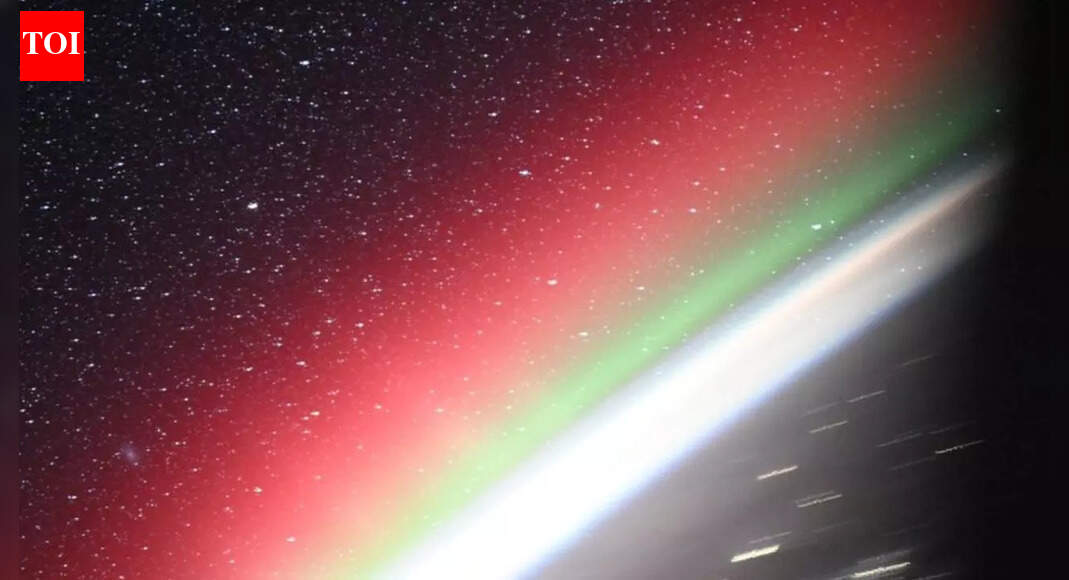
 Source: Don Pettit via X (formerly Twitter) A single photograph taken from orbit has managed to make a rare visual connection between the mundane life on Earth and the vastness of the universe outside. Framed from the International Space Station, the image shows a softly glowing planetary horizon illuminated by colours of the aurora, clusters of winter city lights, and the distant outline of the Andromeda Galaxy hanging in the background. Shared by NASA astronaut Don Pettit via X (formerly Twitter), the image comes at such a time when space-based observation plays a growing role both in understanding Earth systems and public engagement with astronomy. It demonstrates how current orbital photography can combine atmospheric science, human activity, and outer space in a single picture and provide a scientifically based yet easily understandable view of Earth as a part of a much wider cosmic environment.
What causes auroras to shine along Earth’s horizon
The glowing band that follows the Earth’s curve in the photo is because of aurora and airglow, processes that result from the interactions of solar particles with the upper atmosphere of the Earth. Energetic electrons and protons from the Sun follow magnetic field lines and collide with the atoms of oxygen and nitrogen, exciting them so as to emit light at discrete wavelengths. From space, such emissions take the appearance of layered curtains and arcs wrapping around Earth’s night side. A study published in Scientific Reports discusses how changes in the intensity and distribution of auroral light are influenced by variations in solar activity, and hence why low Earth orbit provides an excellent vantage point for observations of these phenomena at a global scale. The photograph shows auroral colour as a thin but dynamic boundary separating Earth from the blackness of space while revealing current space weather action.
What city lights reveal about human activity from space
This photo depicts the scattered dots and the lighting networks that outline the cities and the towns, which are below the atmospheric glow during the winter season. Night-time satellite imagery has been an instrumental method of observation over the years in the studies of human settlement patterns, economic development, and energy consumption. Artificial lighting is a measurable signal that can be compared across different regions and monitored over time, thus giving access to understanding urban expansion and the growth of infrastructure. From orbit, city lights also reveal striking contrasts between densely populated areas and sparsely inhabited landscapes, making starkly visible inequalities in development. The photograph taken by Pettit captures how human-generated light has changed the night environment of Earth from an undisturbed environment to a luminous footprint, from far above the surface, actually. Such a perspective is often adopted in environmental studies, such as those focused on light pollution and its ecological consequences, which include affecting nocturnal wildlife and human circadian rhythms.
How the Andromeda Galaxy appears alongside Earth
Beyond the bright edge of the Earth, the thin, elongated glow of the Andromeda Galaxy, M31, can be seen. The closest major spiral galaxy to the Milky Way, at a distance of approximately 2.5 million light-years away, Andromeda is one of the most-studied objects outside our galaxy. Its presence in an image from near Earth orbit is a rarity because such a distant object requires a carefully framed exposure with minimal atmospheric interference. Placing the Andromeda Galaxy in the same frame as the Earth serves to demonstrate the dramatic scale difference that exists between structures of a planetary nature versus those of a galactic nature. Andromeda is studied extensively by astronomers seeking insight into star formation, dark matter distribution, and the long-term fate of our own galaxy, since the Milky Way and Andromeda are expected to merge over billions of years. Watching Andromeda with the Earth is a visual reminder that our home planet sits within a much larger cosmic neighbourhood.
Why is the space station ideal for capturing rare images
The International Space Station plays a unique role, serving both as a research laboratory and as an observation post. Orbiting at an altitude of approximately 400 kilometres, it places astronauts in a position to photograph Earth and space with flexibility that is difficult to replicate with automated satellites. Human judgment enables the selection of those fleeting moments when conditions in the atmosphere, lighting, and the alignment of celestial objects come together. Improvements in the sensitivity of digital cameras have allowed more to be captured from space, such as very dim astronomical objects and very subtle atmospheric phenomena. Though such pictures are often made public quite widely because of their beauty, they also help to increase scientific knowledge by recording the transient events and by providing the contextual views which help the research of Earth science and astronomy. Thus, the photo that links aurora, city lights, and Andromeda well illustrates how orbital imagery can serve analytical and educational purposes.
Why do space images shape public understanding of science
Images that juxtapose familiar and distant elements are important for the shaping of public perceptions of science. The photograph places Earth’s inhabited surface and atmospheric processes alongside a neighbouring galaxy, establishing continuity between human experience and cosmic scale without resorting to abstraction. Social media platforms allow this type of image to reach wide audiences with unprecedented speed, and encourage curiosity and discussion about space science, climate, and astronomy. This mode of communication cannot substitute for the analysis of detailed information, but enhances it by providing identifiable visions of complex systems. The image Pettit posted is representative of how informed engagement can be encouraged through carefully taken orbital photography, linking scientific observation to a general understanding of Earth’s place within the universe.Also Read | What is behind the mysterious red lights seen over the Pacific