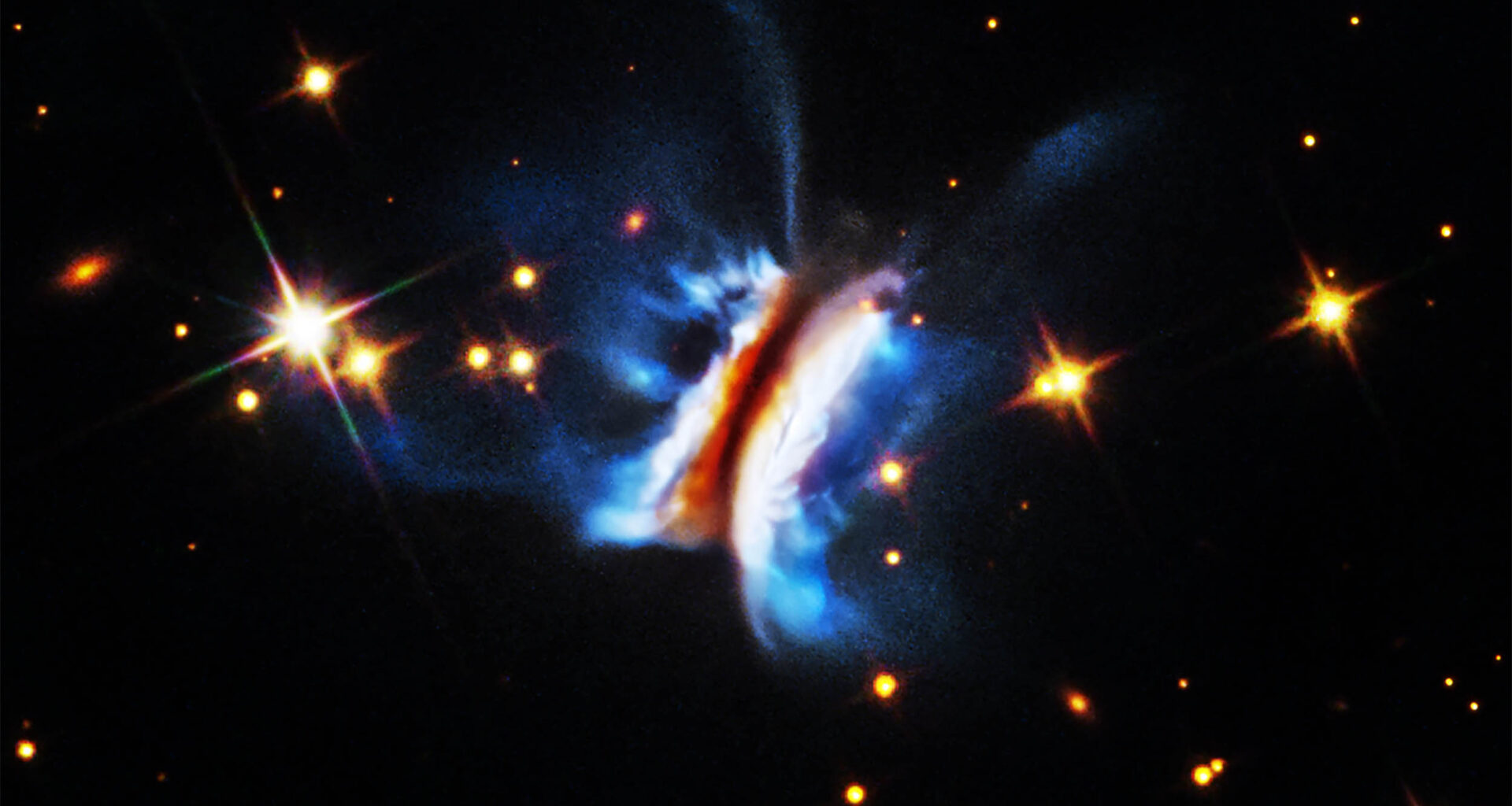
Astronomers are used to neat, flat disks when they look at young stars. Most planet-forming disks behave themselves. They spin, settle, and build planets over time.
A new set of images reveals a disk so large and unruly that it has forced scientists to rethink what a planet nursery can look like.

Instead of calm layers of dust and gas, this system looks stirred up, uneven, and restless. Material shoots far above and below the disk, and it does not do so evenly.
Dracula’s Chivito is massive
The object, known as IRAS 23077+6707, is located about 1,000 light-years from Earth. Astronomers nicknamed it “Dracula’s Chivito.”
The disk spans nearly 400 billion miles from side to side. That is about 40 times the diameter of our solar system out to the Kuiper Belt.
The disk is so thick and dense that it blocks the young star inside from view. Scientists think the hidden source may be a single hot, massive star or possibly two stars locked together.
Either way, the disk around it is the largest known structure of its kind and one of the strangest ever observed.
What stands out right away is the mess. The disk is seen nearly edge-on, and its upper layers are stretched far from the central plane.
Wispy material rises high above and dips far below, reaching distances never seen this clearly before in similar systems.
The disk has a sharp edge
There is another detail that made researchers stop and stare. The tall, filament-like structures appear on only one side of the disk. The opposite side looks cut cleanly, with no matching features at all.
This uneven shape hints at violence or disruption. Fresh dust and gas may have fallen into the disk recently.
The disk could also be interacting with its surrounding environment in ways scientists are only beginning to understand.
Whatever the cause, the imbalance breaks the idea that planet-forming disks are tidy and symmetrical.
A unique lab for planet formation
“The level of detail we’re seeing is rare in protoplanetary disk imaging, and these new Hubble images show that planet nurseries can be much more active and chaotic than we expected,” said study lead author Kristina Monsch of the Harvard & Smithsonian Center for Astrophysics (CfA).
“We’re seeing this disk nearly edge-on and its wispy upper layers and asymmetric features are especially striking.”
“Both Hubble and NASA’s James Webb Space Telescope have glimpsed similar structures in other disks, but IRAS 23077+6707 provides us with an exceptional perspective – allowing us to trace its substructures in visible light at an unprecedented level of detail.”
According to Monsch, the system is a unique laboratory for studying planet formation and the environments where it happens.
The nickname “Dracula’s Chivito” reflects the background of the researchers who studied it. One comes from Transylvania. Another comes from Uruguay, where a chivito is a popular sandwich.
The name stuck, and so did the disk’s reputation for being hard to ignore.
Cosmic chaos of Dracula’s Chivito
“We were stunned to see how asymmetric this disk is,” said co-investigator Joshua Bennett Lovell, an astronomer at the CfA.
“Hubble has given us a front row seat to the chaotic processes that are shaping disks as they build new planets – processes that we don’t yet fully understand but can now study in a whole new way.”
All planetary systems start the same way. Gas and dust swirl around a young star. Over time, gas falls inward, and leftover material clumps together into planets.
In this case, there is a lot left over. The disk’s mass is estimated to be 10 to 30 times that of Jupiter, which is more than enough to build several giant planets.
More questions than answers
“In theory, IRAS 23077+6707 could host a vast planetary system,” said Monsch. “While planet formation may differ in such massive environments, the underlying processes are likely similar.”
“Right now, we have more questions than answers, but these new images are a starting point for understanding how planets form over time and in different environments.”
This system may be an oversized cousin of what our own solar system looked like long ago. It shows that planet formation does not always happen quietly or evenly. Sometimes it happens in fits and starts, with matter flying off course and settling back down.
The images mark a major moment for the Hubble Space Telescope. Seeing this much detail in visible light opens a new window on how extreme systems behave.
The study also reminds scientists that the universe rarely follows simple rules. Even the places where planets are born can be loud, lopsided, and full of surprises.
This article contains information from a NASA press release.
—–
Like what you read? Subscribe to our newsletter for engaging articles, exclusive content, and the latest updates.
Check us out on EarthSnap, a free app brought to you by Eric Ralls and Earth.com.
—–