Deep within one of the last remaining sanctuaries of the Sumatran tiger, a series of camera trap images has upended scientists’ expectations. As this species endures one of the most precarious moments in its history, the photos tell a surprising new story — one of resilience and hope.
Three times larger than Yellowstone, Indonesia’s Leuser ecosystem is the final stronghold of this critically endangered big cat. Once roaming freely across several Sunda Islands, including Java and Bali, the tiger now survives only here — in forests increasingly threatened by logging, poaching, and the collapse of prey populations.
Made up of lowland jungles, rolling hills, and rugged mountains, Leuser is one of the most closely monitored wilderness areas in the region. It’s here that researchers conducted a groundbreaking study, published in Frontiers in Conservation Science, to measure the true impact of ongoing protection efforts on this fragile population.
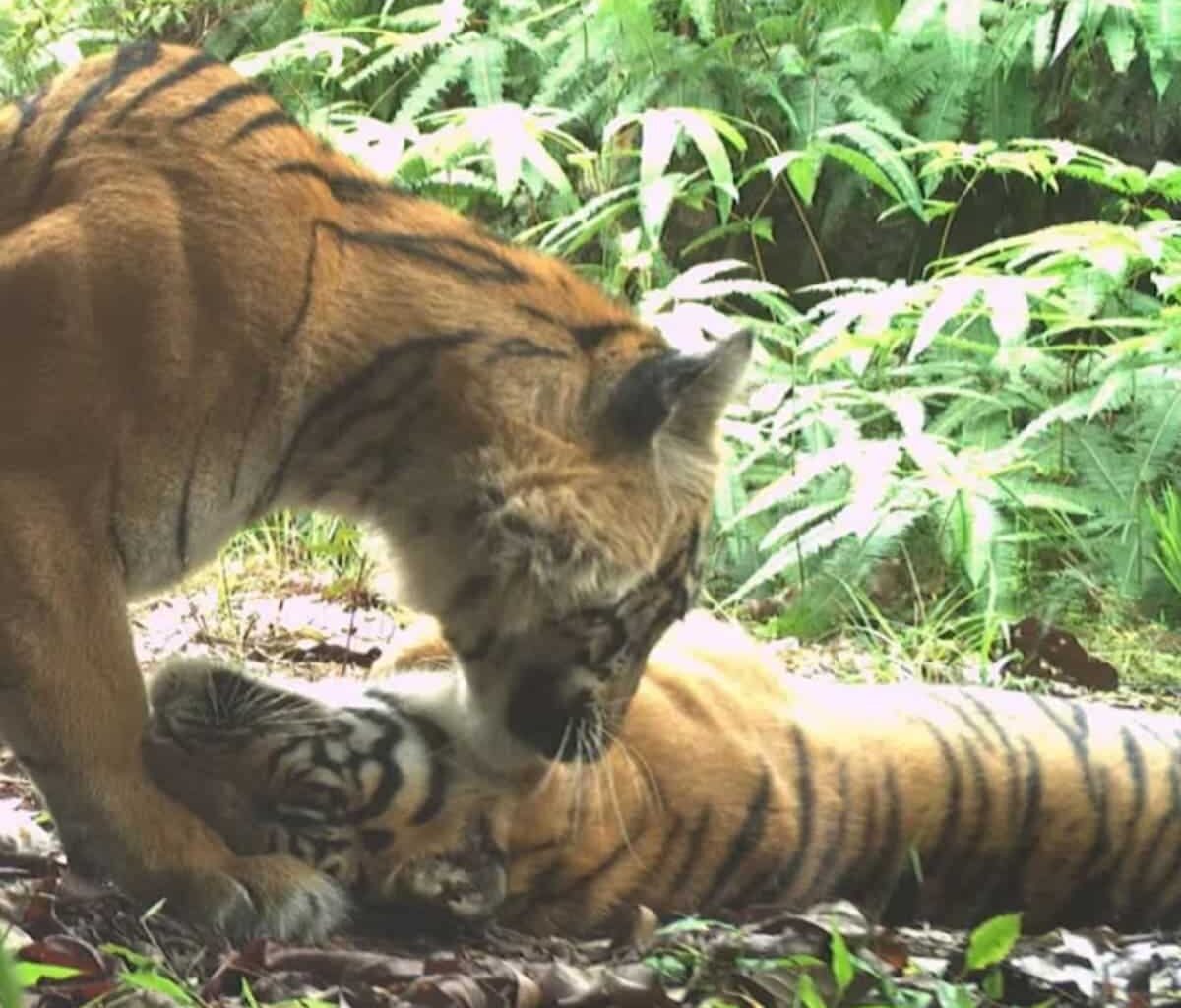
A recent camera trap study captured nearly three times as many images of Sumatran tigers as previous surveys. © IFLScience
A massive photographic tracking effort
To gauge the health of the tiger population, scientists — working hand in hand with local communities — set up a remarkable network of camera traps: 59 cameras from June to December 2023, followed by 74 more from May to November 2024. This long-term tracking effort, says conservation biologist Joe Figel, is crucial to estimating survival rates, territory occupation, and population growth.
The cameras delivered stunning results: 27 tigers identified, including three litters of cubs — a sign of rare vitality in a species so close to extinction. Even more striking, the total number of tiger images recorded was triple that of previous surveys — a beacon of hope for one of the world’s most endangered predators.
Signs of recovery
According to Figel, this encouraging outcome stems from sustained protection of lowland and hill forests — areas richest in prey — and from the collaboration among government agencies, Acehnese and Gayo communities, donors, and scientists.
These findings show that targeted conservation can truly make a difference, even for species on the edge. In the shaded depths of Leuser’s rainforest, the presence of tigresses and their cubs is a powerful reminder that nature’s resilience endures — if given the chance.

Cécile Breton
Journalist
Since childhood, books, photography, and travel have been part of my world. Fascinated by life, by the stars, by landscapes that tell stories without a single word, I quickly realized that I needed to express what I saw and felt.
Passionate about the world around me, I first pursued a degree in History at university, driven by my fascination with the stories of the past and the great civilizations that shaped our world. But over the years, another truth became clear: I didn’t want to spend my life in archives or research. I wanted to be out in the field, behind a camera or in front of a microphone, sharing what I learned.
So, I took a new path. I chose journalism, to learn how to tell stories differently—with rigor and clarity. I learned how to write, to interview, to edit, to capture both attention and emotion.
Giving meaning and sharing what matters
Since then, I’ve worked across different media: print, web, radio, television, and video. All of this has allowed me to bring to life topics that matter deeply to me: nature, animals, space, and the major environmental and human issues of our time.
Today, I continue my journey as a journalist at Futura. As part of the editorial team, I strive to share knowledge with curiosity, clarity, and passion. My guiding thread? To make visible what deserves to be seen, understood, and shared—and to keep my sense of wonder alive.