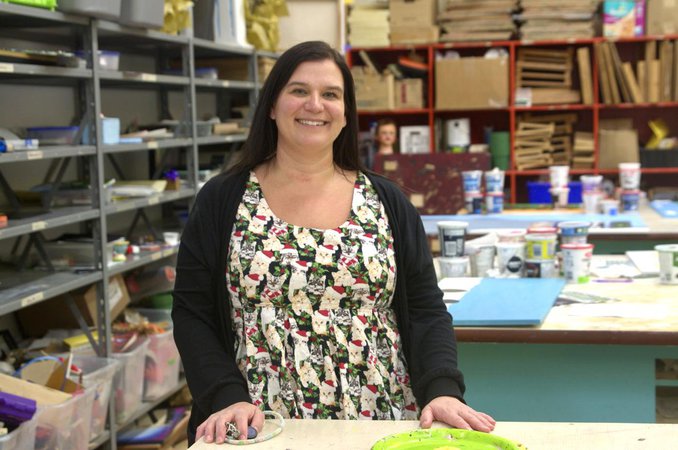
It looks like a classroom, yes, but it feels like a place where students come to understand who they are and that is exactly the point.

For more than a decade, visual arts teacher Becky Tucker has helped shape this room into something more than a space where assignments are completed and marked. It has become a place where young people learn to take risks, explore, trust themselves — and be seen.
“I think that students have to feel really comfortable in an art space, because they have to really look inside themselves,” Tucker said.
“They need to know that what they’re trying will be accepted and validated, that we aren’t all going to make the exact same thing, and this is the way it should look … Of course, there’s always like expectations and a rubric that we’re following, but our products will all look diverse, just as we are all diverse people.”
Tucker teaches Art 10, 20 and 30. Students begin with wide-open experimentation in Grade 10, when they try “a bunch of different materials” including dry media, ink, watercolour, linocut printmaking, hand-building with clay and acrylic painting.
By Grade 11, projects become larger and more personal. Students take on themes such as self-portraits or public art and choose which materials they want to use to bring their ideas to life.
By Grade 12, the course becomes something bigger. Students create full art exhibitions under themes they design themselves, then display their work in the school library for the community to see.
“The sky is the limit, they can create whatever they want,” Tucker said.
One of the most distinctive features of the program is the school’s pottery facility. It’s something many high schools do not have. The space has existed since at least the late 1980s, and Tucker herself first discovered a love of pottery here as a student before graduating in 2004.
She lights up when she talks about it.
“I also think our pottery studio, I’m just going to brag about it again, is an amazing facility, and we’re so fortunate to have it,” she said.
The room includes a large hand-building area with tools such as a slab roller and an extruder, along with pottery wheels and kilns. Students learn quickly that pottery requires patience and skill. Alongside her classroom teaching, Tucker also runs a weekly pottery club for students from Grades 7 to 12, allowing many of them to start young and grow into confident artists as they get older.
For Tucker, though, the real story is not the equipment or even the assignments. The true impact lives in the students themselves.
“My goal is never that I’m going to turn out an amazing artist, but I want students to leave this program feeling empowered, so that whatever life choices they make, those skills help them in the next part of their life,” she said.
She remembers a parent emailing her last year to thank her because their child was finally creating art confidently at home and learning to love who they were. She has also watched quiet students discover new versions of themselves when they create.
“I think that, like the arts, can make or give the opportunities for students to just become other versions of themselves that will help them in the next part of their life.”
The visual arts program is part of a broader wave of momentum in the school’s creative community, alongside drama, music, and cosmetology.
“For me, I think it’s about all students seeing themselves in one of the art streams, maybe all of them,” she said.
“Seeing that they can also enter one of those classes, even if they think like, oh, I don’t fit in there, or that’s not for me.”
Inside the art room, past work remains on the walls as a living record of the students who have passed through. Soon, more art will join it as another group of students builds, paints, sculpts and discovers what they are capable of.
Because here, art is not just something students make. It is something they grow through.
—
Kenneth.Cheung@pattisonmedia.com