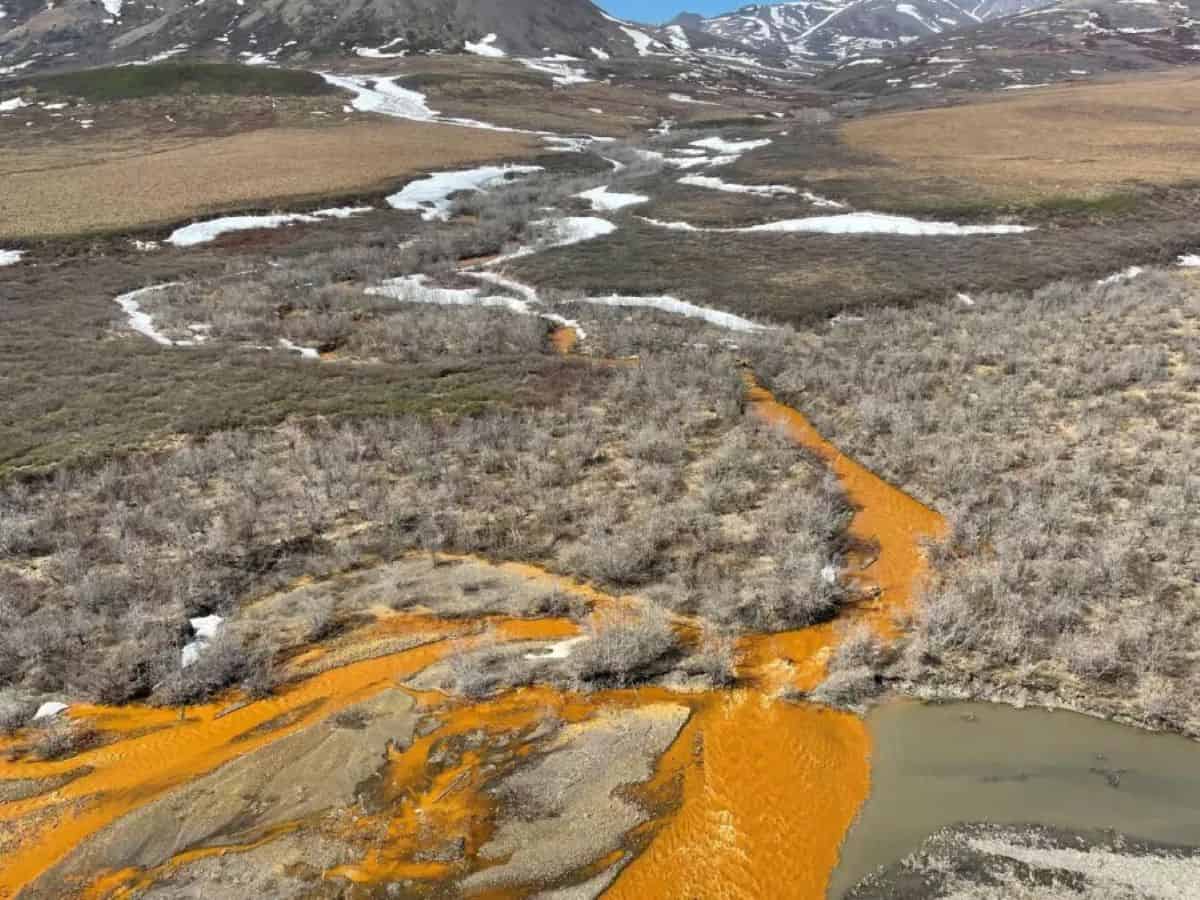
 The orange tributary of the Kugororuk River in Alaska is an example of a “rusting river.” Credit: Josh Koch/U.S. Geological Survey
Local pilots flying over northern Alaska were the first to spot that something was wrong. Below them, pristine river networks looked like they had rusted overnight.
The vivid orange color suggested industrial contamination, but the surrounding land was wild and untouched. There were no mines, no factories, and no human activity for miles.
What scientists eventually realized was far more unsettling: The Arctic itself is leaking.
Across hundreds of miles of Alaska’s North Slope, long-frozen ground is thawing. As it does, naturally occurring metals locked in the soil for millennia are bleeding into streams and rivers. The result is a growing network of what researchers now call “rusting rivers,” a striking and troubling signal of just how quickly the Arctic is changing.
Bleeding Permafrost
The phenomenon is one of the clearest examples in the latest Arctic Report Card, an annual assessment coordinated by the National Oceanic and Atmospheric Administration. This year’s report describes an Arctic that is warmer and wetter than at any point in the modern record—and increasingly unpredictable.
Local communities are also understandably concerned.
“ We heard from people who live in the region—pilots who are often flying over, people in the national parks,” said Josh Koch, a research hydrologist with the U.S. Geological Survey, speaking to NPR.
This has happened before in the past. By 2019, Koch and his colleagues began documenting the phenomenon systematically. Aerial surveys, satellite imagery, and ground expeditions revealed that more than 200 river basins north of Alaska’s Brooks Range had been affected. These were remote, pristine watersheds, not affected by local pollution.
The source was permafrost.
This permanently frozen mix of soil, rock, and organic matter covers much of the Arctic. However, as air temperatures rise, the ground has been thawing steadily since the early 2000s.
When permafrost melts, groundwater seeps into deeper soil layers, exposing minerals that rarely encounter oxygen. One of these is pyrite, an iron sulfide. When pyrite reacts with air and water, it oxidizes, effectively releasing iron and sulfuric acid into the ecosystem.
“It’s often not orange until it reaches the stream, and then all the iron and other metals can precipitate and create this iron staining,” Koch added.
In some places, rivers have shifted from clear to orange over the course of days or weeks. During a 2024 survey in Kobuk Valley National Park, researchers watched the Akillik River change color over the summer. Aquatic biodiversity was heavily affected, according to the NOAA Arctic Report Card.
It isn’t just iron, either. Scientists have detected elevated levels of aluminum, copper, and zinc. This toxic cocktail disrupts ecosystems from the bottom up, threatening the insects, fish, and animals (and eventually, the humans) who depend on them.
Contamination Risk
 Iron causes orange water and snow in a braidplain of the Nakolikruk River, Alaska. Credit: Josh Koch/U.S. Geological Survey
So far, scientists have not found evidence that fish consumed by humans are contaminated, but the ecological damage is visible and the risks are mounting.
Salmon are especially vulnerable. These fish rely on precise chemical cues to navigate rivers and spawn. Even minor changes in water chemistry can scramble their internal GPS.
“It doesn’t take a lot to make salmon less reproductively successful if they are fighting off toxicity,” Nicole Kimball of the Pacific Seafood Processors Association told The New York Times. “They can become confused on where they go to spawn.”
The concern isn’t limited to small streams. If these rusting rivers feed into larger systems, such as the Yukon River, the effects could ripple across Alaska’s $541 million salmon industry. Roughly 10,000 people live in the region directly affected so far, and for many, fish is a primary food source.
Global Consequences
Researchers are racing to monitor drinking water supplies and wildlife populations. They’re also cautioning that these issues aren’t restricted to one region.
The orange rivers are part of a much larger story. According to the latest Arctic Report Card, the Arctic has experienced its warmest and wettest conditions in the modern record.
“To see both of these historical records being set in the same year is quite remarkable,” said Matthew Druckenmiller, a senior scientist at the National Snow and Ice Data Center and a lead author of the report, speaking to The New York Times.
Since 1980, Arctic air temperatures have risen more than double the global average. That warming is accelerating glacier loss, shrinking sea ice, and altering oceans. The Greenland Ice Sheet has been losing well over 100 billion tons of ice per year in recent estimates. Arctic sea ice reached its lowest maximum extent in the 47-year satellite record.
Warmer, saltier Atlantic waters are now pushing deeper into the Arctic Ocean, a process known as Atlantification. In the Bering Sea, these shifts are reshaping marine ecosystems, disrupting fisheries, and altering traditional hunting practices.
Moreover, melting ice contributes to rising seas worldwide. Changes in Arctic temperature patterns can influence weather far to the south, shaping storms, rainfall, and heat waves.
The Arctic Report Card was released amid deep cuts to federal climate research, yet it persists through an international network of scientists. Its findings are increasingly hard to ignore.
The rusting rivers are a visible warning sign. As frozen ground thaws, minerals that were once sealed in permafrost are entering waterways, altering ecosystems faster than researchers expected.