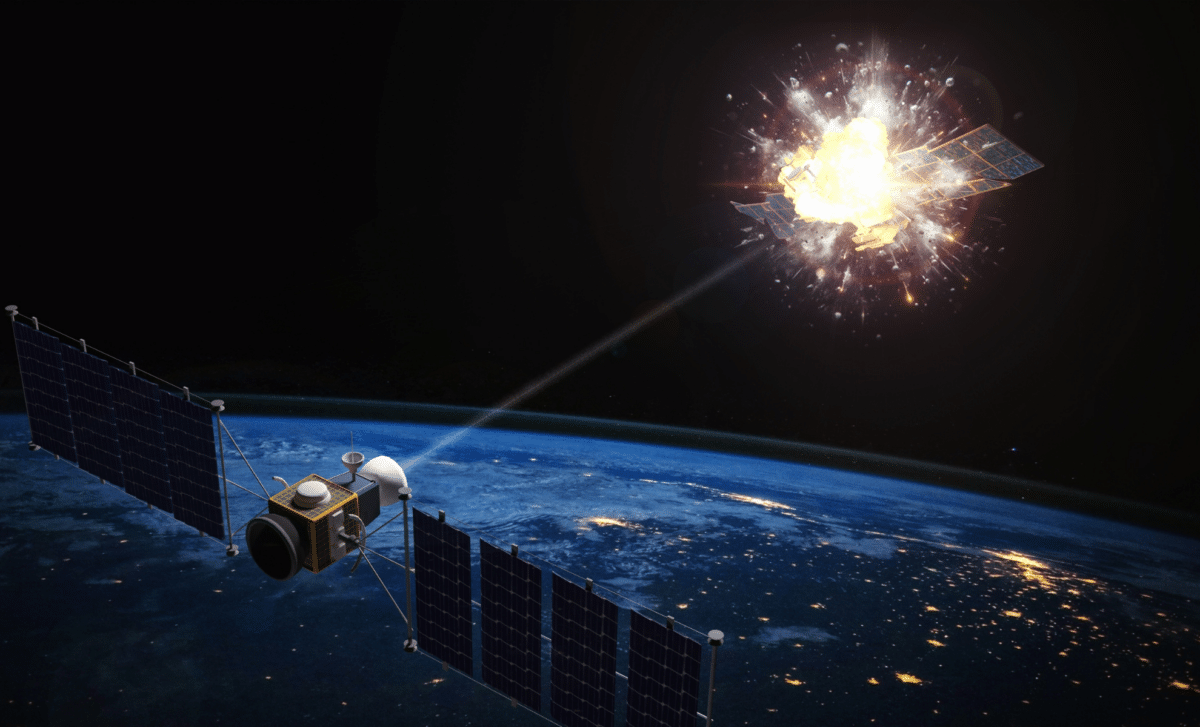
As space junk continues to multiply around our planet, threatening satellites and space missions, a new breakthrough proposes a non-contact solution that uses electrostatic forces to gently move objects in space. The project, led by researchers from CU Boulder’s aerospace engineering department, mimics the principles of the iconic Star Trek tractor beam, only this time, it’s grounded in real science and ready for experimental development.
A Safer Way To Tame The Chaos In Orbit
The inspiration behind the project lies in a growing concern: the escalating space debris crisis. From dead satellites to defunct rocket parts, Earth’s orbit is increasingly cluttered with hazardous fragments traveling at extreme speeds. Any physical contact with this debris can trigger catastrophic chain reactions, as evidenced by past incidents involving satellites.
“Touching things in space is very dangerous,” explained Kaylee Champion, one of the CU Boulder researchers involved in the study. “Objects are moving very fast and often unpredictably.”
To address this, the team proposes an innovative alternative: an electrostatic beam that attracts debris without any physical contact. By using charged particles and controlled electric fields, this system creates what engineers refer to as a virtual tether. The beam would be deployed from a service satellite that flies in close formation with a target piece of debris, slowly altering its trajectory using electrostatic attraction rather than mechanical arms or nets.
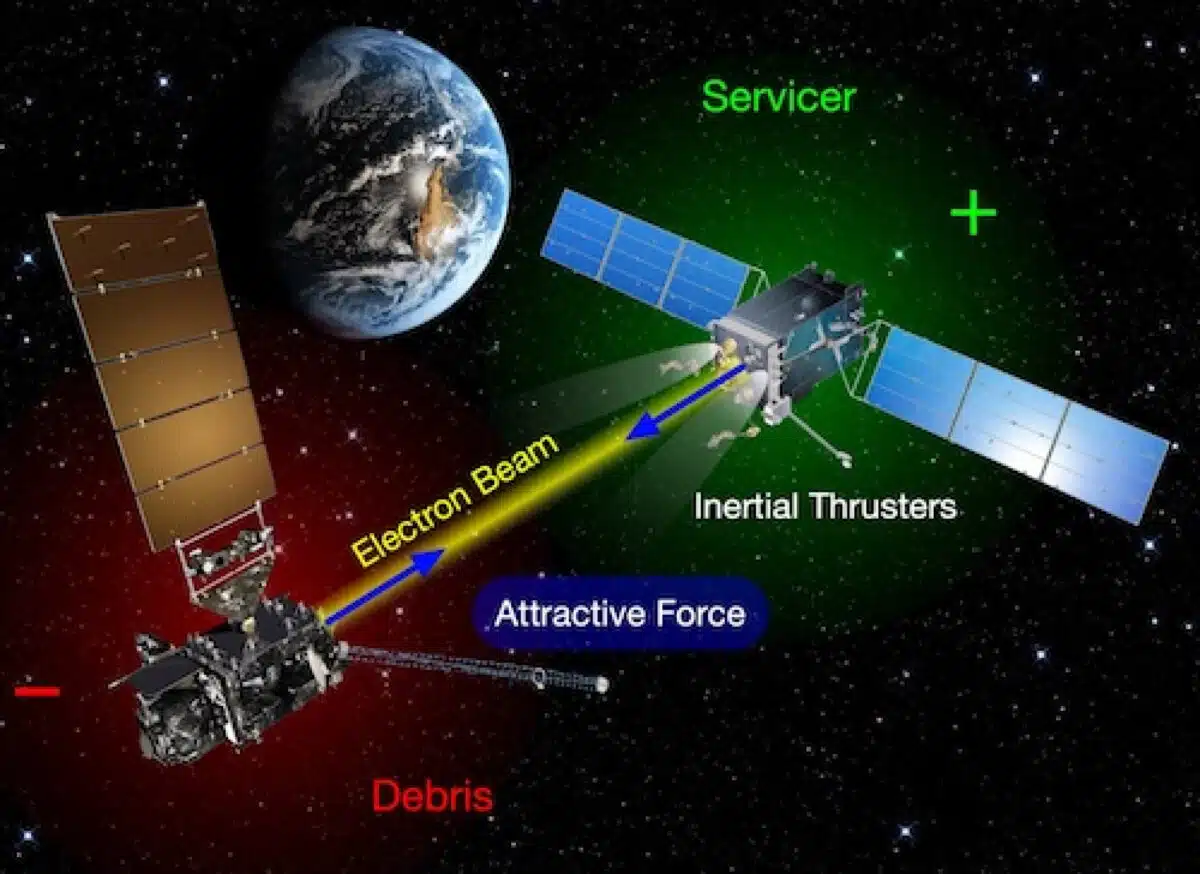 An illustration of the electrostatic tractor concept. Credit: Schaub Lab
The Sci-Fi Inspiration Behind A Real-World Solution
The concept draws obvious comparisons to fictional technology. Hanspeter Schaub, chair of the aerospace engineering department at CU Boulder, acknowledged the connection: “It’s similar to the tractor beam you see in ‘Star Trek,’ although not nearly as powerful.” Unlike its Hollywood counterpart, the CU Boulder beam won’t lift shuttles or planets. Instead, its mission is focused and precise, nudging metallic junk in low-Earth orbit by manipulating their electrical charge.
While previous attempts at space debris removal relied on direct mechanical interaction, such as nets, harpoons, or robotic arms, CU Boulder’s beam introduces a safer, more flexible approach. “With that attractive force, you can essentially tug away the debris without ever touching it,” said Julian Hammerl, one of the lead researchers on the project. The system reduces the risk of collision, conserves fuel, and opens the door to long-term autonomous missions that clean up orbit without human intervention.
CU Boulder Leads A New Frontier In Space Safety
Backed by advanced simulations and supported by both NASA and the U.S. Department of Defense, the University of Colorado Boulder team is currently testing the system in lab conditions that simulate space. Their experiments involve charging lightweight materials and measuring how well the beam can generate attractive forces across varying distances.
The work is interdisciplinary, combining knowledge in electrical engineering, aerospace systems, and orbital mechanics. The electrostatic tractor beam project is part of a broader trend toward active debris removal (ADR), a growing area of focus for space agencies worldwide. As orbital congestion increases, tools like this could soon be essential for maintaining access to Earth’s orbits.