
Workers who participate in pensions auto-enrolment can avoid a “massive drop” in income when they retire, Minister for Social Protection Dara Calleary has said as he urged both employees and employers to get behind the new scheme.
From today, workers, employers and the State will pay into the My Future Fund scheme, which has prompted concern among some employers over costs.
Before the establishment of the fund, between 750,000 and 800,000 people had no pension coverage except for the State contributory pension, which in 2026 stands at “the guts of €16,000 a year”, Mr Calleary said.
The average industrial wage is €46,000 to €47,000, he added. “If you’re going to get to the age of 66 with nothing else in place but the State contributory pension you’re going to take a drop of €30,000. So that’s why My Future Fund is important.”
Participation in the new My Future Fund scheme could see a 25-year-old earning €25,000 end up with a pension of almost €200,000 while a 50-year-old on €50,000 could see an occupational pension of €125,000 to bolster what they get under the existing State pension regime.
The roll-out of the new scheme is a huge undertaking and the Minister is hopeful it will go smoothly.
“I don’t want to hex myself by telling you, ‘Oh it’ll be grand’,” but an “extraordinary amount of work has gone into planning this”, the Minister said in an interview with The Irish Times.
Under My Future Fund, all employees not already in an occupational pension scheme, aged 23-60 and earning more than €20,000 a year, will be automatically enrolled.
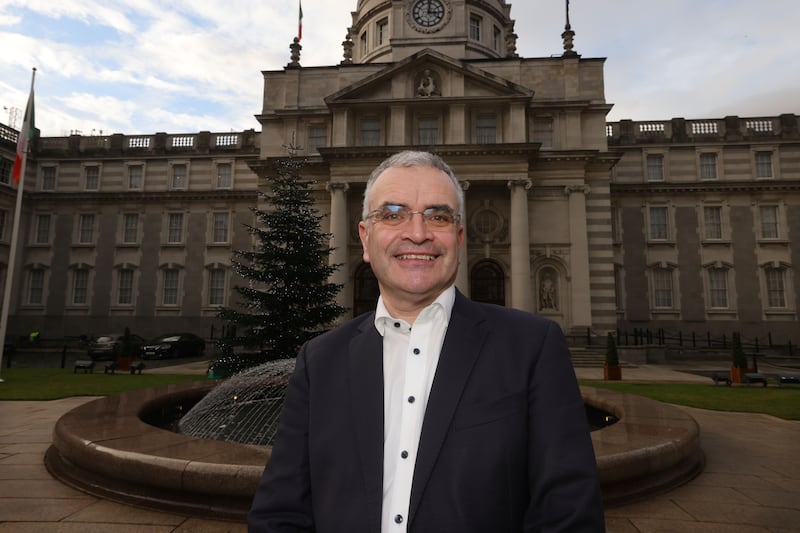 Dara Calleary: The presidential election campaign was a ‘really disastrous episode’for Fianna Fáil. Photograph: Alan Betson
The starting contribution rate is 1.5 per cent per employee/1.5 per cent per employer, and 0.5 per cent from the Government. These contribution rates will increase to 6 per cent from both employees and employers and 2 per cent from the State over 10 years.
Membership is compulsory for the first six months, after which employees can opt out. Those who opt out will be automatically re-enrolled after two years in the hope that they might stay in the scheme in future.
As of Tuesday, December 30th, 83,200 employers with an estimated 670,000 workers had signed up for the scheme.
Mr Calleary outlined how a 25-year-old earning €25,000 is being asked, under the current rate, to put €375 a year into their My Future Fund account. Their employer puts in another €375 and the State contributes €125. He said that before any investment returns that 25-year-old could have €196,000 by the time they reach 66, adding that this is “a game-changer for post-retirement”.
What would he say to low-paid workers who find their pay packet lighter as a result of My Future Fund contributions?
“I understand that at this point it’s challenging. But it’s challenging at any point” and when they get to 66 they will have a fund in place “to sustain them in their retirement”, the Minister said.
He said participation in My Future Fund will ensure that when workers move on to the State pension “they don’t have a massive drop in income without having something to support them”.
There is an expectation that less than 10 per cent of workers who are auto-enrolled will drop out after six months but Mr Calleary noted that they will be automatically enrolled again two years later.
Employers that are not eligible for an exemption from the scheme through the existence of a sufficient occupational pension scheme for staff – and that fail to register with My Future Fund – will be pursued by the independent body overseeing it, the National Automatic Enrolment Retirement Service Authority (NAERSA). Ultimately such employers could be prosecuted and there is a regime of fines of between €5,000 and €50,000.
Mr Calleary said there has been “fantastic co-operation from the employer groups” and there is “no point” in relevant employers not signing up as their contributions are due to start from January 1st and unpaid contributions will be sought retrospectively.
While auto-enrolment will help with the cost of supporting the State’s ageing population in the coming decades there are still challenges in this area.
The Government’s recent Future Forty report set out the fiscal and economic outlook to 2065. It predicts that, “by 2040, the cost of providing pensions will have nearly doubled in real terms, compared to 2025, and is projected to triple by 2060.”
Notwithstanding the changing demographics, Mr Calleary said the State pension age – which stands at 66 – would not be increased by this Government.
The Future Forty report sets out how under a “central scenario” the Republic’s “old-age dependency ratio will rise significantly” and this “will place significant pressure on public finances, pensions and healthcare services”. It states: “Continuing to enhance the management of migration can help sustain a larger working-age population, alleviating some of the pressures from these demographic shifts.”
Immigration has been a contentious issue in recent times. Mr Calleary said “we need sustainable migration”. The work permit system, aligned to where labour shortages are, is “working well and should continue”, he added.
Asked about Fianna Fáil’s ill-fated presidential election campaign, the Minister said the party’s ardcomhairle needed to be ready to make proposals for changes in how the party selects presidential candidates in advance of its next ardfheis. “We made mistakes”, he said, describing the election as a “really disastrous episode for the party”.
He stated his belief that Taoiseach Micheál Martin should continue to lead Fianna Fáil into the next general election “if that’s his wish”.
Would he like to be leader of Fianna Fáil himself someday?
“I’ve never considered it, genuinely. There’s no vacancy and I wouldn’t consider it in the context of there not being a vacancy,” Mr Calleary said. “I don’t do parlour games.”
He said he had a number of roles – Minister for Social Protection; Minister for Rural and Community Development and the Gaeltacht; and TD for Mayo, and “I’ve enough for doing without getting up every morning and imagining what I could be.” He said: “I’m very, very honoured to be doing the job that I am.”