Families will gather on Sunday in south Armagh and in Co Down to mark the 50th anniversary of the murders of 10 Protestant and six Catholic civilians within a 24-hour period.
Shortly after 6pm on Sunday, January 4th, 1976, near-simultaneous UVF gun attacks on two Catholic homes took the lives of brothers John Martin (24), Brian (22) and Anthony Reavey (17) in Whitecross, near Newry, Co Down – Anthony died 26 days later in hospital – and brothers Barry (24) and Declan O’Dowd (19) and their uncle Joe O’Dowd (61) in Ballydougan, near Lurgan, Co Armagh.
Just under 24 hours later, republican paramilitaries ambushed a factory minibus at Kingsmill after four Catholics got off in Whitecross. After ordering the sole remaining Catholic on board to flee, they opened fire, murdering 10 Protestants. One man survived despite being shot 18 times. The South Armagh Republican Action Force claimed the deaths, but ballistic evidence later confirmed that the IRA was responsible.
On Sunday morning, more than 100 members of the O’Dowd family are to attend a memorial Mass in St Colman’s Church, near Ballydougan. The Reaveys are to gather for a memorial Mass in St Brigid’s Church, Carrickananney.
At 3pm on Sunday, relatives of the Kingsmill victims – who were John Bryans (46), Robert Chambers (19), brothers Reginald (25) and Walter Chapman (23), Robert Freeburn (50), Joseph Lemmon (46), John McConville (20), James McWhirter (58), Robert Walker (46) and Kenny Worton (24) – are to attend a memorial service in Bessbrook Town Hall.
No one has been convicted of the atrocities.
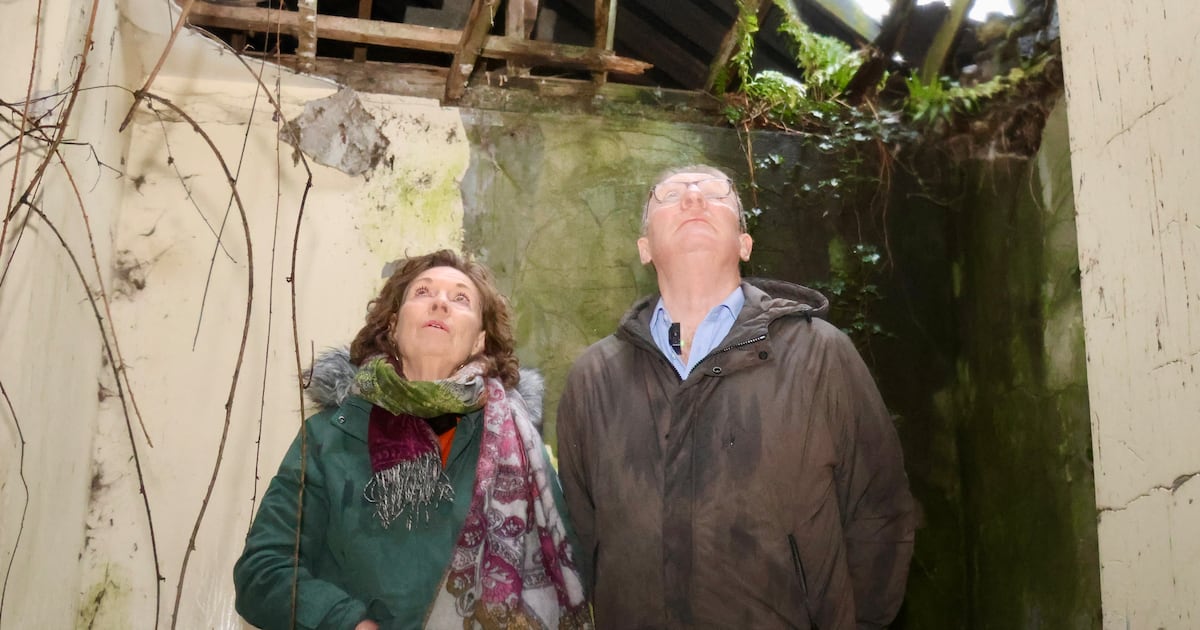
Standing amid the dereliction of the O’Dowd farmhouse, which has lain empty for 50 years, Mary Adams (née O’Dowd) recalled witnessing the murders of her brothers and uncle and the shooting of her father Barney.
“There was a knock at the door and my mother answered it. She screamed when she saw the gunmen and Declan ran out. I dived behind the settee on top of my sister. She was screaming, and I told her to shut up, you’ll get us all killed,” she said.
“My dad was wearing his Christmas present, this really smart leather jacket. After the gunmen left, it was like one of the cowboy films he watched. You know, when somebody’s injured with bullets, you give them a drop of whiskey. So we’re trying to put spoonfuls of whiskey into dad, such a stupid thing, but it was like a Wild West scenario.”
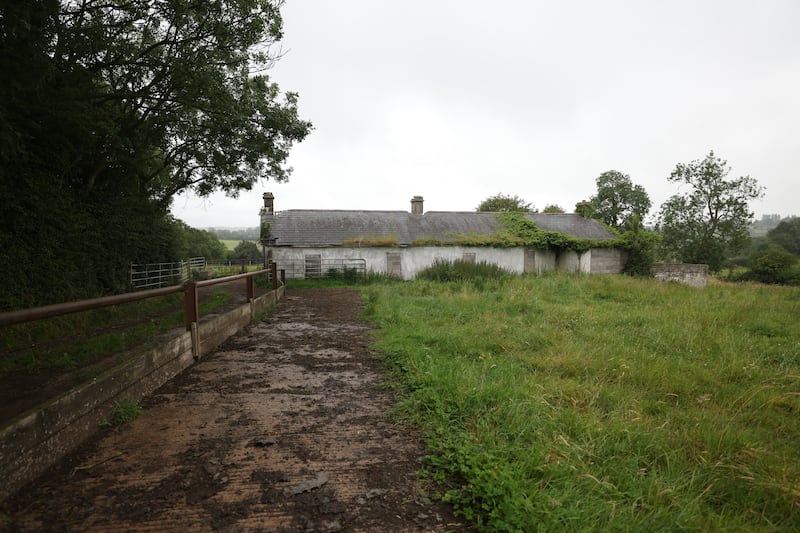 The rural farmhouse outside Gilford Co Down in which his brothers Declan (19) and Barry O’Dowd (24) and their uncle Joe (61) were murdered by UVF gunmen on January 4th 1976. Photograph: Bryan O’Brien
Seamus O’Dowd remembers the agony of having to tell his mother that her husband Joe had been murdered. His face told the story: “When she looked at me, I would have been the colour of them [grey] walls.”
His brother Gabriel said: “Seamus and I worked together on the farm for a year after it and never spoke about it; it was too traumatic. People have no idea. My sister and my mummy took cancer and died of it. Seamus took a heart attack at 39. I spent years on antidepressants. It was only at the 40-year anniversary that we started talking about it.”
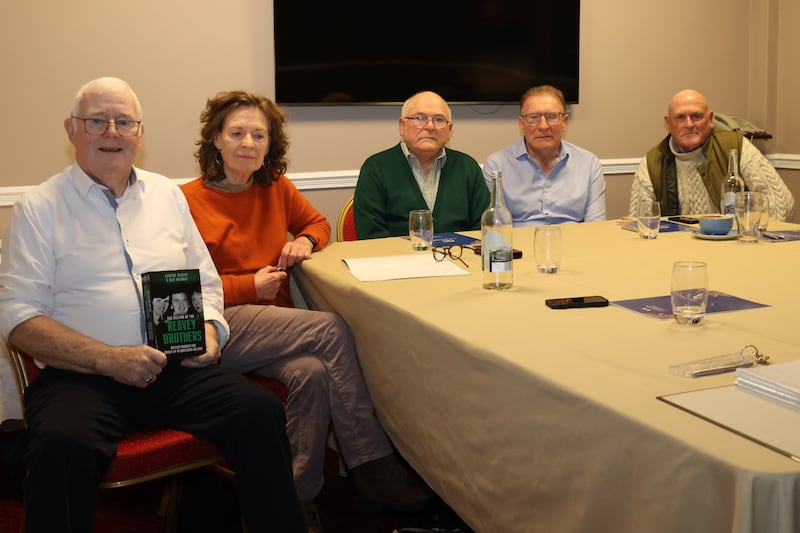 Eugene Reavey, Mary O’Dowd, Gabriel O’Dowd, Noel O’Dowd and Seamus O’Dowd
Seamus took over the family farm. “We lived beside the Presbyterian church and they emptied their hall of chairs for the wake. A lot of my father’s customers were Protestant. The fellas he drank with were Protestant men that he went to the markets with.”
Eugene Reavey takes up the theme that the community was not that divided. The day before his brothers were shot, “Brian and Anthony played football in Bessbrook with the two Chapman brothers who were [later] killed, Reggie and Walter. They then all went to the Lough Inn in Camlough to play pool and watch the football results. They were good friends”.
Local Protestant ministers called to the Reavey home to offer sympathy. “Rev Nixon said at the burial of the first victims that the people who shot the Reaveys may as well have shot the people at Kingsmill and they booed him; people got up and left. He and the wife had to leave.”
The murders were only the beginning of the Reaveys’ ordeal. Returning from the morgue, according to Eugene, their car was stopped by British soldiers, who emptied the bags containing the brothers’ blood-soaked clothes on the ground and danced on them. In 2007, the PSNI apologised for the “appalling harassment suffered by the family in the aftermath at the hands of the security forces”.
In 1999, the late Rev Ian Paisley named Eugene in the House of Commons as a Kingsmill plotter, falsely claiming to be quoting from an RUC file. Then chief constable Ronnie Flanagan said the dossier was not a police file and no evidence linked Reavey to the massacre. Paisley never apologised for his mistake. “It was a terror,” Eugene said. “It didn’t affect me as much as my wife and the children.” He believes Paisley’s source was the late Willie Frazer, himself a suspect in the Reavey murders.
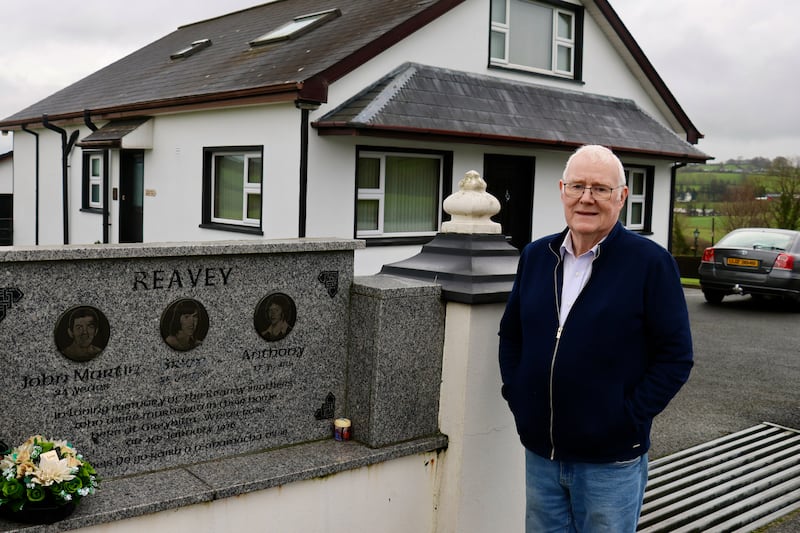 Eugene Reavey outside the family home in Whitecross, Co Armagh, which was targeted by loyalist gunmen
Colin Worton was 15 when his 24-year-old brother Kenny was murdered. He was reading a comic when a TV newsflash reported a gun attack. He asked his mother where Kingsmill was and was reassured it was miles away. “Then a few minutes a neighbour let herself in – we used to leave the key in the door – and gave out to us for having our dinner when our Kenny was lying dead in a ditch.”
Kenny had two girls, Racquel and Suzanne. “They even said to me, ‘Will you be our daddy now?’ Sure, I was only 15. It would break your heart. My education went downhill. I ended up doing the same job as Kenny. People would get us confused, they would even call me Kenny. It was hard to take.”
Kenny’s widow Zelda’s home overlooked the graveyard. Racquel used to lie on his grave. Suzanne cried herself to sleep at night.
“Zelda’s health deteriorated. Her hair fell out and she ends up getting cancer and then she died. But my mother always said she would rather have been the mother of an innocent victim than the mother of a child who took an innocent victim’s life.” (Barry and Declan O’Dowd’s mother expressed the same sentiment, according to their brother Noel O’Dowd.)
Colin attended primary and secondary school with Billy Wright, who became a notorious loyalist killer. “I read years later it was Kingsmill that made him join the UVF. I thank God every day he didn’t ask me to join him.”
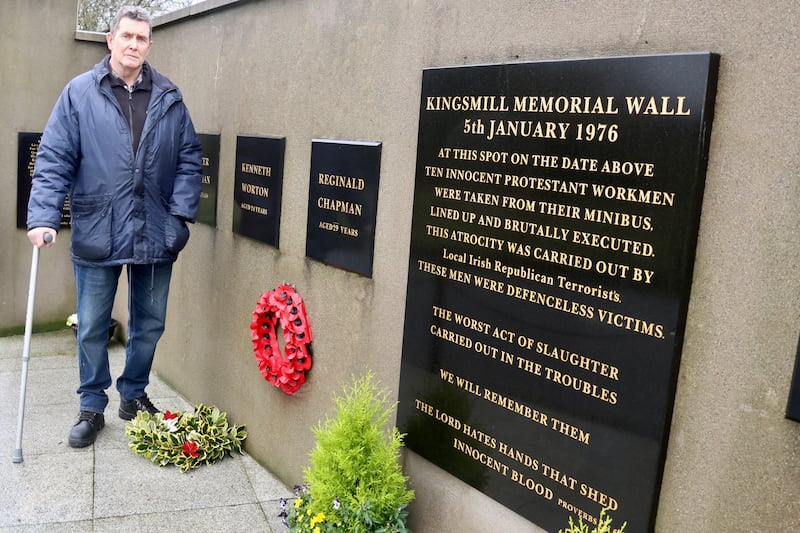 Colin Worton, brother of Kenneth Worton, who was murdered in the Kingsmill massacre of January 1976, at the memorial marking the spot of the atrocity
Was there a lot of fear and hatred afterwards? “Of course. I think that’s one of the reasons why it was done, the terrorists on both sides wanted a civil war.”
Did Kenny’s murder make him bitter? “Of course, I was. At 15, your mind’s not developed right. It took a lot of years for that anger to get out of me.” He regarded all Catholics with suspicion. “You had to. The only reason how those animals were able to kill my brother was intelligence, someone who worked with my brother must have set them up. Mr [Richard] Hughes, the Catholic who survived, identified Reggie Chapman as one of the two who tried to shield him. It gave me comfort to think my brother would have been the other to shield him, for he had friends on both sides of the community.”
He joined the British army’s Ulster Defence Regiment (UDR) “to try to catch people who were guilty of doing things”. However, when Adrian Carroll, a Catholic civilian, was murdered by a UDR colleague in Armagh in November 1983, Worton spent 30 months on remand for his alleged role in covering it up before a judge ruled that his confession has been coerced by RUC detectives. “I always believed anyone even questioned by police were guilty. Now it’s a different story.”
Raymond McCreesh, a 19-year-old IRA man, was captured 5km away from Kingsmill in June 1976 while preparing to ambush British soldiers with a rifle used in the Kingsmill massacre. He died on hunger strike in 1981, and in 2001 the local council named a children’s playground in Newry after him. Kenny Worton’s mother Bea appealed to the Equality Commission to investigate.
“As a result, she got abusive phone calls from people who said they were looking for 10 pieces of Kingsmill bread because they needed to toast it,” Colin Worton said. “There are a lot of good Catholic people they could have named the park after, like [footballer] Pat Jennings. It’s sickening that they had to name it after a terrorist. It doesn’t help my side of the community to say we’re living in a shared space. I’d say the same if a park was named after a loyalist.”
The Denton report on the Glenanne gang is due this spring, two years late. It was originally led by Jon Boutcher, but he stood down on being appointed PSNI chief constable. A summary report last month found that Glenanne was only part of a much wider network in Mid-Ulster of UVF and corrupt members of the RUC and UDR. However, it found no evidence of high-level state collusion.
Eugene Reavey and the O’Dowds are disillusioned. “I have lost faith in the process, the system, the spooks, MI5, and the British government,” Gabriel O’Dowd said, opening a thick lever-arch file full of official British documents. “It’s actually a talent to write thousands of words and tell you less than you already know.”
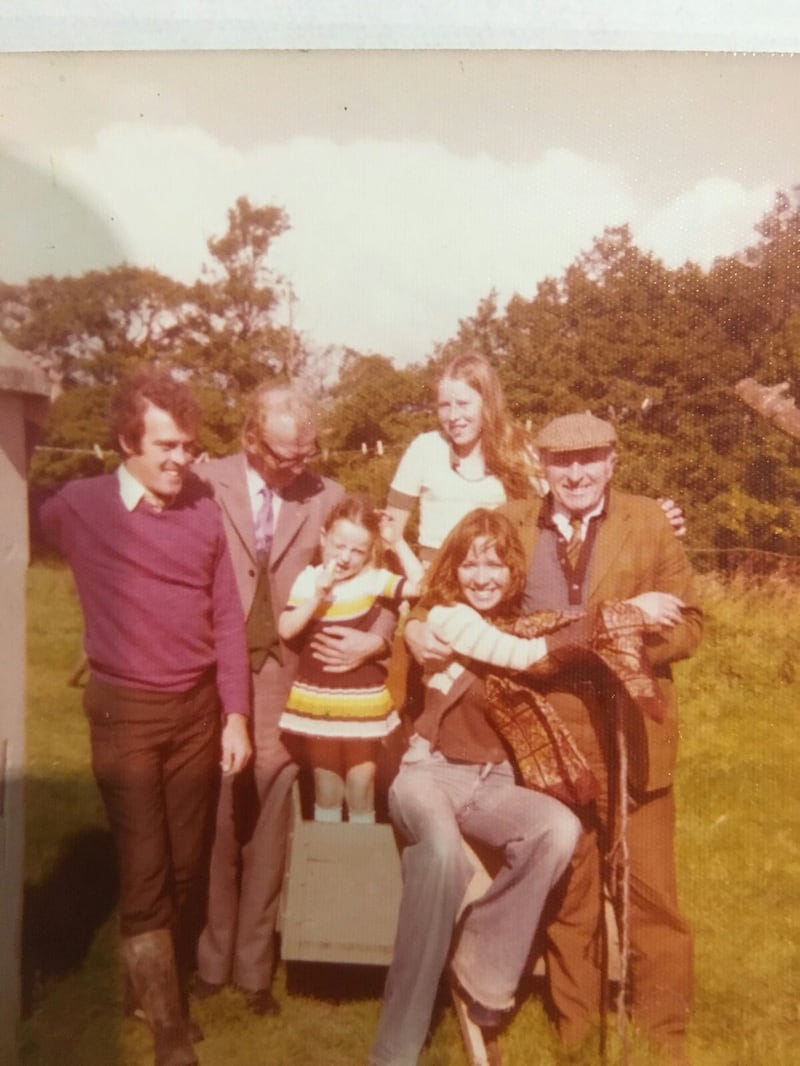 Seamus, Barney, Eleanor, Mary and Joe O’Dowd, with a family friend Maura Campbell, the summer before before the murders
Victims’ families say they are being denied the peace of mind to remember their loved ones as they are still having to drag the British state, slow-walking and stonewalling, through the courts.
“They would spend any God’s amount of money to keep you away from the truth, as long as you don’t mention the higher echelons,” Gabriel O’Dowd said.
“They’ve managed to do it for 50 years. All they need is another 10 years and we’ll all be gone. We are not going to burden the next generation with that. They deserve to move on.
“This was going to solve the whole legacy issue, but it’s gone. All this has done is re-traumatise people. There’s nights I do not sleep, running in my head the way we have been shafted. It’s just sheer disrespect that has been shown to the families that have lost their loved ones.
“Jon Boutcher is an honourable man who has been thrown under the bus.”
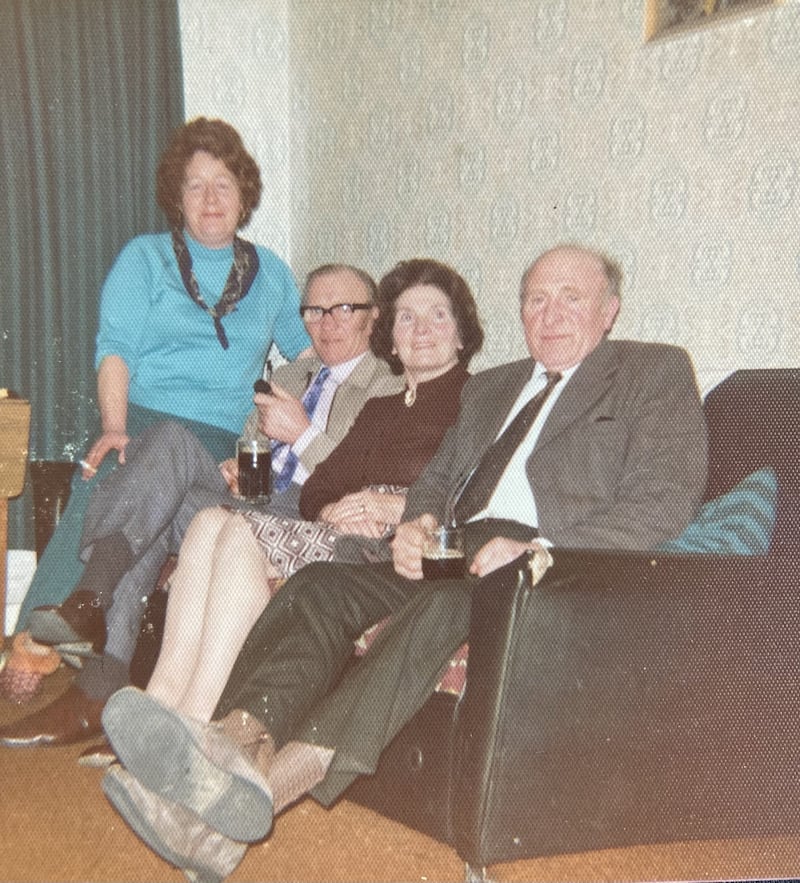 Kathleen, Barney, Winnie and Joe O’Dowd
Hilary Benn, the Secretary of State for Northern Ireland, won a UK Supreme Court case last month to prevent the coroner in a Troubles inquest disclosing intelligence information as it would “be contrary to the public interest in protecting national security”. The PSNI chief constable wanted the information released.
Last month, the British ministry of defence and PSNI agreed to pay £10,000 (€11,500) costs over delays in Eugene Reavey’s civil action and another Glenanne gang case before the High Court in Belfast.
“I always thought I would have this thing put to bed long before the anniversary and we could call it a day after that,” he said. “I’m wore out. I’m not fit to do it any more.”