On the rig, the camera only came out on the easy days.
Most shifts, I wasn’t “the photographer.” I was the drilling fluids specialist, the mud engineer who spent fifteen years making sure the well didn’t do anything it wasn’t supposed to (to the best of my ability). My world was numbers on a morning report, viscosity in a marsh funnel, mud weight on a balance, and a constant, low-level awareness that if the fluid system got away from us, everyone on location had a problem.
There were nights when the pumps never seemed to shut up, gas readings crept higher than I liked, and I lived between the pits and the lab, adjusting properties and double-checking data. On those tours, my cameras stayed tucked in a bag by my bed. Work came first and sometimes work swallowed everything.
But every so often, a well-behaved well did. The formation played nice, the mud program did exactly what the spreadsheet said it should, and the rig settled into a rhythm that didn’t feel like a fist around your chest. Those were the days when the other part of my brain, the part that has always reached for a camera—finally had room to breathe.
I took photography gear on every hitch anyway. If the location looked promising when we spotted the rig—big sky, interesting terrain, a farm tucked just beyond the lease road—I’d make sure a few rolls of film and at least one camera made it into my duffel. On night shifts, when the charts were steady and the derrickman didn’t need me, I’d come out with an RB67 Pro S that had no business being that close to drilling mud and try to make sense of sodium vapor lights and steam on 6×7 film. On calmer days, I’d sling a Rolleiflex SL35 or a Canon AE-1 Program over my shoulder and walk the perimeter, treating the blowout preventer stack and substructure like they belonged in a landscape series.
Some people spend their film on Paris streets or mountain sunrises. I spent mine on iron, mud, and the farms wrapped around the rig road. Film turned a jobsite most people only see in stock photos into a place I could study slowly—one frame at a time—without ever forgetting that my first responsibility was keeping the well under control.
Rig Life Through a Mud Engineer’s Eyes
If you’ve never worked on a rig, “drilling fluids specialist” sounds like someone who shows up, checks a few gauges, and leaves. In reality, the mud engineer is glued to the whole operation. Every formation change, every increase in rate of penetration, every hint of gas pushing back from the hole shows up in the pits and on the reports long before it becomes something you can photograph.
My day usually started well before sunrise, coffee in hand, staring at the mud pits and the morning numbers. Weight, viscosity, gel strengths, fluid loss—they all had to line up with what the well plan expected and what the driller was actually seeing at the bit. If the mud ran too thin, we risked losing control. If it ran heavy or too thick, we could damage the formation or slow the whole operation down. Most of my time was spent in that space between what the office wanted and what the rig could live with.
That job forces you into a strange split vision. One part of your brain is always doing quiet math: pump strokes, volume changes, density trends. The other is constantly scanning the environment—pit levels, shaker flow, how hard the pumps sound like they’re working. You end up noticing everything because anything might matter.
That’s exactly the eye I brought to photography on location.
When I walked around with a camera, I wasn’t just chasing “cool rig shots.” I was seeing the same things I watched as a mud engineer: the way fluid moved across the shakers, the way steam curled off a line on a chilly night, the way the derrick cut the sky into geometric shapes. The blowout preventer stack wasn’t an anonymous piece of hardware to me—it was the last wall between a difficult day and a disaster. Photographing it from low angles, letting it loom in the frame, felt honest.
Because I lived in that in-between space—between the office and the floor, between the pits and the doghouse—I had time to see the rig as more than just a workplace. On easy days, when the system behaved and the calls from town slowed down, I could let my eyes wander past the gauges and up to the sky, or out across the fields hugging the lease road. Film was just the medium I trusted to bring those observations home with the same weight they had out there.
Planning Around Easy Days and the Land Around the Rig
I never treated the rig like a photoshoot. If anything, photography was the reward I dangled in front of myself when the job eased up. That meant I learned to read the rhythm of a well the same way I read the light.
When we’d move into a new state or county, I’d pay attention long before I loaded the first roll. Some locations were all dust and scrub brush, nothing but brown and beige under a washed-out sky that begged for black and white. Others were set down in the middle of rolling farmland, pivoting sprinklers throwing arcs of water into the evening light, cows drifting along fence lines. In some regions, the way the sky opened up at dusk made me think in color before I ever saw the first negative. In others, the harsh contrast of steel and mud against a flat, gray horizon practically begged for a punchy, forgiving black-and-white film.
On my days off between tours, I’d mentally scout the next hitch before I even packed my bag. If I knew we were headed to a part of the country with big sunsets and red dirt, a couple rolls of color went into the kit along with my usual monochrome. If it was a place I remembered as flat and bleak, I leaned heavier into black and white. Either way, the cameras came with me every time. The drilling schedule changed, but the habit of taking film to work didn’t.
Once we rigged up and settled into a pattern, I started scouting in a more deliberate way. During daylight, when things were quiet and I wasn’t needed, I’d walk the perimeter of the location and look at it like a photographer instead of an employee. I’d note where the flare stack sat in relation to the rig. I’d watch how the shadows from the derrick ladder fell across the substructure in the late afternoon. I’d pay attention to the fields that wrapped around the site—corn one hitch, winter wheat the next, sometimes just a lonely farmhouse sitting back from the road, watching us chew into the earth.
Those walks were like sketching. I wasn’t firing the shutter yet; I was building a mental map of the frames I wanted to make when the day finally cooperated. On the easy days, when the crew had breathing room and the supervisors weren’t circling like hawks, I knew exactly where I wanted to stand.
That’s when the big RB67 came out at night. I’d line it up on a tripod and try to make something beautiful out of sodium vapor lights, steam, and steel. During the day, the Rolleiflex SL35 or AE-1 Program felt more practical, lighter in the hand as I moved around the location. I’d photograph the blowout preventer stack from low angles, so it looked as monumental and intimidating on film as it felt standing beside it in real life. I’d back up and let the whole rig sit against a sky that changed every hour. And when I stepped off location onto the lease road, I’d turn my attention to the farms and fields that made the rig feel small for a change.
It wasn’t just about getting “cool oilfield shots.” Planning around easy days and scouting the land turned the rig into an anchor point inside a larger landscape story. The wellhead, the BOP stack, the substructure, they were all just pieces of a bigger frame that included the fields we were cutting through and the people who lived just beyond the fence line. Film slowed everything down enough that I could see all of that at once.
Choosing Cameras and Film for a Hostile Environment
The drilling rig was never a friendly place for cameras. Everything out there was designed to be washed down, beaten up, or bolted in place. My gear was none of those things. If I was going to bring film into that environment, it had to earn its right to be there.
At night, the RB67 Pro S became my main rig camera, partly because it made absolutely no sense. It’s huge, heavy, mechanical, and about as subtle as parking a refrigerator on the catwalk. But the first time I saw a 6×7 frame of the rig under lights, all that weight felt justified. The big ground glass let me really see what the sodium vapor lamps were doing to the steam and the steel. Composing on that screen, with the derrick lines cutting through the frame and the flare stack glowing in the distance, felt closer to setting up a painting than taking a snapshot. Ten shots on a roll meant I couldn’t just spray and hope; every exposure had to be earned.
On some of those easier days, when the mud numbers were boring and the sky was doing something interesting, that same RB67 left the pad with me. I’d load Velvia 50, throw the camera over my shoulder, and start walking the dirt roads that spidered out from the location. Velvia on 6×7 is a different kind of commitment. At ISO 50, you’re not grabbing casual frames—you’re on a tripod, watching the light crawl across the fields, waiting for the moment when the rig, the road, and the land all line up. The color it gave me out there never felt subtle. Red dirt, rusted steel, green crops, and a blue sky all hit the slide like someone had turned the saturation knob past polite and into “this is what it felt like to stand there.” Those frames are some of my favorites because they sit right on the line between industrial documentary and landscape photography.
Daylight on the pad itself was busier, so I leaned on smaller 35 mm cameras: a Rolleiflex SL35 and a Canon AE-1 Program. Both were simple enough that I could run them on muscle memory after a long shift. I knew where the shutter speed dial lived without looking. I could ride the aperture ring by feel as I moved from the deep shadow under the substructure out into the open lease road. The viewfinders were bright, the shutters sounded like they meant it, and if a camera did take a hit from a stray clump of mud or a careless elbow, I wasn’t sacrificing my entire kit.
Film choice eventually settled into its own quiet routine. The Rolleiflex SL35 almost always wore E100. That stock became my way of dealing with clear air and big sky, the kind of locations where sunset hit the side of the rig like a hammer. E100 rendered those evenings with a crisp, almost surgical clarity, the cold blue in the shadows, the warm smear of sodium vapor light, the thin line of color on the horizon where the day was bleeding out. It didn’t flatter everything, but when the light lined up, it made the whole scene feel like it had been etched onto the transparency instead of just exposed.
The Canon AE-1 Program was more flexible by design, and the film I loaded into it reflected that. On some hitches, it lived on Ektar 100. Ektar liked the rig more than I expected. It managed rust and red dirt and overcast skies with a kind of saturated stubbornness that matched the place. Steel looked heavy and deliberate, warning signs popped, and the farms wrapped around the location took on this rich, almost postcard quality when the sun dropped low and caught the tops of the crops.
Other times, the AE-1 was my HP5 camera. Four hundred speed black-and-white film made sense when the memory of a location felt flatter or more washed out—endless gray sky, dusty lease roads, not much color worth preserving. HP5 gave me just enough speed to keep the shutter reasonable in the pits or under the substructure, and enough latitude to survive the mistakes that come with shooting when your head is half in the mud report. The grain never bothered me. Oilfield life is not a fine-grained experience. It’s loud, rough, and full of hard edges. Letting that life show up as texture in the negative felt more honest than trying to sand it down.
Once those roles settled in—Velvia 50 in the RB67 for the dirt roads and fields, E100 in the SL35 for clean, precise color on the pad, and Ektar 100 or HP5 in the AE-1 depending on the mood of the place—I stopped overthinking my film choices. I packed what I trusted and let the location decide which camera I reached for. Over years of tours, that combination became less about chasing perfect color science and more about giving myself a few familiar voices I could speak this environment in.
Composing Steel, Mud, and Sky
If you’ve never stood on a drilling location, it probably looks simple in your head: one rig, one big vertical line, some equipment around the base. In reality, it’s visual chaos. Hoses snake across the ground, cables cross the frame at odd angles, generators sit exactly where you’d put your tripod, and there is always something in the background trying to ruin your composition.
Film forced me to clean that up in my head before I ever raised the camera.
I started by treating the rig like a giant, temporary building. Instead of thinking “derrick,” I thought “architecture.” Where are the strongest lines? What happens if I let the ladder rungs draw the eye upward? How does the crown block look if I stand far enough back to give it space against the sky instead of letting it tangle with the flare stack? By thinking in terms of shapes and weight, I could turn a cluttered location into something readable on a small rectangle of film.
Foregrounds were everywhere if you were willing to look down. Mud-streaked grating, coiled hose, a section of drill pipe waiting on the catwalk—any of it could be used to frame the rig or lead the eye toward the main subject. A slight change in stance, one step left or right, and a messy scene suddenly had a clear path through it. On 6×7, where every frame felt like a small commitment of time and money, I spent more time moving my feet than moving the camera.
Sky was the other half of the equation. Some days it was a blank white ceiling that did me no favors; other days it put on a show. Storms rolling in from the horizon, long streaks of cirrus cloud catching evening light, flat gray broken just enough to let a sliver of sun fall across the substructure. With film, especially slide film, you don’t get to save a boring sky in post. If the sky wasn’t working, I framed tighter and let steel and texture carry the image. When it was working, I backed up and let the rig be a character in a much larger landscape.
The hardest part was resisting the urge to put everything in the frame. The rig is loud, literally and visually. It wants to dominate every photograph. Film reminded me that not every image had to explain the entire operation. Sometimes it was enough to isolate a section of handrail, a row of boots by the doghouse door, or the curve of a hose lit by the setting sun and let the viewer fill in the rest.
Night Shift on the RB67
Night on the rig is a different world. The noise doesn’t change, but the way it feels does. Sodium vapor lights carve hard shadows across the floor. Steam from hot lines glows in the dark like something alive. The flare, if you had one, throws an orange pulse against everything metal. It’s beautiful in a way you don’t appreciate until the job loosens its grip just enough for you to stand still.
Those were the nights I reached for the RB67.
Working at ISO 50 or 100 on a medium format camera in that environment sounds ridiculous, but it forced me into a rhythm that felt almost meditative. I’d wait until my reports were caught up, check that nobody needed me on the floor, then grab a tripod and pick my way across the location. The goal wasn’t to document every angle; it was to find one or two scenes that felt true to what night shift actually felt like.
Metering was half science, half guesswork. I’d meter the lit areas, let the shadows fall where they wanted, and accept that the film would render the extremes in its own way. Long exposures turned moving steam into soft, ghostlike shapes. The rig floor, which felt chaotic in real time, became a still stage set under harsh overheads. The derrick stood out as a black ladder against whatever the sky was willing to give me.
The RB67 made all of that deliberate. From the moment I flipped up the hood and looked down into that glowing ground glass, the rest of the rig seemed to quiet down for a second. Framing became a slow conversation between verticals and diagonals, pools of light and darkness. I’d lock in a composition, breathe with the noise and vibration, and then press the cable release and let the shutter stay open long enough to soak up a version of rig life most people never see.
Those transparencies and negatives are some of the most honest images I’ve ever made from that part of my life, because they show the rig as it felt at two in the morning when the world shrank to a handful of tired people and a very expensive hole in the ground.
Farms, Fields, and the Quiet Beyond the Derrick
For all its noise and steel, the rig was never the whole story. Most of the locations I worked on were dropped into the middle of someone else’s life: a field that had been plowed and replanted for generations, a pasture that belonged to a family whose last name you’d see on mailboxes for miles, a stretch of land that would go back to being “just a farm” long after we’d packed up and moved on.
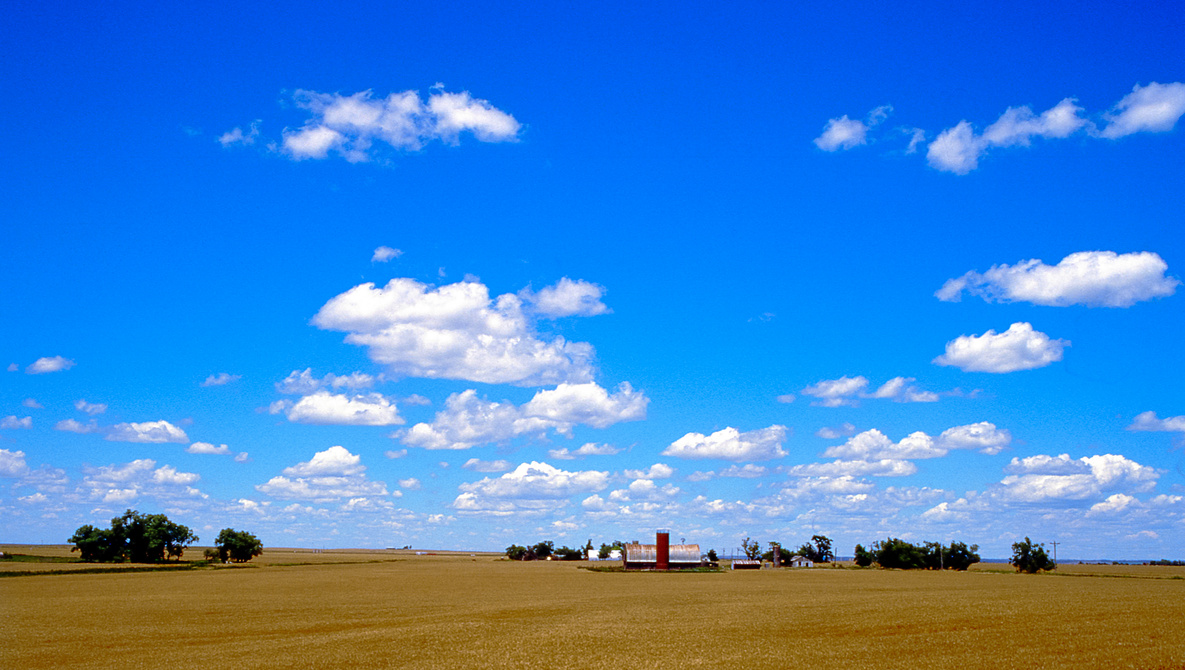
On easy days, when I’d finished my checks and knew I could step away without causing trouble, I’d load Velvia 50 into the RB67 and walk down the lease road until the rig got small behind me. The further I walked, the more the sound of engines and pumps faded into background noise. Ahead of me was the kind of scene landscape photographers drive hours to find: dirt roads disappearing into the distance, fence lines that cut the frame into clean thirds, fields catching late light as it brushed the tops of crops.
Velvia did something special with those evenings. The slides came back with colors that felt slightly more intense than reality, but in a way that matched how the days felt once they were over. Red dirt, green fields, a blue sky starting to fall toward purple, and off in the distance, the rig lit up like a strange metallic tree. In some frames the rig isn’t much more than a suggestion on the horizon, just a vertical stitch of light and steel in a landscape that would otherwise read as pure rural peace.
Those photographs matter to me because they show both halves of the story in one frame. In the foreground, there’s a road any local could recognize. In the background, there’s the reason I was there in the first place. Film let the two coexist without one swallowing the other. It’s all there on a piece of 6×7 chrome you can hold up to the light: the work and the land trying to share the same space for a little while.
Keeping the Gear Alive (and Out of the Way)
Bringing film cameras to the rig was romantic on paper and practical in exactly zero ways. Everything about the environment wanted to ruin them. Fine dust found its way into every crack. Mud splashed wherever it wanted. Weather swung from brutal heat to freezing wind in the same week. None of that fused gracefully with mechanical cameras and delicate emulsions.
The only way it worked was by respecting the fact that I was a mud engineer first and a photographer second.
The cameras lived in a dedicated bag in my bunk or in a clean corner of the lab, never on the rig floor. I only took them out when I knew I wasn’t on the clock for something more important. If the driller needed numbers or the company man had questions, the camera went away. If weather came in fast or the operation changed, the camera went away. There’s no photograph worth being the hand everyone is waiting for.
When I carried a camera, I kept it simple. One body, one lens, maybe a spare roll in a pocket. No swinging bags around moving equipment, no lens changes in the wind, no balancing gear on railings “just for a second.” I treated the rig like it was always one careless move away from eating my camera, because it was.
This caution extended to the people around me. I never stuck a camera in a roughneck’s face while he was working. If I wanted a frame that included people, I waited for true downtime and read the room. Some guys didn’t care, some actively hated being photographed, and a few were proud to be in frame with the rig behind them. You learn quickly who is who.
The reward for all that discipline was simple: the gear survived, and nobody ever had to worry about me being in the way while I made my pictures. On a rig, respect is its own kind of access. If you don’t disrupt the job, you earn the space to quietly document the world you’re all trying to hold together.
Seeing the Work Differently Once the Negatives Came Back
At the time, the photographs felt like a side project. They were something to think about when the reports were done and the well was behaving. The weight of the job always sat heavier than the act of pressing the shutter. It wasn’t until I started seeing the negatives and transparencies on a light table, far away from the noise, that I realized how much those frames were doing for me.
Film has a way of flattening time. A shift that felt like twelve hours of monotony and twenty minutes of panic becomes a single, quiet moment on a contact sheet. A location you swear you never want to see again turns into a landscape with better light than you gave it credit for. The rig that felt like a prison some nights starts to look like a temporary sculpture built out of steel and vapor and human stubbornness.
Looking at those RB67 Velvia frames from the dirt roads, I can smell the dust again and feel the weight of the heat, but I also see something I missed while I was living it: the way the rig sat small against the sky, not the other way around. The work felt enormous at the time. On film, it’s just one more structure on a long horizon of places people have worked and moved on from.
The HP5 negatives from gray, uninspiring locations surprised me in a unique way. They stripped the color out and left me with shape and texture: boots, ladders, handrails, pits, the geometry of a world I used to move through half-asleep. In black and white, the oilfield looked less like a job and more like a stage set for some strange industrial play.
Those images didn’t make the work easier while I was doing it, but they gave me a way to carry it forward once I wasn’t. They turned a long, complicated chapter of my life into something I could hold up to the light and look at, instead of just trying to forget.
Your ‘Real Job’ Might Be Your Best Film Project
Most film photography stories we hear are built around romantic locations: big cities, national parks, perfect street corners in neighborhoods with good coffee and better light. There’s nothing wrong with that. But if you’re reading this from a break room, a night shift, or a jobsite somewhere far from the usual photo destinations, I want to make a case for the place you’re already standing in.
The rig was never an easy subject, and it certainly wasn’t a safe one to treat casually. I had to respect the work first, the people second, and the pictures a distant third. But within that order, there was still room for film. There was room to load a roll on an easy day, walk the perimeter, step out to the edge of the property, and see the place—not as a grind or a paycheck, but as a landscape full of stories, lines, and light.
Film didn’t change my job. It changed my relationship to the world where I did it.
If you’ve got a “real job” in a place most people never see, that might be your best film project waiting quietly in the background. You don’t need to force it or turn every shift into a shoot. Start the way I did: one camera in the bag, a couple rolls of a stock you trust, and a promise to yourself that on the easy days, when the pressure lets up for just a moment, you’ll look around and make a frame or two.
Years from now, when the work has changed and the location is just another line on your résumé, those negatives might be the most honest record you have of who you were and what the world looked like while you were out there trying to keep it all together.
All the photos belong to the author, Steven Van Worth.