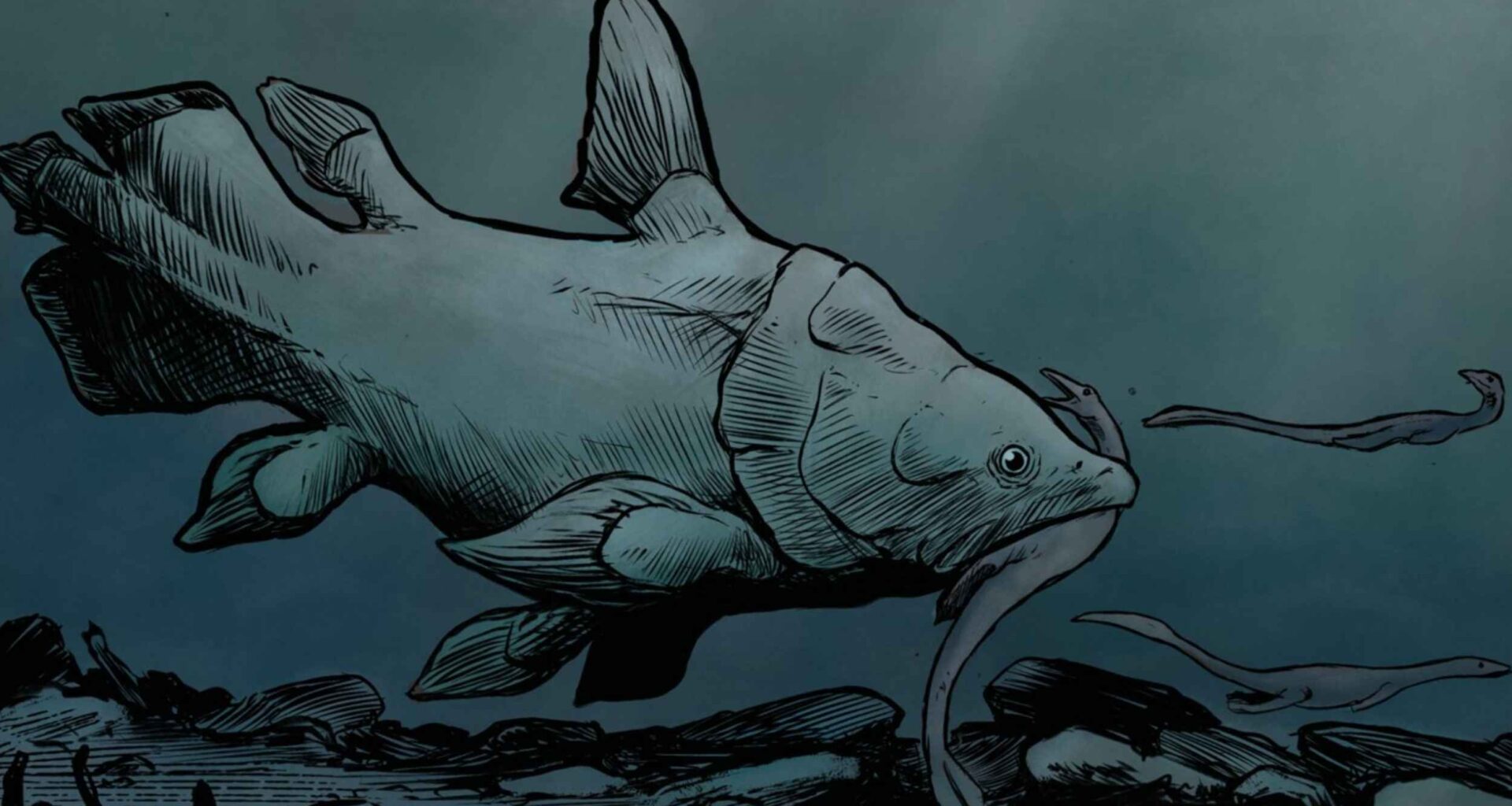
In museum collections across southwest England, scientists have uncovered coelacanths, ancient lobe-finned fishes that swam with early dinosaurs about 200 million years ago.
For decades, many of these bones sat in drawers labeled as small marine reptiles, even though they actually belonged to large predatory fish.

A new study of old specimens now shows that British Triassic rocks hosted a surprisingly rich community of these ancient fish.
Misidentified fossils reexamined
By reexamining bones long attributed to the marine reptile Pachystropheus, researchers boosted Britain’s Triassic coelacanth record from four examples to more than 50 fossils from the Bristol area.
The work was led by Jacob Quinn, a paleontologist at the University of Bristol who studies how fossil fish communities change over time.
The team realized that many fossils once assigned to the small marine reptile Pachystropheus actually came from coelacanth fishes.
The team noted that Pachystropheus and coelacanth fossils have striking similarities, and further checks of collections around the country revealed that the same misidentification had occurred many times.
Coelacanths have a long fossil history that stretches back more than 400 million years and includes about 175 species in seas and lakes.
The Devonian, a period starting more than 400 million years ago, marks the first clear appearance of coelacanths in the fossil record, though many lineages later vanished in multiple extinction events.
Today, the only living genus of coelacanth, Latimeria, includes two species known from deep waters off eastern Africa and Indonesia.
The group was rediscovered in 1938 when South African fishing nets hauled in a fish that a museum curator recognized as a living coelacanth.
Missing chapter in Triassic history
Until this reassessment, late Triassic coelacanth remains from Britain were known from a handful of isolated bones, leaving their local story frustratingly incomplete.
The Triassic, a period more than 200 million years ago, saw Earth recovering from an extinction and setting the stage for dinosaurs and mammals.
The coelocanth fossils described here come from the Rhaetian, the final Triassic slice, when shallow seas flooded low-lying coastal plains around southwest Britain.
At the time, the Bristol region formed a patchwork of islands in a shallow sea, providing habitats where coelacanths, reptiles, and fishes could thrive.
What the late Triassic seas looked like
The remains come from bone beds in shales that record a shallow continental shelf where storms stirred the seafloor and concentrated skeletons into layers.
The same layers that preserved the coelacanth bones also contain sharks, bony fishes, marine reptiles, and the occasional remains of dinosaurs and other land animals that were carried in from shore.
Fossil spores and plankton in the mud hint at a nearshore setting with pulses of freshwater flowing in, though the environment was still broadly marine.
Those conditions suit coelacanth families that preferred brackish shallows or deeper offshore water, which helps explain why several lineages appear together in these beds.
Seeing inside stones
To separate fish bones from reptile bones, the team used micro CT, very high-resolution X-ray scanning, to reveal canals and joint surfaces without damaging the fossils.
Inside key skull bones, they traced nerve canals and cartilage-covered surfaces that match those of known coelacanths from other regions.
The scans let the team build digital models so they could compare the Bristol bones with complete skeletons described from other continents.
Features such as braincase joints, the pattern of sensory canals, and the form of jaw bones are diagnostic for coelacanth groups.
Most of the Bristol bones match the family Mawsoniidae, a group of coelacanths that usually lived in shallow, brackish waters instead of the deep sea.
A smaller set of bones seems closer to the family Latimeriidae, the line that ultimately includes the living, deep-water coelacanth Latimeria.
Judging from jaw and shoulder bones, the animals ranged from juveniles to adults of about 3.3 feet I1 meter) long.
Shapes of skull roof, jaw, and shoulder bones suggest more than one species shared these habitats, though the team cannot yet name them.
Reconstructing coelacanth family tree
Taken together, the mix of sizes and bone types hints at a coelacanth community with juveniles, subadults, and adults using this coastal zone.
This pattern may mean the area functioned as a feeding ground or nursery, where coelacanths returned repeatedly across generations.
Many coelacanth bones were found alongside fossils of the long-bodied marine reptile Pachystropheus. This suggests that these animals frequently used the same seafloor neighborhoods.
Based on comparisons with living coelacanths, the Bristol fish were opportunistic predators that cruised near the seafloor and snapped animals, possibly including Pachystropheus.
What this reveals about coelacanth evolution
The Bristol mawsoniid fossils strengthen the view that this family flourished before Jurassic times in waters near Europe, rather than only off southern continents.
The Bristol material reflects a pattern in which coelacanths changed rapidly early on, then kept similar body designs for many millions of years.
Against that backdrop, Latimeria – as the last coelacanth genus – looks like one surviving branch of a lineage that has weathered many environmental changes.
Studies of their skeletons show that, even while their outline stayed familiar, details of skull shape, fin structure, and sensory systems kept evolving.
Why museum collections still matter
Many of the Bristol coelacanth bones were collected in the 1800s, when they were logged as reptile or mammal fragments and stored away.
“It is remarkable that some of these specimens had been sitting in museum storage facilities, and even on public display,” said Quinn.
The work hints that many museum drawers of misassigned bones around the world may still hide pieces of deep history.
As imaging techniques improve, specimens collected generations ago can yield fresh anatomical data and ecological clues without leaving their storage trays.
Coelacanth mysteries remain
For now, the Bristol coelacanths remain known only from isolated bones. This means that scientists cannot say how many species existed or what full skeletons looked like.
New finds from Triassic rocks could reveal complete coelacanth skeletons and show whether the Bristol bones represent known groups or separate branches.
The study also raises questions about how these fishes used coastal habitats just before the end Triassic mass extinction.
For the fish that outlived the dinosaurs, these English fossils add a chapter that stretches from ancient island seas to modern deep ocean coasts.
The study is published in the Journal of Vertebrate Paleontology.
—–
Like what you read? Subscribe to our newsletter for engaging articles, exclusive content, and the latest updates.
Check us out on EarthSnap, a free app brought to you by Eric Ralls and Earth.com.
—–