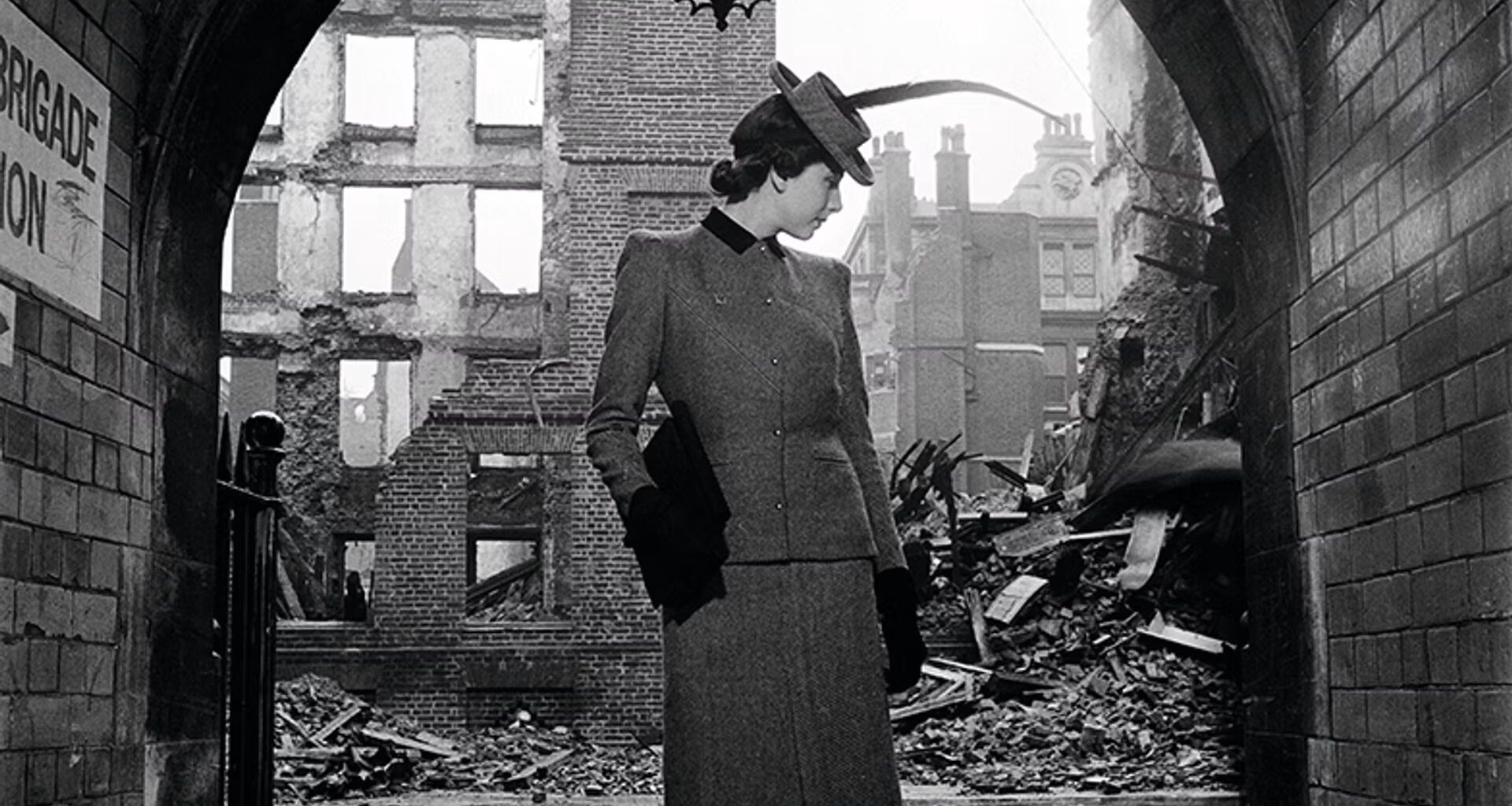
The brilliant photographer Lee Miller (1907-77) is the subject of a major Tate Britain exhibition which continues until February 15. The well-illustrated catalogue (Lee Miller, edited by Hilary Floe and Saskia Flower, Yale UP, 247pp, £40/$60) has perceptive chapters on all aspects of her life.
She had been a model and had a wide range of subjects: high-fashion women, erotic and enigmatic Surrealist scenes, the Egyptian desert and portraits of famous artist friends. In prewar England she was a Vogue photographer. She then left that world of wealth and fashion to work for that glamorous women’s magazine as a war correspondent, and reported the London Blitz, the European battles and the concentration camps.
Driven by fearless curiosity, Miller created photos of power, originality and beauty. She overcame military restrictions on women and fought her way to the front. During the siege of Saint-Malo in wartime Brittany, the heroic Miller recalled that “she had sheltered in a kraut dugout, squatting under the ramparts. My heel ground into a dead detached hand and I cursed the Germans for the sordid ugly destruction they had conjured up in this once beautiful town.” A contributor notes that “she used tight crops, reflections, unusual juxtapositions and disorienting angles to reveal a world at once strange and beautiful.”
Since there are no extended analyses in this book, more could be said about her photographs. Miller was five feet, seven inches, tall and weighed 126 pounds. In Nude self-portrait she has bright blonde hair, a perfect profile, arms raised behind her head to elevate her breasts (one higher than the other), silky smooth skin and torso cut off by a wavy cloth beneath her navel. She appears as a modern Venus de Milo, a perfect human being personally made by the hand of God.
Fascinated by the human body, Miller witnessed several medical operations. In her Severed breast from radical surgery she serves up a real severed breast, after a complete mastectomy, as a Surrealistic cannibal feast. This disgusting dish is placed on a simple, ironed, white cloth, with a steel fork and spoon ready to devour it. The specimen looks like soft bits of black brain disguised as bubbly caviar that oozes from under a crablike carapace. It’s hard to imagine this horror attached to a human body.
A contributor describes Man and tar as “a sinuous web of soft, semi-coagulated tar oozing across the pavement, sticky and glistening.” The melted tar looks like a creature with pointed arms (one holding a victim), thin bones, winglike body, diaphanous membrane and slimy surface. It looks like a repulsive oleaginous bat about to encircle and attack the man standing next to it.
In Rat tails four white-furred rodents, which seem to have crawled out of a Paris sewer, face away from the viewer. Strangely lined up and parallel like tight-packed soldiers ready to march into battle, they perch incongruously on a wooden bar suspended in the air. One ear, eye and paw of the rats appear in front of the shadowy background, along with their long, bare, extruding, spear-like tails that point menacingly downward into nothing.
Miller wrote that in Egypt the strange and attractive young girls were “impossible to photograph unless one had a telephoto lens as even at the sight of us they would run, spitting and cursing, and making signs against the evil eye.” She then found a beautiful young man. Her Bedouin stands in a rocky barren desert, in profile and looking to the right. His white headscarf, blown parallel to the ground, contrasts with his dark face, legs and bare feet on the hard surface. He wears a loose cotton robe with a black belt and leather straps across his chest. He recalls the young Sheikh Ahmed, of whom T. E. Lawrence wrote: “I loved you, so I drew these tides of men into my hands, that your eyes might be shining for me when I came.”
The artists in Miller’s portraits collaborated with her to create her incisive images. The German-born Surrealist artist Max Ernst sits in the craterous moonscape of the Arizona desert, which resembles the background of his weird paintings. The extremely handsome, hawk-faced man, hands clasped at his knees, is bare-chested, white-haired and well-tanned. He gazes upward, seems reflective and fits perfectly into this inhuman setting.
The French novelist Colette, aged 71, is seated before two shelves with leatherbound books and a symbolic framed butterfly. She wears a silk scarf and heavy robe, and has frizzy hair, arched eyebrows, heavy lids, pointed nose and wavy upper lip. Her open manuscript lies on the desk and, ignoring the camera, she gazes intently down at a crystal ball as if trying to decipher her murky future.
The pencil-thin Jean Cocteau stands in profile before a tall blackboard with many random words in French and his profile drawing of Lee Miller herself. Tightly framed by a bust resting on a pillar and by a pile of manuscripts, his jacket hanging on his left shoulder, he smokes a cigarette and places his veined right hand on his narrow hip. In Cocteau’s film The Blood of a Poet (1930), Miller “played a statue that comes to life, driving the male artist character to madness and destruction.”
Picasso’s attractive lover Dora Maar sits in profile facing left. Her jagged, fractured portrait by Picasso and his gentler, idealized drawing appear above the marble fireplace and the iron radiator in her Paris apartment. Her dark hair is tied in a bun, a bright light is reflected on her face, bare arm and crossed legs, and she cradles a comforting cat in her lap. The fiery and tempestuous Maar often clashed with Picasso, but Miller depicts her as unusually calm and composed.
In Pablo Picasso (Cannes, 1956, aged 75) the artist is framed by a decorated ceramic lamp, a tall bright window above his head and a blurred painting, perhaps of a woman in a Spanish costume. He sits in a chair, close up and facing the viewer, in an open shirt and dark sweater. His left elbow rests on the arm of the chair, his raised fingers hold a smoking cigarette and his thumb touches his cheek. The bald, white-haired young-old man has grooved cheeks and a cunning smile, and the famous mirada fuerte gives him a vigorous appearance. Miller had been Picasso’s lover, and her “intimate and penetrating” portrait is both artistic and sexual.
Miller’s war photographs are sometimes horrific but always compelling. In Bad burns case the victim, heavily wrapped on his head and face, has dark slashes for the apertures of his eyes, nose and mouth, and huge boxing-glove bandages on his hands. Lying on a bed, facing left toward the camera and seen from above, his bare right arm contrasts with the rest of his covered body. This severely damaged survivor must have experienced the most excruciating pain when burned by gasoline after an explosion. His image recalls at once a morbid clown, a silent mummy and a monster in a horror film.
The Nazis did not have time before retreating from the Russians to incinerate the recent corpses, and Miller portrays only one of them here. She took US soldiers examine a rail truck load of dead prisoners by climbing into the railroad car and stepping among the corpses. Emaciated and dressed in rags, the bald head of the prisoner lies on his back and drops halfway out of the car. His mouth is agape and a few jagged teeth protrude above his sparse beard. He’s watched by two American Red Cross soldiers in helmets and battle dress. Standing just outside the truck with crossed arms, bent heads and grim expressions, they seem to be thinking, “this could have happened to me.”
Another photo of a corpse shows what had happened to the captors. In Dead SS prison guard floating in canal (Dachau,1945) the brutal guard had either committed suicide or been murdered by the surviving prisoners. Seen from above, he lies in profile, dressed in a wrinkled black leather jacket that seems to have been dipped in oil and contrasts with the smooth flowing water that supports him. A few projecting green leaves on the canal bank give a slight surge of life. The floating guard suggests a grotesque version of John Everett Millais’ celebrated painting Ophelia, the mad woman drowned in Hamlet.
Miller summed up her traumatic war experience in one of her best and most compassionate reports, which echoed the famous last paragraph of James Joyce’s “The Dead,” “snow falling . . . upon all the living and the dead.” She wrote, “The snow which shrouds innocent lumps and softens savage craters covers alike the bodies of the enemy and of our platoon. The new craters are violent with black circles of clods around, the smell is choking. In the ditch, a waxen-faced dead German was frozen in a heroic pose.” She returned to Paris with “cracks in every finger from holding the camera in bitter frost.”
Jeffrey Meyers has published Painting and the Novel, Impressionist Quartet, biographies of Wyndham Lewis and Modigliani, and a book on the Canadian realist painter Alex Colville.
A Message from TheArticle
We are the only publication that’s committed to covering every angle. We have an important contribution to make, one that’s needed now more than ever, and we need your help to continue publishing throughout these hard economic times. So please, make a donation.