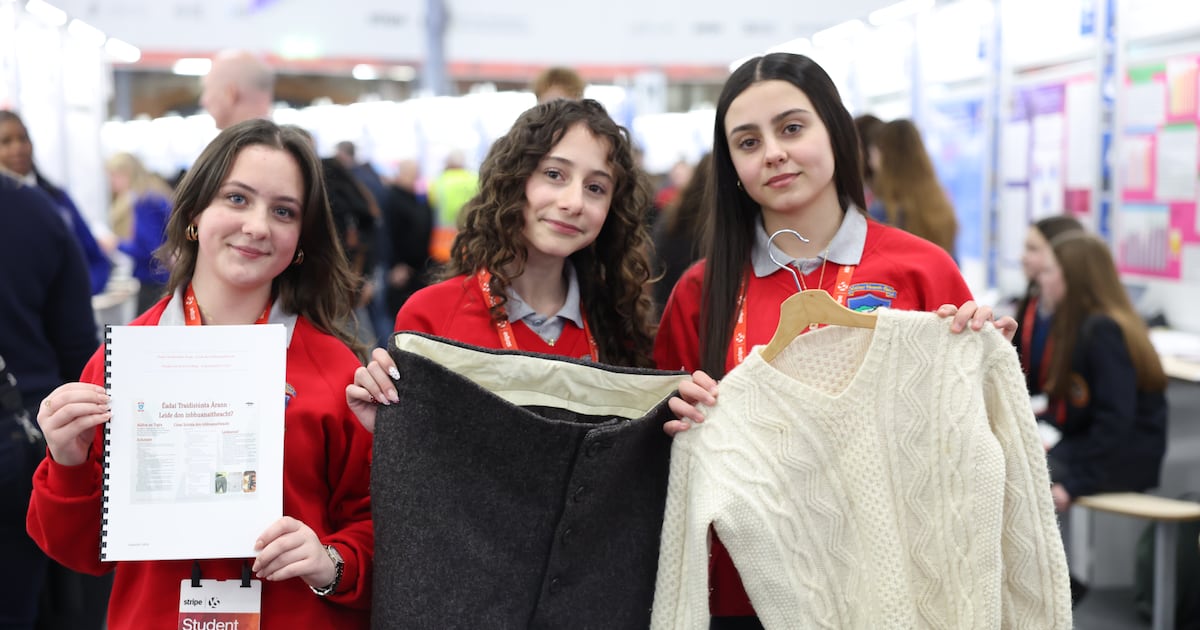
The Aran jumper Ailbhe de Blácam’s uncle wore on his First Communion day bears none of the scars you might expect from a garment worn by a boisterous seven-year-old exposed to the rigours of island life.
And that is exactly the point Ailbhe and her classmates from Coláiste Naomh Eoin on Inis Meáin hoped to demonstrate.
“It’s almost perfect,” she said, presenting the handknit that has held its shape, colour, softness and strength through 35 years of hand-me-down tradition.
“Compare that with the bally sweater you bought six months ago from Temu, Shein or Penneys. That’ll barely last a year – and in 35 years it could still be in a landfill, not decomposing because it’s made of plastic fibres.”
Ailhbe, Laylabelle Ní Chléirigh and Michelle Ní Fhátharta investigated the sustainability of clothing made from natural fibres compared with fast fashion versions for their project for the Young Scientist and Technology Exhibition.
In a series of tests, the Aran jumper and a pair of 50-year-old woollen trousers scored far higher points than their synthetic alternatives.
All three girls have or have had family connections to the local knitting company on the island, but are the first to admit that flannel trousers and cable-knit sweaters are not their number one fashion choice.
“But this project has really changed our perspective,” said Laylabelle.
“Even financially, you’re better off buying a few good items of wool or natural fibres and getting creative about how you wear them rather than buying cheap items every few months and throwing them away.”
[ AI gets put to real-life test at Young Scientist ExhibitionOpens in new window ]
The girls’ project is one of 20 presented in Irish at this year’s exhibition, where 550 finalist entries are competing for prizes.
Topical issues feature in many projects which explore subjects such as the competitive advantage of wearing skorts versus shorts, the psychological effect of water quality issues on people in north Cork, the potential for AI-powered early flood-warning systems and the success or otherwise of school phone pouch initiatives.
No topic is beyond scrutiny – at least two projects examine the competition itself, exploring how participation has changed over the last 15 years and seeing whether AI can predict the winning entries.
Some students found inspiration for their project in everyday places such as the bin.
“Our school has a compost bin, and you see the apple cores and banana skins decomposing but the little sticky labels on them are still there. They don’t break down,” said Emma Harmon.
Emma and classmates, Keelynn Keogh and Aimee O’Reilly, from Scoil Chonglais in Baltinglass, Co Wicklow, created biodegradable stickers with plastic sheets made from cornflour, glycerol, vinegar and water, attached with a glue made from porridge and decorated with biodegradable ink.
[ From traffic congestion to musical trends: inside the Young Scientist ExhibitionOpens in new window ]
They also replaced the nylon string bags that hold onions and oranges with alternatives made from nettle fibres.
“The EU is banning single-use plastics in packaging on fruit and vegetables in 2030 so there’s only four years to find alternatives. Well, we have them here,” said Aimee.
Other students looked further afield for ideas.
Jarlath Wruck, of Meán Scoil Nua an Leith-Triuigh in Co Kerry, made his own radio telescope last year. This year he is using AI to profile dark matter halos from galaxy rotation curves or, as he summed it up: “mapping the invisible”.
It is a tricky concept for the non-scientific to grasp, but he explained it would help identify the forces that shape galaxies.
“There’s a psychological element to it,” he said. “Humankind always wants to know how the Earth was formed and how the universe works. Hopefully I can help accelerate understanding and feed that hunger for knowledge.”