Hello from Las Vegas. After a three-month sabbatical, it feels refreshing to be back at work — and I’m excited to resume hosting the weekly #techAsia newsletter. I’m currently in Sin City covering CES, the world’s largest technology show, where Asian companies have a strong presence, led by those from South Korea and followed closely by their Chinese counterparts.
The US feels markedly different since Trump returned to power. On past trips, immigrant Uber drivers would tell me how they love the country’s freedoms; this year, an Iranian American driver who has lived in the US for 25 years — and has been a citizen for 17 — told me he now carries his passport everywhere in case he is targeted for detention or deportation because of his appearance.
CES is once again full of “world’s first” claims, from pocket-sized AI companions to AI cooking machines and robot mops. My impression from a quick walk around the show floor, though, is that many of these ideas have been around for years and have just been rebranded with fresh buzzwords. AI companions, for example, particularly from Chinese companies eyeing Japan, are everywhere this year, but there’s little sign of meaningful progress in either design or functionality.
However, compared to previous years, AI is indeed moving more visibly into everyday life. LG, for example, said it plans to launch an AI television that is just 9 millimetres thick around March. The new model will come with an AI button on the remote control, a feature missing from earlier versions, and can, for example, tell you each team’s odds of winning a soccer match as you watch it live.
The South Korean home appliance giant also showed off a concept humanoid robot for household chores equipped with Nvidia chips, promising everything from doing the laundry to handing you a bottle of water if it senses, from changes in your voice, that you’re thirsty. Please bear in mind, however, that CES has a long history of showcasing bold ideas that never make it beyond the show floor, so a healthy dose of scepticism is still warranted.
Overall, there is a strong focus on physical AI — bringing artificial intelligence into the physical world through robotics and self-driving cars — with high-profile keynote speeches from Nvidia’s Jensen Huang and AMD’s Lisa Su both talking about it. Su was joined on stage by a slew of tech bigwigs, including OpenAI co-founder Greg Brockman and “AI godmother” Fei-Fei Li, while the line for general admission for Huang’s speech, like last year, stretched for hundreds of meters — it made me feel like I was going to a Blackpink concert.
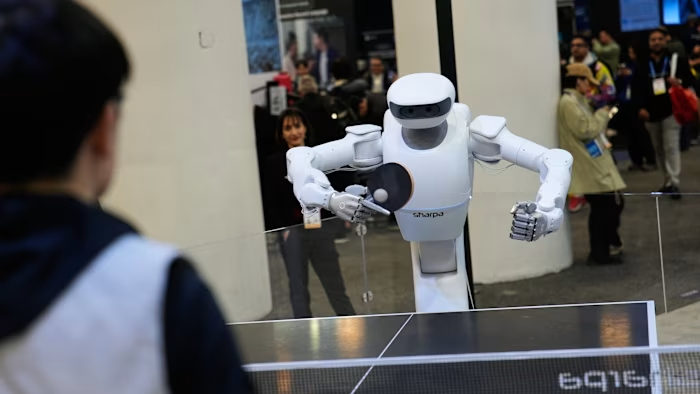
Humanoid robots definitely attracted the most attention. While Boston Dynamics’ humanoid robot delivered a jaw-dropping performance, Chinese players also tried to steal the spotlight at CES. From Unitree and AgiBot to lesser-known start-ups, their live demos — from fighting to dancing — drew crowds, even if many of the moves were remotely controlled amid the show-floor noise. A humanoid robot from Singapore’s Sharpa even took a picture of me with an instant camera, printed it out and handed it to me.
But one topic that tech leaders at CES were eager to play down was talk of an AI bubble, even as concerns grow about the pace and scale of investment into the technology. The message from the stage was clear: AI is here to stay, and demand for computing power is only set to rise.
Sticking with it
Jensen Huang is not giving up on China. The Nvidia CEO says the AI chip titan is seeing “strong” demand for its Hopper 200 chip from Chinese companies, write Yifan Yu and Cissy Zhou. The only problem? The company needs the approval of two governments, American and Chinese, before such sales can start.
Washington is working on the licensing framework to allow Nvidia to ship to Chinese clients, according to Nvidia, but Beijing has yet to give a clear signal on when — and how much — it might allow the H200 to be sold in the country.
But Huang is even confident that Nvidia’s latest AI chip, the Rubin, will be available in China “in time.”
“H200 is competitive in the market. It won’t be competitive forever,” Huang said when Nikkei Asia asked about Nvidia’s prospects in China during a Q&A session at the CES 2026 trade show in Las Vegas.
Given the emergence of Chinese chip challengers like Moore Threads, MetaX and Biren, he may be right to worry.
Hands off Manus?
Chinese officials are reviewing Meta’s $2bn purchase of artificial intelligence platform Manus for possible technology export control violations, write the Financial Times’ Ryan McMorrow and Zijing Wu.
The deal announced last week is a rare case of a US group acquiring a cutting-edge AI start-up with Chinese roots at a time when Washington and Beijing are battling over a range of advanced technologies.
Two people familiar with the matter said officials in the commerce ministry had begun assessing whether the relocation of Manus’s staff and technology to Singapore and the subsequent sale to Meta required an export licence under Chinese law.
While the review is in its early stages and might not lead to a formal investigation, the need for a licence could provide Beijing with an avenue to influence the transaction, including trying to force the parties to abandon the deal in an extreme case, the people said.
Manus declined to comment. China’s commerce ministry and Meta did not respond to requests for comment.
Financial wizardry
The race to build larger, more advanced data centres to power the growth of artificial intelligence is intensifying in Asia — and so is the complexity in financing them, writes Nikkei Asia’s Lorretta Chen.
Over the past decade, nearly $70bn in private equity investments have been made in data centre operators and their projects in the Asia-Pacific region, data from MSCI shows. Some $40bn of that total was made in the past two years alone.
Hundreds of billions of dollars more will be required to build facilities now being planned in Asia, and borrowing to finance new projects is becoming more aggressive. Borrowers are moving from traditional funding approaches involving equity from company founders and local investors and plain-vanilla bank loans to riskier debt from institutional investors, some with equity kickers. But as concerns about overcapacity start to emerge, will the financing boom turn to bust?
Putting the brakes on
Fallout from the political row over chipmaker Nexperia continues to rattle the auto industry.
Japan’s Honda Motor says it will suspend operations at three Chinese factories for longer than originally planned due to a shortage of automotive semiconductors, writes Nikkei’s Shoya Okinaga.
They had initially been slated to restart Monday after being shut down for the five days through this past Friday, but they are now expected to resume operations on January 19.
Honda uses off-the-shelf semiconductors from Nexperia, but shipments of such products have been disrupted amid a dispute between the Netherlands and China over control of the chipmaker.
Suggested reads
-
From SoftBank’s strategy to the AI boom: Tech trends to watch in 2026 (Nikkei Asia)
-
SoftBank strikes $4bn AI data centre deal with DigitalBridge (FT)
-
China’s domestic procurement drive squeezes foreign companies (Nikkei Asia)
-
Dating apps turn to Asia as swipe-right fatigue takes hold in the west (FT)
-
Iran offers to sell advanced weapons systems for crypto (FT)
-
Lenovo partners with Nvidia on AI ‘gigafactory’ program (Nikkei Asia)
-
India launches nationwide AI-skilling program for one million youths (Nikkei Asia)
-
Apple battery supplier takes on Chinese rivals in smart glasses push (FT)
-
Japan’s TDK sharpens AI focus with smart glasses, data centre parts (Nikkei Asia)
#techAsia is co-ordinated by Nikkei Asia’s Katherine Creel in Tokyo, with assistance from the FT tech desk in London.
Sign up here at Nikkei Asia to receive #techAsia each week. The editorial team can be reached at techasia@nex.nikkei.co.jp