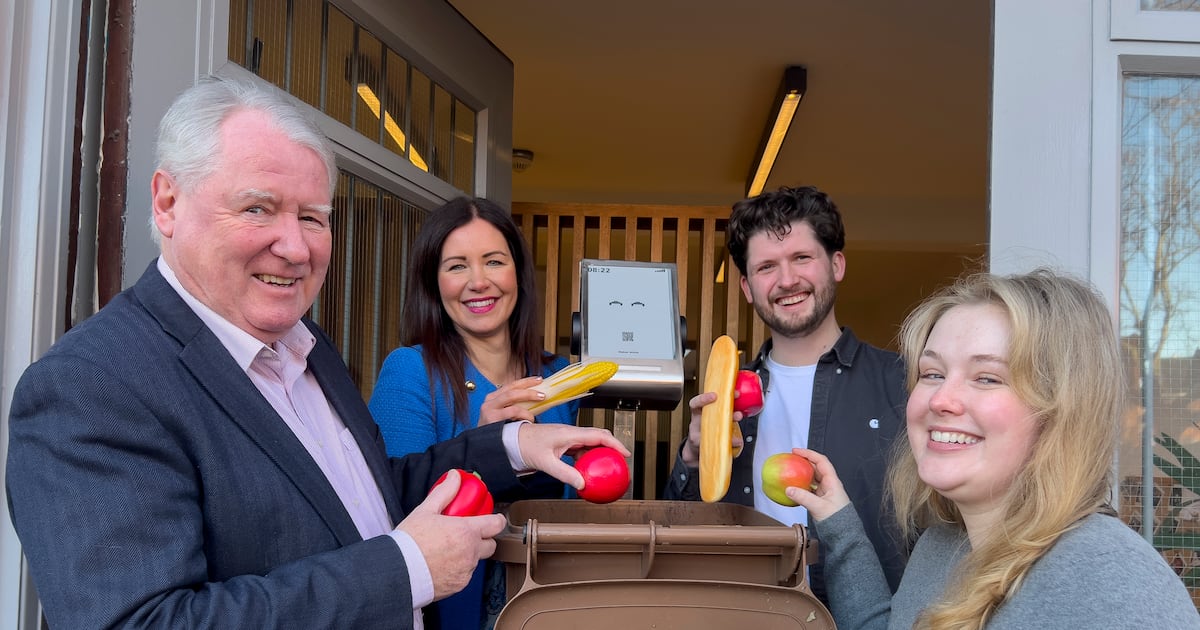
A Dublin business looking to eliminate food waste in the commercial food sector has raised funds to allow it to expand internationally.
Positive Carbon has developed a fully automated, AI-powered “Scrappy” sensor which monitors and analyses food waste in commercial kitchens and food centres, helping to reduce waste dramatically, without impinging on staff resources.
Founded in 2020 by Mark Kirwan and Aisling Kirwan, it is already used at sites in Ireland and Britain including Croke Park, the Aviva Stadium, the Convention Centre Dublin, the Guinness Storehouse, retailer KC Peaches and in a number of hospitals, hotels and offices.
Now the company is looking at expanding internationally, and has raised a sum understood to be in the region of €1 million from John Conroy’s Redesdale Food and Beverage Fund and Enterprise Ireland.
“Securing investment from Redesdale and Enterprise Ireland is a massive vote of confidence in our technology and our team,” chief executive Mr Kirwan said. “This funding allows us to not only refine our data capabilities but also to aggressively expand our footprint internationally.”
John Stapleton, a partner in Redesdale, said Positive Carbon was “a real and practical example of a company helping businesses to both reduce costs and achieve sustainability objectives”.
The Redesdale investment comes on top of €2.3 million raised two years ago through the Employment and Investment Incentive Scheme (EIIS), led by Dublin-based Business Venture Partners, and close to €600,000 raised in 2022 form investors including German venture capital group APX and Austrian venture capital player Gateway Ventures.
“We are committed to giving commercial kitchens the tools they need to turn food waste data into actionable, cost-saving decisions,” Mr Kirwan said.
[ New Positive Carbon food waste system targets hospital billsOpens in new window ]
Positive Carbon currently offers three products, one that simply tracks waste volumes, another that uses AI to identify the food items going into waste and a customisable option for larger multi-site operators.
According to its website, customers pay €299 a month for the basic monitoring product, or €599 for the AI-driven food identification version.
The company says its technology delivers a return on investment of between two and five times cost, saving individual businesses up to €75,000 annually by pinpointing waste and providing real-time insights that drive sustainability.
Mr Kirwan has noted previously that a third of all food produced globally is wasted, contributing significantly to greenhouse gases. That includes around one million tonnes in Ireland each year, of which roughly a quarter is accounted for by the food service sector, costing industry hundreds of millions or euro annually.
“We are delighted to be partnering with an Irish company in the food space which has a clear and ambitious plan for international expansion,” said Michael Cantwell, another Redesdale partner.
The Redesdale Food & Beverage Fund, founded by Mr Conroy and backed by Enterprise Ireland, Musgrave, Coca-Cola, Monaghan Mushrooms and Tate & Lyle, focuses on early-stage companies in the food, drinks, nutrition and food technology space.
Positive Carbon is the sixth investment the €27 million fund has made.
Last November, it invested in Talio Technologies, a business that uses artificial intelligence to help food businesses identify emerging consumer trends by gathering and analysing data on menus, retail trends and social habits to help food companies make faster and better-informed decisions on new products and marketing.
Other investments to date include: Dundalk-based Soothing Solutions, which makes dissolvable jelly lollipops made from honey and other natural ingredients to provide relief for children with sore throats; Thanks Plants, which produces a range of plant-based products such as frankfurters, sausages and roasts for health-conscious consumers; Fiid, a maker of plant-based microwaveable meals for the convenience meal market; and Kwayga, a company that has developed technology to help supermarket buyers cut their sourcing times dramatically.