
It’s no mean feat to give a politician an inferiority complex but that’s just one of the things the entrants in the Young Scientist and Technology Exhibition (YSTE) are good at.
“I’m just blown away by their ideas and their innovation,” said Minister for Foreign Affairs Helen McEntee.
She’d just been on a tour of projects from schools in her Co Meath constituency on topics such as visual-spatial reasoning, the implications of atmospheric drag for space missions and advanced methods of identifying autism.
Minister for Arts Patrick O’Donovan was on a similarly vertiginous learning curve. “I’m coming here for over 20 years and they keep getting better and more impressive,” he said of the entries.
“And in our age group, you continue to feel more and more inadequate.”
Jim O’Callaghan, Dara Calleary and Kieran O’Donnell were also among the visiting Government Ministers to be humbled by the young participants, many of whom are some years off voting age yet.
The students, meanwhile, took the attention all in their stride. Not even a head-to-head with a local boy turned billionaire could intimidate them.
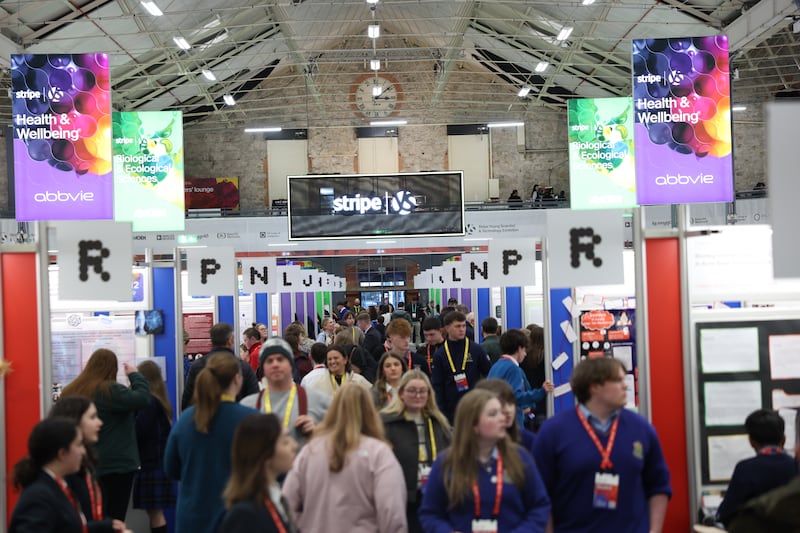 Participants and visitors explore the exhibition at the RDS. Photograph: Enda O’Dowd
In a question-and-answer session between Patrick Collison and the teenage audience, the one-time YSTE winner and global payments company founder was quizzed in depth about his motivations, methods and message to upcoming innovators.
He had some insights to share, including that first impressions are not always right.
“I thought biology was terrible,” he said of his schooldays bias. “I thought it was just about memorisation and these 19th-century unlabelled sketches of animals. I was completely wrong.”
His company, Stripe, which sponsors the YSTE, also funds Arc, a non-profit research support organisation that is backing scientists working to solve tricky problems, many of them in the health field.
Collison also said that going to college was not essential although he quickly clarified that he didn’t advocate everyone dropping out like he and his brother and Stripe co-founder, John, did.
Covering everything from traffic congestion to plants on the pill, the Young Scientist Exhibition offers a world of solutions to everyday issues.
The keys to developing a successful company, he said, were creating something useful and loving doing it.
Having employees, investors and obligations could all be demanding if the core activity wasn’t fun.
And it’s not all about the money, he said, referring to the Google founder who retired but returned to work because he was bored despite having the means to buy anything that was purchasable on Earth or beyond.
 Patrick Collison at the event. Photograph: Bryan Meade
Sharing experiences is part of the YSTE ethos and the reason why the contest has been replicated with Ireland’s help in Jordan and Kenya.
The Department of Foreign Affairs said it was also talking to other countries in Africa to see how they could be helped establish their own version.
The winners from the Jordan and Kenyan contests received a trip to Ireland to take part in the YSTE.
Kon Lual and Ian Mwadiloh from Eldoret in Kenya created Afronomy Chain, an online anti-corruption platform to track financial flows in public transactions.
Jenna Al-Rashdan from Jordan developed a mobile device, ThrumboGuard, that detects deep vein thrombosis (DVT) using sensors placed in a sleeve that wraps around a patient’s leg, which sends analysis to an app she also created.
“We call DVT the silent killer because the symptoms are mild or vague, so people don’t go to the hospital to get them checked out,” she said.
“My aunt developed severe complications because she delayed getting help and if people don’t have access to hospitals, they are even less likely to get medical treatment in time.
“My device could be in clinics, doctors’ surgeries, even in patients’ homes if they are at risk.”
Jenna, it should be noted, is just 16 years old.