 Tim Sadler

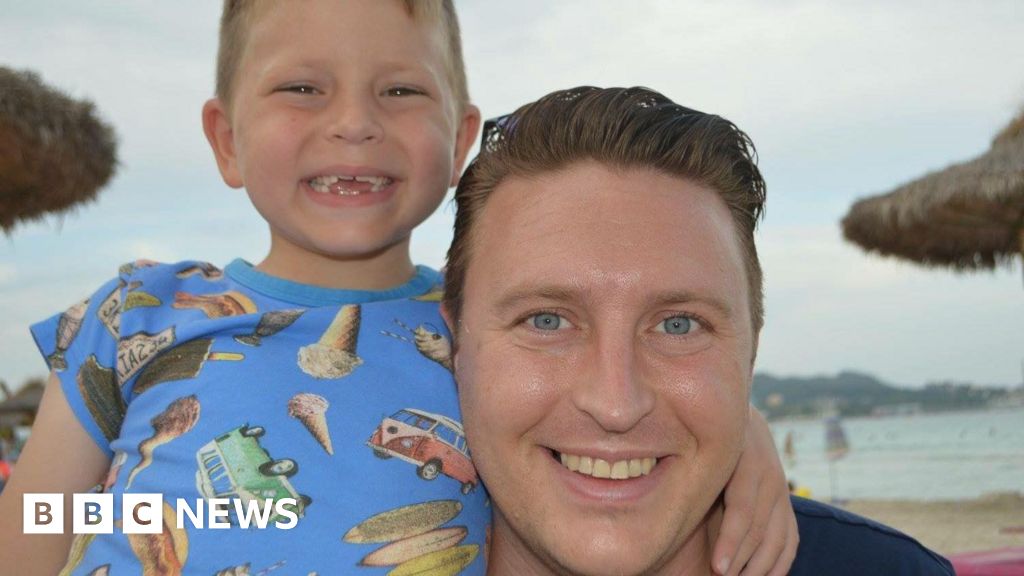
Tim Sadler said his entire world turned upside down when his son Michael was diagnosed with cancer
A man whose young son went through three years of cancer treatment, and whose sister died from the disease as a teenager, is helping to shape the government’s National Cancer Plan.
Tim Sadler, from Brockworth in Gloucestershire, is sharing his views with a cross-party group of MPs about what parents like him need from the upcoming plan.
The strategy was due to be published last year but is now expected to be launched this February.
“When a child’s diagnosed with cancer, your entire world’s turned upside down. It hits families so hard. I’m incredibly grateful for the listening exercise [but] the time for action is now,” said Sadler.
 Tim Sadler
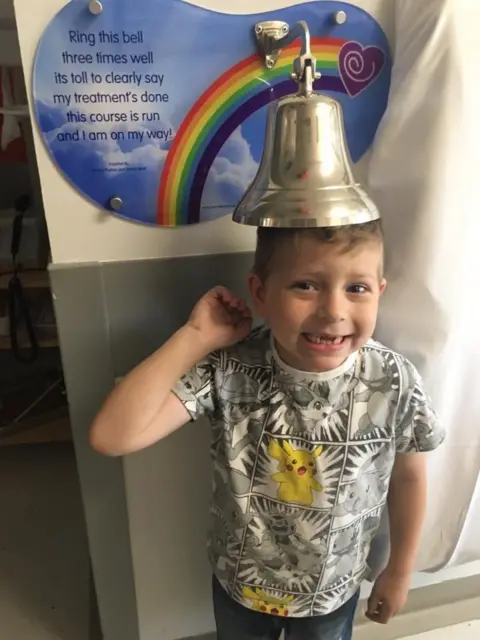
Michael was diagnosed with cancer in 2014 after experiencing pains in his legs
Sadler, 44, said his son Michael was diagnosed with Acute Lymphoblastic Leukaemia (ALL) in April 2014, aged two, after he “started experiencing pains in his legs”.
“A few days later it was too painful for him to walk,” he said.
“So we ended up going to A&E and by 11pm that evening we were told he had a diagnosis for ALL.”
He said the diagnosis had a huge impact on the whole family and they struggled to know who to turn to.
But the charity Young Lives vs Cancer, which he now volunteers for, stepped in and supported the family “hugely” through Michael’s illness.
“It was a week before Michael’s third birthday – we ended up moving to Bristol with a two-month-old baby,” he said.
“It’s really hard to access everything but they gave us somewhere to live, social workers, nurses – we couldn’t believe people did things for us.”
 Tim Sadler
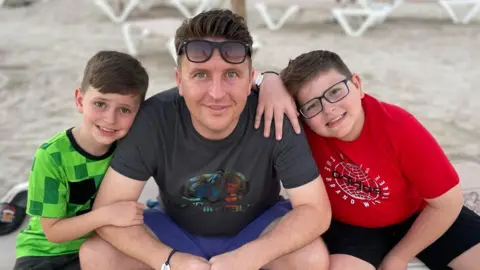
Sadler says he does not want young people “to be forgotten once the treatment period ends”
Despite the “brilliant” support from the charity, Sadler said there were still lots of gaps in the support, and he is “desperate to help other families”.
He wants to see more mental health support offered to children and their families, as well as the setting up of a young person’s travel fund.
“When we were in Bristol we were meeting families from Cornwall – that was their closest treatment centre,” he said.
But the dad-of-two said the “biggest thing” he wants is for children and young people with cancer to “to be able to thrive not just survive” after their treatment has finished.
“I don’t want young people to be forgotten once the treatment period ends,” he added.
“We’re so happy with Michael and so grateful to still have him – he’s doing really, really well but I want to not let their cancer diagnosis define them.”
The All-Party Parliamentary Group for Cancer in Children and Young People is due to meet later, ahead of the launch of the government’s National Cancer Plan in February.