
The European Union Copernicus Climate Change Service has confirmed that 2025 was the third warmest year on record and that global temperatures from the past three years have averaged more than 1.5C above the pre-industrial levels.
It also confirmed that the past 11 years have been the 11 warmest years on record.
This is the first time the level of global warming, over a three-year period, has exceeded 1.5C.
Florian Pappenberger, the Director General of the European Centre for Medium Range Weather Forecasts (ECMWF), which released the results, said this is not good news and is quite concerning.
He said climate change acts as a threat multiplier, because a warmer atmosphere holds more moisture.
This increases the probability of more precipitation and extreme weather events.
The average global surface air temperature last year was 1.47C above the pre-industrial level, according to the report.
This followed 1.6C in 2024, which was the warmest year on record.
The pre-industrial period refers to the years between 1850 and 1900, before humans had a significant impact on the planet’s climate.
Paris Climate Agreement
Ten years ago, almost all nations committed in the Paris Climate Agreement to limit global warming to well below 2C, and ideally below 1.5C.
This is why confirmation that the 1.5C target has been exceeded over the past three-year is important.
However, Director of the Copernicus Climate Change Service, Carlo Buontempo, pointed out that this does not mean that the Paris Climate Agreement has been breached.
He said that would require exceeding the 1.5C target over many more years, possibly as many as 20 years.
Nevertheless, he added, that based on the current rate of warming, the Paris Agreement’s limit of 1.5C for long-term global warming could be reached by the end of this decade.
This would be over a decade earlier than seemed likely at the time the agreement was signed.
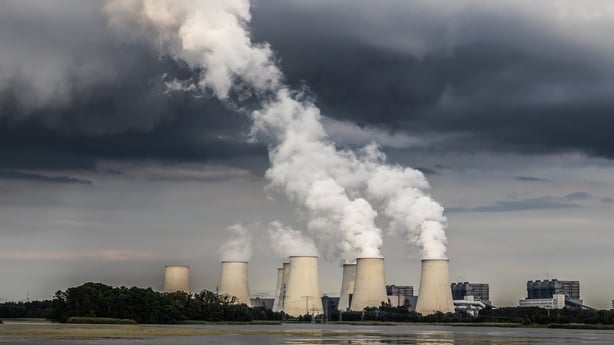
Countries committed to limiting global warming below 1.5C in the Paris Climate Agreement
“The choice we now have is how to best manage the inevitable overshoot and its consequences on societies and natural systems,” he said.
The report mentions two main reasons why the last three years have been exceptionally warm.
The first is the build-up of greenhouse gases in the atmosphere.
This was due to continued emissions, mainly from fossil fuels, and a reduced uptake of carbon dioxide by natural carbon sinks.
The second reason was that sea-surface temperatures reached exceptionally high levels across the oceans.
This was associated with a naturally occurring El Niño warming event and other ocean variability factors, amplified by climate change.
Additional factors include changes in the amounts of aerosols and low cloud, and variations in atmospheric circulation according to the report.
‘Devastating impacts for people’
Strategic Climate Lead at ECMWF Samantha Burgess said: “It is not so much the long-term trend in climate change that impacts people and nature.
“Rather it is the extreme events that cause those catastrophic, devastating impacts for people and our environment.”
Ms Burgess added: “We are likely to see increasing extreme events in the next few years, until we cap our emissions and work towards net zero.”
Europe saw many different heat waves, especially across the summer months of 2025.
It also experienced its highest annual total wildfire emissions.
A long heatwave in June, with temperatures not normally experienced until the end of July or early August, impacted a large area from the UK all the way across to Greece.
Significant temperature anomalies were also experienced in the Nordic countries.
The report also confirmed the average air temperature over global land areas throughout 2025 was second warmest on record.
The Antarctic saw its warmest annual temperature on record and the Arctic its second warmest.
Half of the global land area experienced more days than average with at least strong heat stress – defined as “feels-like” temperature of 32C or above.
Heat stress is recognised by the WHO as the leading cause of global weather-related deaths.