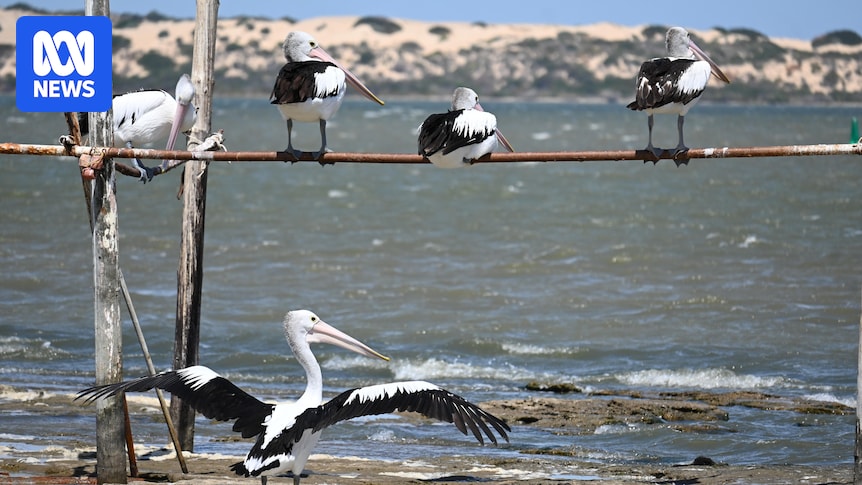
Environmental protections along a huge stretch of the River Murray will be boosted, following a decision to officially list the area as “critically endangered”, the federal government says.
The government said the move covered the lower river system, including the river and associated wetlands and flood plains downstream of the Darling — an area that includes all of the Murray in South Australia, the Coorong, Lake Alexandrina, Albert Wetland and water channels east of Goolwa.
Environment Minister Murray Watt said the listing would mean major new developments with the potential to affect the area’s ecosystem would need to be assessed and approved under environmental law.
“If people want to clear large amounts of native vegetation or make substantial changes to water flows through new mines or new dams and bridges, then they’ll need to take account of the impact that they would have on this ecosystem in a way that they haven’t had to do before,” Mr Watt said.
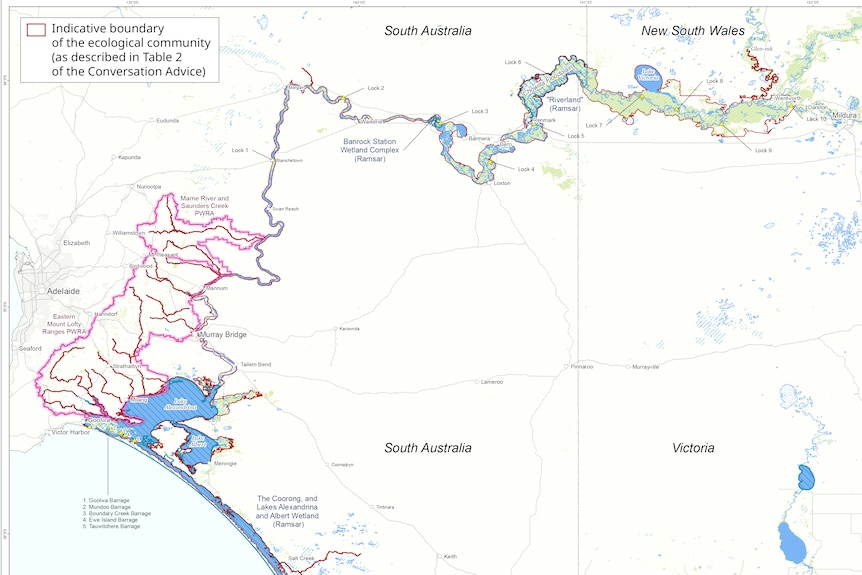
Bordered by red, the River Murray and associated wetlands and flood plains are listed as “critically endangered”. (Supplied: Australian Government)
But the government said it would not change “land tenure or prevent continuing uses of land and water”, and that areas currently used for “crops, plantations, exotic pastures and infrastructure, or are otherwise cleared of native vegetation” would not be impacted.
“There’s an exemption within the national environmental law for what’s known as continuous uses, so if farmers are simply are seeking to continue their existing activities, whether that be cropping, grazing, fencing, whatever they might be doing, that won’t be prevented as a result of this listing,” Mr Watt told ABC Radio Adelaide.
Mr Watt said the region was previously protected for several months in 2013 under the Rudd Labor government but the listing was repealed when the Coalition came into power.
The recommendation to re-list it was made by a group of scientists who advise the government, known as the Threatened Species Scientific Committee.
“What this scientific committee is telling us that it [River Murray] is at really serious risk of not being viable if we don’t continue to take action to protect it,” Mr Watt said.
“This listing we see as a positive step in the sense of recognition that despite all of the effort from governments and communities to restore the health of the Lower Murray, there’s a lot more to be done.”
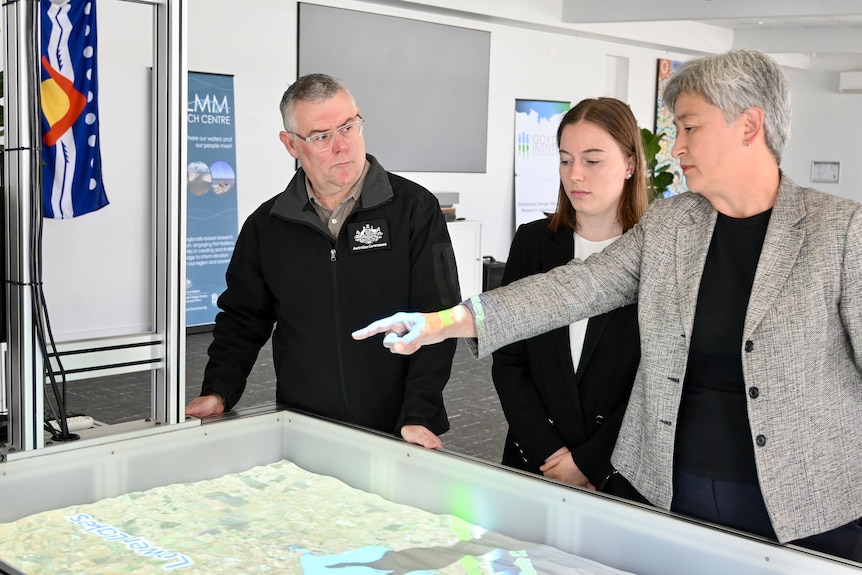
From left: Murray Watt, SA senators Charlotte Walker and Penny Wong at Goolwa to make the announcement on Thursday. (ABC News)
Mr Watt said the listing “could well” trigger more funding for the protection of the river.
He also said a $20 million grant program to support existing and new industries in River Murray communities would start today.
The government also accepted the committee’s recommendation to list the wetlands and inner flood plains of the Macquarie Marshes in north-western NSW, as endangered.
What does a ‘critically endangered’ listing mean for a river?
Mr Watt said the government has recovered 170 gigalitres of water out of the 450GL target under the Murray-Darling Basin Plan, with more water purchases to be undertaken by the end of the year.
“It’s important to remember that this was additional environmental water that was to be recovered in addition to water that was already committed to under previous plans,” he said.
Ecologist Faith Coleman was excited about the federally recognised listing, which could open up funding opportunities.
“It’s more about the federal government saying really clearly, ‘This is a priority for us,'” she said.
“In many ways it streamlines the process in that we already have species that are critically endangered, endangered or vulnerable, so listing the entire community gives us a cohesive way of approaching that.
“It gives us an opportunity to apply for grants that weren’t previously available, it gives us an opportunity to start shifting the system back towards what it used to look like.”