Published January 13, 2026 06:00AM
Ever wanted to share your love of triathlon in your workplace? A “lazy triathlon” may be the perfect way to inspire colleagues who may otherwise find the sport intimidating to get tri-curious and stay active.
To learn about the benefits of a workplace-based lazy triathlon, the keys to successfully organizing one, and how to make the challenge accessible and fun, we caught up with Brigham Young University (BYU) Lazy Triathlon race organizer and Student Wellness Program & Marketing Manager Haley Hickman and some longtime participants.
Building community beyond the water cooler
In 2011, Dr. Larry Hall, the founder of BYU’s Student Wellness department, debuted the “Lazyman Ironman” after an Idaho couple visited his office and asked if he’d ever heard of the event.
“They explained that participants have the flexibility to log their miles when and where it’s convenient for them. The staff and I thought it was a fantastic idea, so we gave participating students and staff the whole month of November to swim, bike, and run 140.6 miles. They were rewarded with a finisher’s shirt that people went crazy for!” says Dr. Hall. “The whole purpose was to encourage consistent exercise and community building.”
Completing a lazy tri can be an attainable goal for beginners who want a taste of triathlon, individuals who want extra motivation to workout, and even experienced athletes looking for a low-pressure challenge.
“We’ve had a 10-year-old who completed it with their parents and a retired professor who is in his 80s,” says Hickman, adding that the event was eventually renamed the “Lazy Triathlon” and has been held every fall, with 483 registered participants in 2025.
Professor Clark Callahan, who has participated for about a decade, enjoys sharing the journey with colleagues: “There’s a core group of us who do it every year, tracking each other’s progress. It’s genuinely a positive bonding experience.”
“The camaraderie of working out together – and joking about who’s logged the most miles – is really a highlight. We often walk from our building to the gym together so it’s a good time to decompress and chat about things outside work. We’ve also discovered the sauna and go there after working out to recover,” adds Professor Ed Carter, who also appreciates that the daily workouts improve his focus when he returns to the office. “Clear your head. Get away from the screens. You’re a more productive employee after.”
A blueprint for your own workplace triathlon challenge
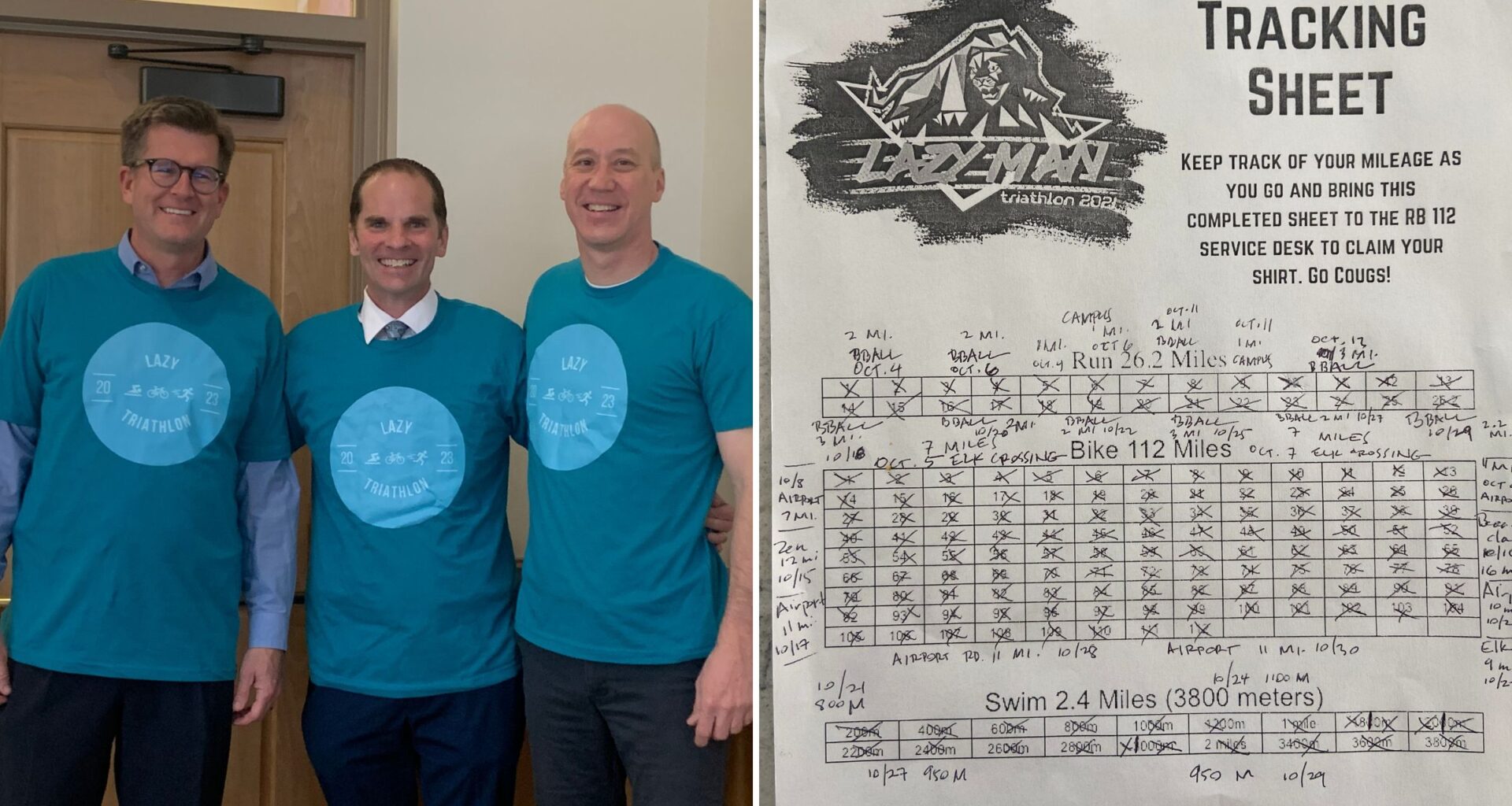
 Brigham Young University’s “Lazy Triathlon” offers a blueprint for how to start a corporate challenge in your workplace. (Photo: Courtesy of H. Hickman)
It’s fairly easy to organize a lazy triathlon in your workplace if you keep these practical tips in mind:
“Think about starting with a workplace survey to help you determine how much interest there is, and decide on the best distance and time of year,” says Hickman, who recommends offering a 70.3-mile challenge, or shorter, for the first year. Creating an online home for the lazy tri, such as a web page on your employer’s site or a Facebook page that includes a section for registration (and possible payment for finisher shirts), is also a must.
Registration fees might be just as intimidating as the distance for a tri newbie, so don’t charge for the event itself. Do include a downloadable tracking sheet on the event page. Participants can complete as much or as little as they want each day, logging their progress on an honor system. They can also workout where and when they feel comfortable, including the community track, rail trail, a backyard pool, the treadmill or spin bike at a fitness center, or even their own driveway (provided that they know the exact distance).
“People come in throughout the month, wanting me to take a photo of them with their tracking sheet and shirt!” says Hickman, who gives finisher shirts to anyone who submits their completed tracking sheets in person or via email. “And those who finish the Lazy Triathlon in one week get a special Tri Hard hat along with their shirt.”
Making triathlon fun (and accessible) for coworkers
While organizing a lazy tri isn’t complicated, it can be frustrating if others are too intimidated to register.
“Be excited!” says Hickman about how to have a conversation about the lazy triathlon with coworkers. “Go the extra mile and offer to take a spin class with them at lunch. Invite people to walk a mile with you every day or bike with you on the weekends.”
“The key is identifying who’s already interested in being healthy and active, and inviting them first,” says Callahan. If your employer has offices or remote workers in other locations, including them in the challenge can create unity across the distance. “Once you have that core community, it’s much easier to extend the invitation to others who may not be as health-conscious or confident. The fun and camaraderie become the selling points.”
Carter, who participated in his first Lazy Triathlon in 2021 after being invited by colleagues, recommends talking up the lazy tri, even after the start date. “This last year, I talked to other colleagues and had around seven participants from the beginning. One colleague finally joined in at the end of the month. The last day, he had to swim for a couple hours. We went down to cheer him on and he finished.”
“In 2025, BYU’s Lazy Triathlon was open to students, staff, their families, and the public. There were family members in Ohio, Michigan, and even Canada who participated,” says Hickman, adding that since some people feel more comfortable working out with others, inclusivity is prioritized. Participants are also encouraged to modify their workouts when necessary.
“If they can’t run, they can walk. One athlete had a cast on her hand and couldn’t swim so she took barre. If a participant is unable to do certain parts of the triathlon, time spent in a fitness class, or on a rowing machine or elliptical trainer counts,” says Hickman. “Be flexible about what the three ‘sports’ are and the time frame. I’ve had participants ask if they can finish in November, after midterms. That’s fine! After all, this challenge is about building healthy habits.”
“For me, one of the benefits of this health journey has been losing 20 pounds. I feel motivated to remain active and healthy, and that makes me a more productive contributor in my job,” Carter says.
“The Lazy Triathlon encouraged me to complete a half marathon, which I probably wouldn’t have done without the motivation and foundational experience of the workplace tri,” adds Callahan. “It’s a great bonding activity and the month-long format makes it accessible for people who are older or who have physical limitations (like my bad knees). The extended timeframe allows participants to pace themselves instead of overexerting their bodies. Overall, the benefits are significant: improved physical health and mental well-being, and stronger workplace relationships.”