
It began in 2020, when sailors started reporting unnervingly close encounters with orcas in the Strait of Gibraltar. The meetings often ended the same way: snapped rudders, disabled yachts, crews left drifting.
They all involved a single pod, led by a female known as White Gladis. She and her companions were cast as insurgents — cetacean saboteurs taking aim at the elitist world of luxury sailing. At sea, they appeared to be conducting their campaign in near silence.
Only now has the “orca uprising” acquired a soundtrack.
For the first time, scientists have captured the sounds made by White Gladis — the name is a nod to the animals’ old scientific classification, Orca gladiator — and her companions.
The results reveal that boat-tampering is not the only thing that sets them apart. The recordings show that they communicate using a dialect unlike any previously recorded: a newly identified orca language, learnt rather than innate, and unique to this group.
“We’ve been studying these orcas for 30 years,” said Renaud de Stephanis, a marine biologist who leads the research organisation Circe.
“Until now they were thought to be very silent. But now we’ve learnt that their calls are totally, totally different to any others. From a cultural conservation point of view, that’s just amazing. It’s like suddenly finding a new [human] language in the middle of Europe.”
The orcas’ silence, it seems, was tactical. These whales specialise in hunting bluefin tuna, an alert and skittish prey. Making a lot of noise would send supper fleeing. Only with new, cutting edge acoustic equipment have Stephanis and his colleagues been able to eavesdrop on their calls.
Orcas, in general, are a vocal species. To the untrained ear, their clicks, whistles and pulsed calls sound broadly similar wherever they are heard.
In fact, said De Stephanis, orca pods around the world “speak” in recognisably different ways, much as humans do. But the newly recorded calls, he explained, do not merely represent a different orca “accent”.

Structurally, they are markedly different from those of orcas in the North Atlantic or Pacific. What the research seems to reveal is less a regional twang than a separate branch of the linguistic family tree.
“It’s like the difference between Arabic and Latin,” De Stephanis said.
In just a few hours of recordings, a research team led by Dr Javier Almunia of the University of La Laguna identified four distinct call types, none of which match those heard elsewhere.
Young whales learn calls from their mothers and pod-mates. The sounds help co-ordinate hunting, travel and social life, binding individuals into cohesive groups.
The discovery of a new dialect gives an added twist to conservation work. If a pod dies out, it is not only its genetics that vanish. Its vocabulary goes too, along with a broader body of traditions, including knowledge about where to feed, how to hunt and how to survive in a particular sea. To lose a population of orcas is to lose a unique way of life.
The research was funded by the Loro Parque Fundación. The findings, accepted for publication in the Journal of Marine Science and Engineering, showed the newly identified calls belong to a group of about 40 individuals whose home range stretches from the Strait of Gibraltar and up the Atlantic coast of Iberia. Occasionally, they will venture as far north as the English Channel, De Stephanis said.
About 15 of them have been implicated in the “orca uprising”, a term coined after nearly 700 reported interactions between the whales and boats, several of which ended with the sinking of sailing vessels.
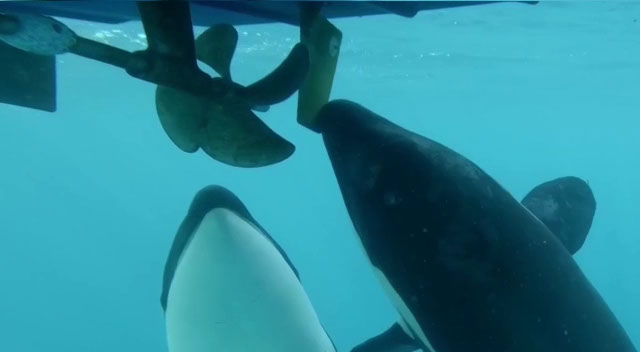
The orcas might simply view the boat parts as toys, experts say
There is no evidence that Gladis and her pod are attacking humans or that they intend to harm people at all. In fact, wild orcas have never been seen treating people as prey.
They do, however, have a thing for “fads”, where they take up behaviour that has no obvious benefit. One famous example involved a female in the Pacific northwest who, in 1987, was seen wearing a dead salmon on her head.
The trend spread. Other orcas across Puget Sound were soon spotted with their own “salmon hats”. And then, as abruptly and as mysteriously as it started, the fashion fizzled out.
Other orcas have been seen draping kelp over their backs or heads, carefully balancing it while swimming. Again, the behaviour appears to serve no practical purpose.
To scientists, the behaviour with the boat rudders looks similar. After wrenching one free, Gladis and her companions tend to bat it around for a while, then lose interest and swim off. The most plausible explanation, researchers said, is that these highly intelligent apex predators are playing. One believes the orcas see the yachts, with their long detachable rudders, as “giant toy dispensers”.