
Laura Liston always wanted to be a mother. She was maternal by nature, and a strong believer in social justice, focusing on probation work and increasing visitation rights for women in prison.
The 36-year-old and her husband Fergal Mannion had met in Galway almost two decades ago, but didn’t start dating until a few years later when they reconnected at a friend’s wedding.
They spent “six wonderful years” in Dublin before deciding to move to Limerick, where Ms Liston is from, to build a house in Croom, about a 20-minute drive south of Limerick city.
Engaged in December 2018, they married the following December and decided to start trying for a family.
However, the pair experienced difficulty conceiving, and underwent fertility treatment, which was successful.
Their story was told at the Limerick coroner’s court inquest into her death on Wednesday.
In February 2022, the couple contacted Sandra Healy, a self-employed community midwife working with the HSE, to hear more about potentially having a home birth.
They completed a risk assessment and application form, and were approved for a home birth. Ms Healy told the court she had multiple appointments with them between their first contact and Ms Liston’s due date in June of that year.
In his deposition at her inquest, Mr Mannion said on March 18th, Ms Liston became concerned about a bleed and reduced movement of her baby.
They went for a check-up and were told there was “an issue” with the placenta, Mr Mannion said, but he added that they were still approved for a home birth and were not advised of any risks.
 Co Limerick woman Laura Liston who died after giving birth to her son at home in June 2022.
[ Verdict of medical misadventure in death of woman who died after home birthOpens in new window ]
It was early in the morning on Saturday, June 4th, 2022, around 7.30am, when Ms Liston believed her waters broke, the inquest heard.
She contacted Ms Healy and they had a conversation over the phone. The midwife visited Ms Liston’s house at 11am for an assessment and advised her that labour was “favourable” that day.
They remained in touch through the phone throughout the day. Ms Healy contacted another midwife, Sinéad Murphy, that afternoon to see if she would be able to attend the birth with her. Ms Murphy confirmed she would attend.
At 7.11pm, Ms Murphy advised the primary midwife that she had an estimated travel time of 90 minutes between her location and that of the Liston’s house.
Ms Healy arrived at Ms Liston’s house around 10 minutes later in preparation of the birth. The midwife also contacted the national ambulance service, in line with guidelines, to advise that a home birth was taking place but no ambulance was required at this time.
Ms Liston was giving birth in a large mobile home that the couple were living in while their house was being built. A number of witnesses at her inquest described the lighting as “dim” during the labour and birth, with Mr Mannion stating there were two or three candles used as light, while Ms Healy said the midwives had a torch.
The 36-year-old woman was in a birthing pool to help with pain relief. She was advised beforehand that she would not be able to give birth in the pool due to HSE guidance and would have to get out.
However, just before 11pm, the birth of the child became imminent. The midwives felt it was no longer appropriate to ask Ms Liston to exit the pool.
Their son was born in the pool at 22.58.
Ms Liston was asked to try to deliver the placenta in the birthing pool but she had difficulty and was experiencing serious pain.
At 23.20pm she was asked to exit the pool. When she stood up, Mr Mannion told the inquest, she “collapsed” and fainted, dropping her newborn into the birthing pool. She also experienced blood loss, low blood pressure and vomiting.
Ms Liston was moved to a couch nearby. Her husband said she “did not look well”.
In response to questions, Ms Healy said “in hindsight” she could have called for a transfer to hospital at this point, but Ms Liston appeared alert and while there was a concern she was unstable, she believed it was “reasonable” to wait at that stage.
Giving evidence at the inquest, Prof Amanda Cotter, consultant obstetrician-gynecologist at University Maternity Hospital Limerick, said that if this had happened in a hospital setting it would have been treated as an “emergency” and a multidisciplinary team would have been called.
After midnight, the midwives decided to escalate Ms Liston’s care. They called for an ambulance and two arrived, one for the newborn and another for Ms Liston. They were both to be transferred to the maternity hospital at this time.
Jim Hartnett, one of the paramedics who attended the call, said the water in the birthing pool was a “dark red colour” and had birthing products and clots floating on top.
He described Ms Liston as being cold, clammy and very pale. He said she called out to him: “Help me.”
Andrew Connaughton, a paramedic in the midwest for over 30 years, said: “The lady’s colour was frightening. I got a fright as soon as I looked at her.”
Mr Connaughton was driving the ambulance Ms Liston was in. Ms Healy, the midwife, was also in the ambulance. An obstetrician called the midwife while they were in the ambulance and she provided guidance during the journey to the hospital. Mr Mannion and their son were in the other ambulance.
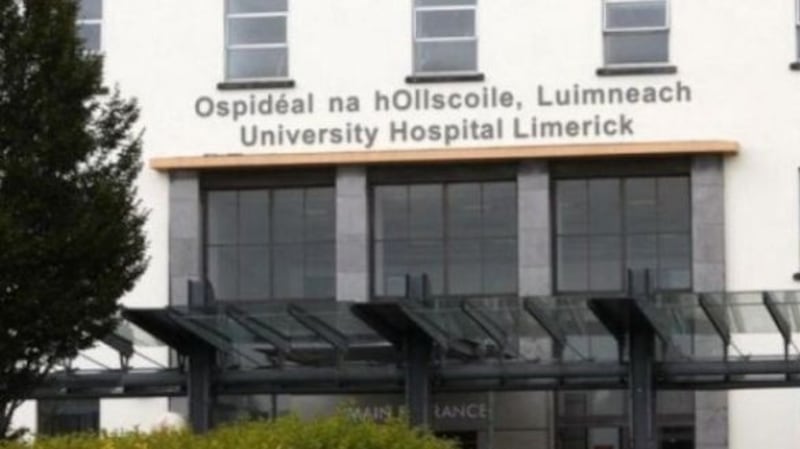
There had been conversations in the back of the ambulance about whether the patient should be brought to University Hospital Limerick (UHL) instead of the maternity hospital near the city centre. (UHL is about five km closer to the couple’s home in Croom and was chosen because it has an emergency department and resuscitation unit.)
 University Hospital Limerick
Mr Connaughton said her condition started “deteriorating rapidly” and he announced with “some force” they were going to UHL.
At one point, the ambulance had to pull in at Croom graveyard because Ms Liston had gone into cardiac arrest. They began compressions and her heart started beating again.
Upon arrival at UHL, Ms Liston went into cardiac arrest again. She was brought to the resuscitation bay but was pronounced dead at 2.15am.
“We fought hard for this lady. And we still lost her,” Mr Connaughton said.
Pathologist Margot Bolster said the cause of death was haemorrhage and shock due to a uterine inversion, a rare and life-threatening complication associated with childbirth.
In Ms Liston’s case, the placenta had grown into the uterine wall, she said, which resulted in the difficulty in delivering the placenta after her son was born.
At the inquest, the HSE read out an “unreserved” apology for the “failings in care” in respect of Ms Liston’s death.
The inquest returned a verdict of medical misadventure.
In the immediate aftermath of her death, the HSE suspended home births in the midwest region covering Limerick, Clare and north Tipperary and commissioned an external review into her care.
They remain suspended pending “full implementation” of recommendations arising from this review, which included national policies, resourcing, recruitment, education and training.
“At present, and following ongoing clinical and operational review, the HSE Mid West and University Maternity Hospital Limerick (UMHL) are not in a position to safely reinstate a home birth service,” the spokesman added.
“Reinstatement of home birth services will require the establishment of a sustainable model with adequate numbers of appropriately trained and experienced midwives, clear clinical governance arrangements, and alignment with national policy and best practice.”
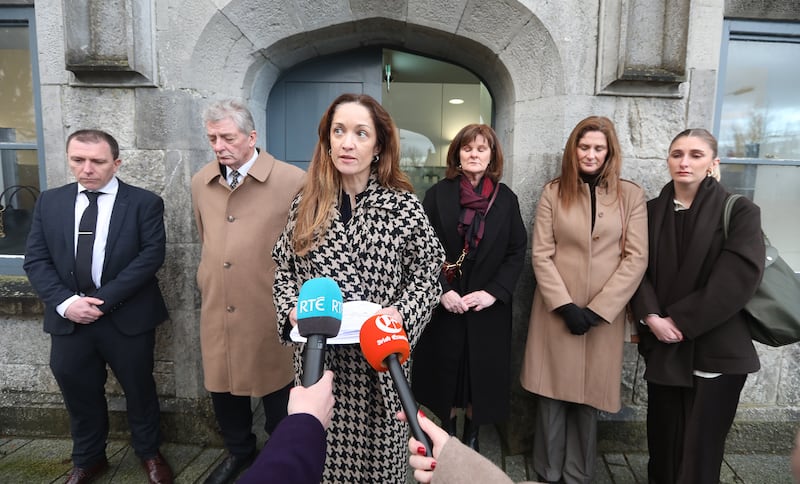 Scarlett Griffin O’Sullivan, solicitor of the family of Laura Liston, speaking outside the coroner’s court in Kilmallock, next to Laura’s husband Fergal Mannion, her father John and mother Fiona Liston, and sisters Jennifer and Sarah Liston. Photograph: Brendan Gleeson
In a statement read outside of the coroner’s court by the family’s solicitor Scarlett Griffin O’Sullivan on Wednesday, they said Ms Liston’s case was “not about being pro or anti home births”.
“The inquest highlights the urgent need to ensure basic clinical standards and protocols are followed in maternity care, which are unfortunately lacking in Laura’s case with fatal consequences,” she said.
[ Two-thirds of healthcare workers ‘actively’ considering leaving role, study findsOpens in new window ]