A once little-known Saudi royal, prince Badr bin Abdullah bin Farhan, sent shock waves through the art world in late 2017 when he was unveiled as the mystery buyer of Leonardo da Vinci’s Salvator Mundi, which had sold just weeks earlier for a record-breaking $450.3 million (€386.5 million) at auction.
Speculation then – and since – has held that the true purchaser was crown prince Mohammed bin Salman, the kingdom’s de facto ruler, who has elevated his distant cousin in the past decade to several prominent roles that were traditionally reserved for the Salman branch of the family.
As Saudi Arabia’s first minister for culture, prince Badr is a key figure in his boss’s Vision 2030 project to diversify the oil economy and develop sectors like technology, tourism, entertainment, and logistics.
While the 40-year-old is known to personally avoid the spotlight, he made an unlikely cameo appearance last week in court documents stemming from one of the biggest Irish boardroom bust-ups in recent years: between airport operator DAA and its chief executive Kenny Jacobs.
In a bid to be reinstated in his job after being suspended last month, Jacobs said in sworn evidence that a trip he had made to meet “crucial and important Saudi business partners”, including prince Badr, was now part of one of 20 lines of investigation by the DAA into its chief executive.
“This allegation seems to have been included in a deliberate attempt to cast unwarranted and baseless aspersions about my character and bona fides by suggesting that I was somehow deriving personal benefits from a business trip and/or consuming lavish hospitality and somehow conflicting myself,” he said, adding that he had informed DAA chairman Basil Geoghegan and checked with DAA’s company security to confirm the trip was appropriate.
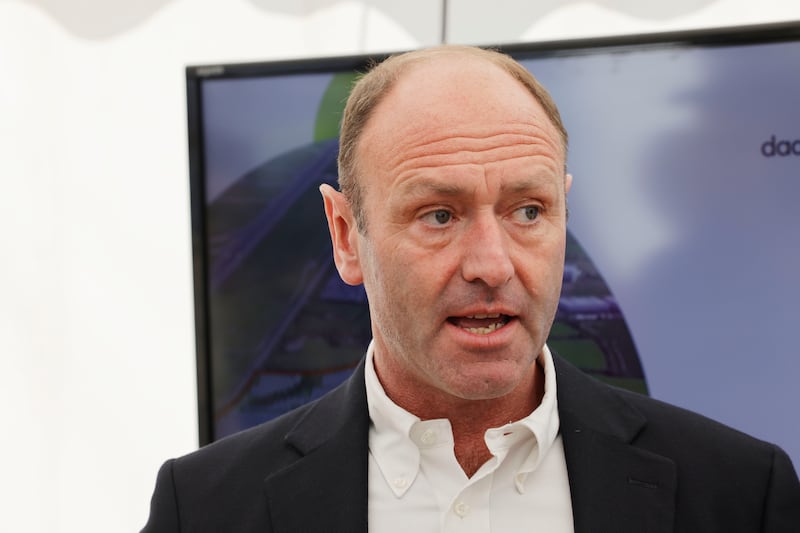 For now, Kenny Jacobs’s sworn evidence is the most detailed account to date of the long-running dispute – albeit only that of one side. Photograph: Alan Betson
The State-owned operator of the Dublin and Cork airports has management and consultancy contracts in Saudi airports. It also has airport retail operations there and a dozen other countries.
“I am extremely concerned that rather than taking any reasonable steps to inquire about the actual facts behind this innocuous, genuine and important business trip – insofar as any such inquiry is necessary – the board has perversely elected to frame it as an allegation in the most damaging and pejorative way possible.”
For the record, he said, that while he did recall “there being reference at the meeting to a whiskey valued at €70,000 per bottle being as available at the hotel in question, [he] did not consume any of that whiskey nor was invited to.”
The board’s decision to hire barrister Kelley Smith SC last month to investigate 20 new allegations levelled against Jacobs – and suspend him in the meantime – followed a decision by Minister for Transport Darragh O’Brien in November not to sign off on a mediated exit package for the chief executive.
That settlement, known to amount to almost €1 million, followed a months-long standoff between Jacobs and the board. Members of the board had expressed the view in a meeting with O’Brien in early October that he was “unsuitable for the position of chief executive”, the chief executive’s affidavit evidence said, even after a previous investigation, carried out by Mark Connaughton SC early last year, did not uphold two initial allegations against him.
“It is my understanding and belief that what transpired at the meeting consisted, in large part, of a ‘hatchet job’ being conducted on me by members of the board,” he said.
He also alleges that Geoghegan went about soliciting complaints from senior DAA executives in the lead-up to the new investigation.
[ DAA commits to pausing investigation into Kenny Jacobs pending hearingOpens in new window ]
“I say and believe the solicitation of a large number of complaints/allegations by board members has been done to achieve the highest prospect of there being an adverse finding of any kind, on foot of which the board can execute its decision that I will be removed from office,” he said.
Mairéad McKenna SC, for DAA, told the High Court on Monday that the airport operator is “absolutely opposed” to the application by Jacobs. The court heard that the company will file a responding affidavit by 6pm on Friday – with the case scheduled to come before the court on January 23rd, when it is expected that a hearing date will be set.
A spokeswoman for DAA declined to comment other than to confirm an intention to “comprehensively contest” the application of Jacobs, a former Ryanair executive, who joined the group in early 2023.
Initial investigation
For now, Jacobs’s sworn evidence is the most detailed account to date of the long-running dispute – albeit only that of one side.
It stated that on February 4th last year, a complaint was made under protected disclosure rules by a woman staff member – referred to in the affidavit as reporting person one, or RP1, – alleging “inappropriate behaviour on my part and that I was interfering with procurement processes”.
A second complaint, from a man referred to as RP2, “alleged that I was endangering an individual’s health and safety due to misconduct”.
Geoghegan appointed a subgroup, comprising board members Risteard Sheridan and Paula Cogan, to consider the complaints. They appointed Connaughton on April 7th to investigate.
Connaughton concluded that RP2’s allegation that Jacobs engaged in workplace bullying, which caused harm to employees, including some having suicidal thoughts, was “overstated”, according to one of the excerpts from his report, quoted liberally in the 63-page affidavit.
Regarding RP2’s claim that Jacobs verbally abused and threatened to manage his performance, Connaughton concluded that “while the conduct of the [relevant] meeting was not appropriate”, it did not endanger the employee’s health or safety.
The investigator also did not uphold RP2’s claims that Jacobs made sexually explicit comments about staff and passengers, and he regarded as “hearsay” RP2’s allegation that the chief executive harassed another named employee, according to the affidavit.
“Overall, it is my view that the core of RP2’s expressions of concern are a number of personal grievances, which are largely unresolved,” the Connaughton report is quoted as saying.
Connaughton also rejected allegations from RP1 that Jacobs engaged in “sexist, misogynistic, racist, homophobic and ageist behaviours in [his] comments to or about employees” on the basis that there was “no reliable evidence to substantiate them”.
He said that much of RP1’s list of “serious allegations” were accounts from conversations with others, some of which were said to have occurred more than two years before she filed her complaint.
“I am concerned not only because of the passage of time but because RP1 admits she never sought to verify or even clarify with the individuals that she had accurately recorded what they are purported to have said, either then or later,” Connaughton said.
Connaughton said that one alleged witness to RP1’s claims had no recollection of events that were referred to.
However, it is also clear Connaughton did not speak to a range of witnesses either, as he said: “It is not unreasonable to expect that others might have similarly responded.”
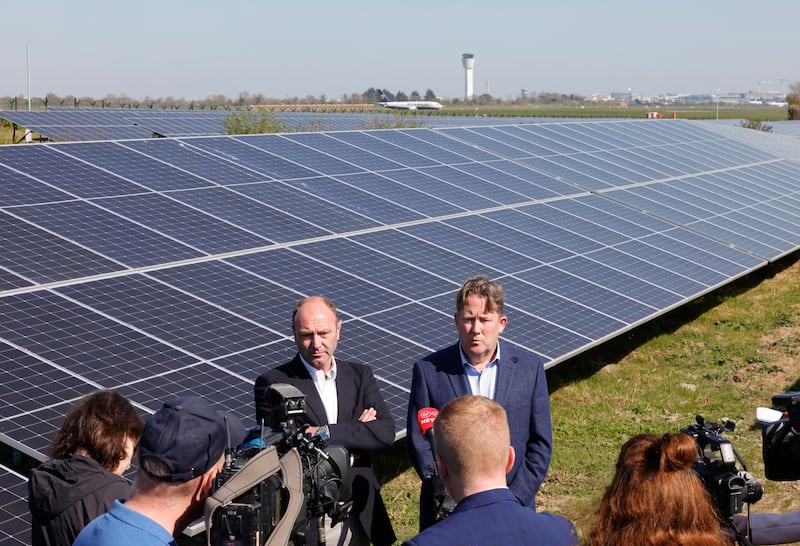 Jacobs (left) and Minister for Transport Darragh O’Brien at the official opening of Dublin Airport’s solar farm in 2025. Photograph: Alan Betson
Jacobs alleges that he was due to attend the subgroup – on July 30th – to discuss the Connaughton reports, when he got a call at 7.50am that day from the DAA chairman, requesting that he not attend the meeting.
“Mr Geoghegan stated that I ‘should resign’ and that he would get me an ‘amazing deal’ if I did,” the affidavit alleges. “Mr Geoghegan also stated, with no elaboration, that new complaints had come to him ‘out of the woodwork’.”
Jacobs – represented by law firm Arthur Cox – subsequently entered a mediation process with DAA, chaired by industrial relations veteran Kieran Mulvey.
This resulted in an agreement – reached in mid-September – that Jacobs would leave in early 2026. The Irish Times has reported that the exit package amounted to about €960,000. The mediated deal required ministerial approval.
Jacobs took issue with what he claimed were damaging leaks around that time to the media, including The Irish Times.
Specifically, he said 41 questions sent by Arthur Beesley, current affairs editor with The Irish Times, to the DAA press office on September 22nd led him to believe the reporter was “improperly provided” with a DAA paper related to the mediation process “with the effect of further damaging and undermining my good name”. His affidavit does not list the questions, noting that each relates to “new information” that had not previously been made public.
On October 29th, DAA’s solicitors, McCann FitzGerald, wrote to Arthur Cox saying a DAA director had received a written report from a staff member of comments Jacobs allegedly made at a retirement event 12 months earlier. Jacobs said that he has “a very real concern” that the complaint was the result of active solicitation by “certain board members”.
“I emphatically reject the substance of the allegations which have been made, specifically that I told a story about working at Dublin Airport security and women passengers having to remove their hoodies,” he said.
Jacobs said he was “shocked and personally shaken” when the claims became the source of a media query from the Sunday Independent on November 8th.
He said he was “genuinely shocked and in disbelief” when he was passed an email from Beesley to the DAA press office on November 11th, suggesting – accurately, as Jacobs subsequently found out – that the Minister had declined to approve the mediated exit package.
Jacobs wrote to each DAA board member on December 1st offering to enter a conciliation process. He added that he was “utterly shocked” by Beesley’s reporting of this, and also the potential for the board deciding on a new investigation and suspension of the chief executive.
Platinum privileges
Jacobs said he learned on December 9th that professional services firm Deloitte had been hired to investigate suspected leaks of confidential information.
He alleges that this appears only to have taken place when the Business Post reported in detail on DAA directors’ usage of free access to the Platinum Services VIP terminal at Dublin since 2018. The report highlighted that Geoghegan, an investment banker, was the biggest beneficiary, availing of the service 238 times during the period at a commercial cost of almost €90,000. It also said that usage by directors was within the airport operator’s rules.
Jacobs expressed regret in the affidavit at threatening the disclosure of directors’ use of platinum services in May 2025 in a conversation with Sheridan, chair of the subgroup presiding over the initial investigation. He claims it was an “emotional outburst”. Jacobs also denies improperly disclosing the information on Platinum usage to anyone.
Jacobs said that he was “shell-shocked” coming out of a virtual meeting with Geoghegan early on December 15th, where he was informed that he was being suspended and a new round of allegations were being investigated.
“I felt ambushed and humiliated by Mr Geoghegan,” he said, adding that he was ordered to leave his office immediately, not communicate with any staff or access his email or DAA IT systems.
[ Suspended DAA chief Kenny Jacobs rejects claims of ‘sexist, racist behaviour’Opens in new window ]
Claiming that he had been sick at a nearby coffee shop only minutes after having been told by the chairman to leave his office, Jacobs has told the court that the stress caused to him, his wife and his family by his suspension and matters leading up to it has been “immense”.
The board decided that Jacobs be placed off duty during the investigation because of the risk of interference with witnesses and retaliation and potential for leaking of confidential information to the media, according to minutes of a board meeting, quoted in the chief executive’s affidavit. He denied that there were any such risks.
Jacobs received a letter the same day outlining the new set of 20 allegations against him.
He said that the first was a “clear attempt” to “re-agitate an interpersonal issue” between him and Sheridan during the Connaughton investigation. The second relates to the Business Post report.
Another stems from private text messages to Geoghegan during the initial investigation. “Taking these private text messages and reframing them as inappropriate communications causes me great concern,” he said.
Others, he claims, “originate from people who have either not asked for matters to be investigated, or positively asked that they not be investigated”.
Jacobs said he’s not clear about what’s claimed in the 12th allegation. It relates an email to the head of DAA International Nick Cole – who was appointed deputy chief executive last month and is currently the most senior executive working in the group – to relay to Saudi partners that DAA was withdrawing from an exclusivity agreement on a project in a “friendly way”, he said.
Jacobs also said it’s “utterly unclear” how the Saudi trip – where, he said, he met with business partners, prince Badr and other Government officials – has been framed as another matter for investigation.
“The implication that it was necessary for my employer to remove me from employment pending an investigation has clear and obvious connotations in respect of my conduct, character and integrity and generates a very specific stigma, which [in] this instance is wholly unfounded and unfair,” he said.
He said that due to the stress that this has caused him, he had been prescribed medication by doctors that is “normally used for the treatment of anxiety and insomnia”.
DAA’s counsel McKenna told the court on Tuesday that the investigator appointed to look into the second round of allegations would be instructed to hold off starting her work, pending the hearing of Jacobs’s application.
“That seems to deal with your concerns,” Ms Justice Marguerite Bolger told lawyers for the chief executive, noting that the case will ultimately be presided over by Mr Justice Brian Cregan. “You can take it that the parties will be given an urgent hearing date.”