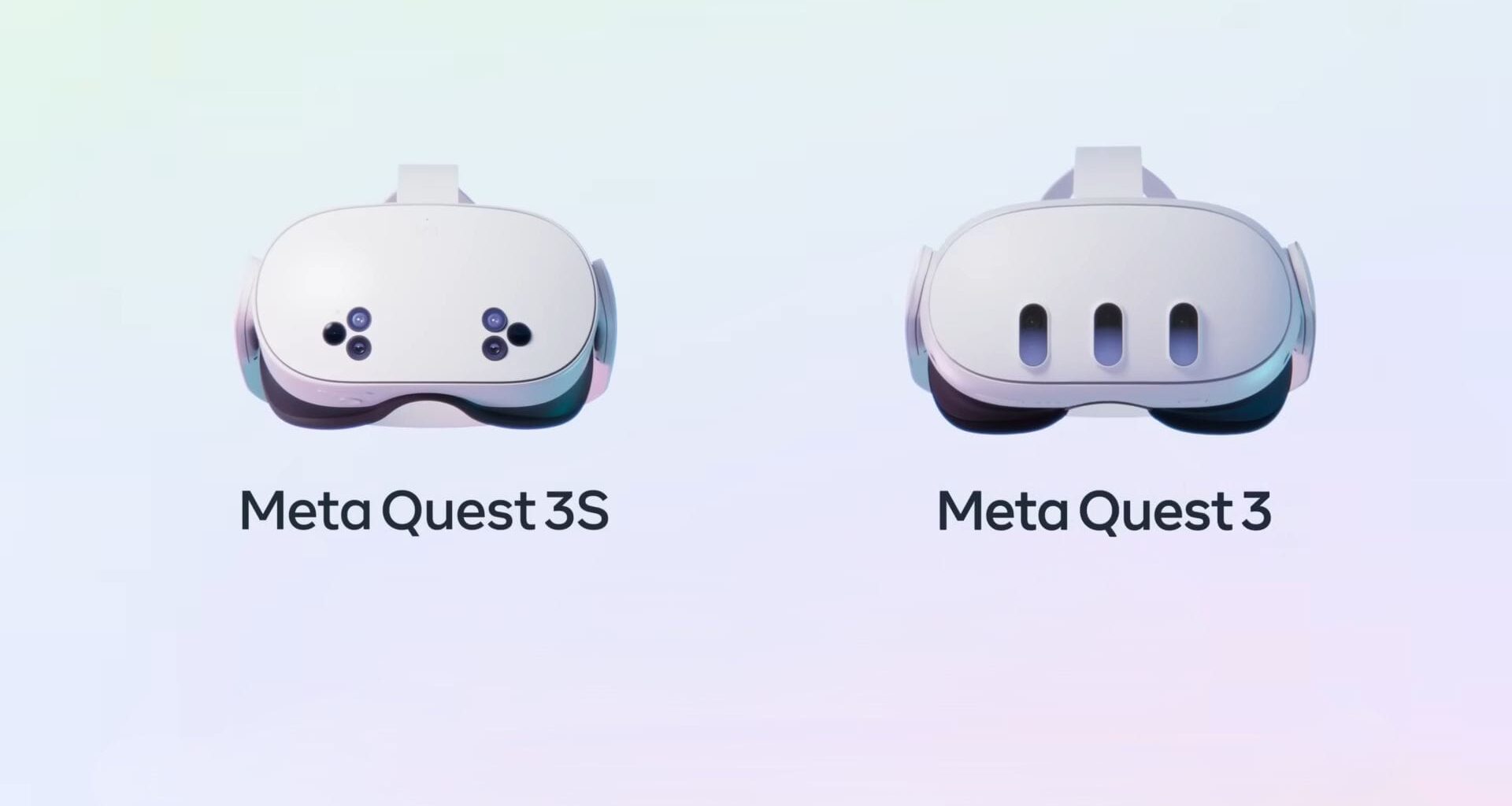

Meta Quest 3 and Meta Quest 3S are basically Meta’s entire consumer VR lineup right now, especially after the Meta Quest Pro got discontinued. And honestly, it’s a pretty interesting matchup because the two headsets are impressive in their own way. The Quest 3 is the one most people recommend first when someone says they want to “properly get into VR,” while The Quest 3S is the cheaper, more accessible version that cuts a few corners to drop the price by $200.
They run the same ecosystem, so the real question is which one makes more sense for the way someone actually plays VR.
Meta Quest 3 vs Meta Quest 3S: Specs, prices, and features compared
At a glance, the Meta Quest 3 and Quest 3S are standalone headsets, and both hit the same high refresh rate. The major differences show up in resolution, lenses, and storage.
Meta Quest 3 vs Meta Quest 3S (Image via Meta)
Here are the specs:
Price
Meta Quest 3S starts at $299.99 for the 128GB model and goes up to $499.99 for 512GB. Meta Quest 3 costs $499.99 and only comes with 512GB storage. So yes, the Quest 3S is the cheaper entry point, and it’s a huge deal for anyone who’s still unsure about VR in general. But storage is where it gets tricky. VR games aren’t tiny anymore.
Something like Batman Arkham Shadow is around 20GB, and 128GB fills up faster than most people expect. Once someone starts thinking about upgrading storage, the gap starts shrinking, and the Quest 3 suddenly feels more tempting.
Read also: 7 VR games that are worth buying on Meta Quest
Display and lenses
Quest 3 vs Meta Quest 3S lenses (Image via Meta)
Meta Quest 3 uses pancake lenses, and they’re a big reason the headset feels like a newer generation. They’re thinner, sharper, and don’t punish you for not having your eyes perfectly aligned.
Meta Quest 3S uses Fresnel lenses, which are basically the same style used in Quest 2. Fresnel lenses still work fine, but they come with a smaller sweet spot, meaning the image looks clean only when your eyes are positioned just right. If it’s slightly off, clarity drops, and you’ll notice it during longer sessions. Quest 3’s pancake lenses don’t have that same limitation, so things stay sharper across more of your view.
Quest 3 offers a wider field of view at 110° horizontal and 96° vertical. Quest 3S is tighter, at around 96° in that range (with the 3S being narrower overall). That wider view makes VR feel less like you’re peeking through goggles and more like you’re actually inside the space.
Quest 3’s per-eye resolution is higher, and because VR screens sit right up against your eyes, the difference isn’t subtle. Quest 3S still looks good, but compared side-by-side, it comes off more grainy and less detailed.
Fit and comfort
Both headsets look very similar with the same general white body design and a Y-shaped strap. Both can also be upgraded with the same strap accessories, like the Elite Strap or the Elite Strap with Battery, so the default fit isn’t wildly different.
Where Quest 3 helps itself is the shape. It’s slimmer and doesn’t stick out as far from your face, which improves weight distribution. Even though it’s about 24g heavier than the 3S, the balance makes it feel less awkward during play. There’s also a practical bonus here: you’re less likely to smack the headset with your controllers mid-game.
One small but important win for Quest 3 is that it includes a headphone jack, while Quest 3S doesn’t.
Performance and passthrough
Snapdragon XR2 Gen 2 chip (Image via Meta)
Both headsets use the Snapdragon XR2 Gen 2 processor with 8GB RAM, which means they run the same games and hit similar performance. Quest 3S still gets that “new-gen” jump compared to Quest 2 because the chip is the same one powering Quest 3. So if someone was worried the cheaper headset would be weaker, it’s not.
Color passthrough is basically equal as well. Both headsets offer full-color passthrough, using the same 4MP cameras. It’s a huge upgrade compared to Quest 2, and it’s useful whether you’re playing mixed reality content or just trying to move around your room without pulling the headset off. It’s not Apple Vision Pro-level clarity, but both Quest 3 and Quest 3S do it well, and neither really beats the other here.
Controllers and tracking
Both headsets use the same controller design, and motion tracking is essentially the same since they rely on outward-facing cameras to track the headset and controllers. That said, there have been occasional tracking issues noticed in fast-paced games like Beat Saber. It’s not a dealbreaker, but it’s there, and it’s hard not to miss if you play rhythm games seriously.
Some of you might even feel the older Quest 2 ring-style controllers were a bit more consistent for that kind of movement. Hand tracking exists too, but it’s limited on both, and neither headset has a clear advantage in that area.
Battery life
Quest 3S has a smaller battery (4,324mAh) compared to Quest 3 (5,060mAh), and Meta claims:
- Quest 3S lasts around 2.5 hours
- Quest 3 lasts around 2.2 hours
The Quest 3S features a lower-resolution display compared to the Quest 3. Since the Quest 3 pushes more pixels (and does it at high refresh rates), it has to work harder during use. The Quest 3S doesn’t need to drive the same level of visual output, so it can stretch its battery a bit further even with less capacity.
This doesn’t mean the Quest 3 has bad battery life. It’s still in the same general range, but it does show that the 3S is slightly more efficient for typical play sessions.
Read more: Viture Beast vs Viture Luma Ultra: Which are the better smart glasses?
Storage
Quest 3 comes with 512GB, no choices, no compromises. Quest 3S comes with either 128GB or 256GB, which can feel limiting once you start stacking bigger VR titles. If someone plans to keep a decent library installed at all times, Quest 3 is the safer long-term pick.
Audio
Built-in sound is one of those things people don’t talk about until they notice it. Meta Quest 3s speakers can feel like they have more bass and punch, which some people will enjoy. But the audio can also a bit muffled compared to Quest 3’s clearer sound profile. Quest 3 doesn’t hit as hard, but its sound is cleaner.
And again, Quest 3 having a headphone jack makes its audio easier to improve without workarounds.
Should you buy Meta Quest 3S or Meta Quest 3?
Quest 3 is the better headset, no question. The display, pancake lenses, wider field of view, smoother IPD adjustment, slimmer build, and bigger storage all add up to a noticeably higher-end experience. It earns the $200 gap. But Meta Quest 3S is still a strong buy, and for some people, it’s the smarter one.
Quest 3S makes more sense if…
You’re new to VR and don’t want to spend big money before knowing you’ll stick with it. It’s also a safer pick for kids, especially if they’re rough with tech. You still get the same processor, the same games, and solid mixed reality features without committing to the higher price.
Quest 3 is worth it if…
You already know you’ll use VR often and want the best picture and optics Meta currently offers. The sharper visuals, wider view, and better lens clarity make a real difference over time, especially in games where better immersion matters.
Check out other content on Sportskeeda:
Why did you not like this content?
Cancel
Submit
Was this article helpful?

Thank You for feedback
Edited by Rishi Pallav