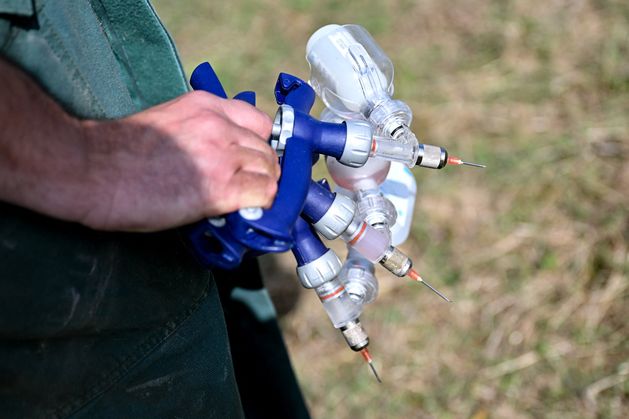
Minister for Agriculture, Food and the Marine, Martin Heydon, said a bovine infected with bluetongue virus serotype 3 (BTV3) was identified in a herd through routine surveillance.
The discovery marks the first time the disease has been found in the Republic, ending hopes that Ireland’s island status would keep it free from the virus that has caused major disruption across Europe.
“This is unwelcome news but unfortunately it is not surprising, given the spread of this virus across Europe, Great Britain and recently Northern Ireland,” Minister Heydon said.
Bluetongue is an insect‑borne viral disease affecting cattle, sheep and other ruminants. Crucially, it cannot infect humans and poses no food safety risk, the minister stressed.
“I want to emphasise that bluetongue cannot infect people and does not pose any food safety or human health issue,” he said, while expressing sympathy for the affected farmer.
The virus is spread primarily through midges. Fortunately, the current seasonal drop in temperatures is expected to limit transmission.
“The replication of the virus in infected midges cannot happen when the daily temperatures are lower than 12 degrees Celsius,” Minister Heydon said. “The recent seasonal drop in temperatures means that infection is unlikely to spread widely at the current time.”
Department officials are carrying out further sampling and investigations to establish the source and extent of the infection.
However, the immediate fallout for the livestock trade will be significant. Diseases such as bluetongue can trigger restrictions for live exports, a major outlet for Irish cattle and sheep.
“This outbreak will have an impact on exports of cattle and sheep, with additional costs and logistical issues required in order to comply with the rules set by the countries of destination,” the minister noted.
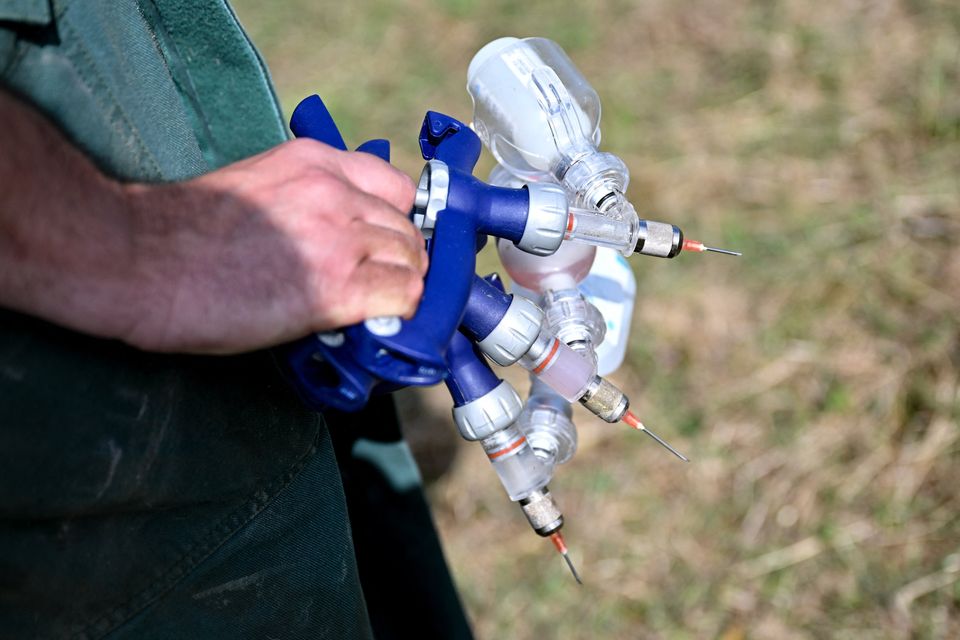
This photograph shows vaccines after a vaccination campaign on cows in France. Two serotypes of this disease, FCO3 and FCO8, transmitted by midges, are currently circulating in sheep and cattle farms across Europe. (Photo by LOU BENOIST / AFP) (Photo by LOU BENOIST/AFP via Getty Images)
News in 90 seconds Saturday January 24
Exports of meat and dairy products are not expected to be affected for the EU, UK or most international markets, and the Department has already been working to revise health certificates for third‑country markets to minimise disruption.
Looking ahead, Minister Heydon highlighted the importance of vaccination.
“My decision last year to approve the use of BTV3 vaccines in Ireland from 2026 provides farmers with a valuable tool,” he said, encouraging farmers to discuss vaccination options with their vets.
The President of ICMSA Denis Drennan, was among the first to react to the outbreak in Wexford and described the news is hugely worrying for the family concerned and the wider farming community.
He said it is hugely important that the sector work together to contain the outbreak as much as possible and that every support is given to farmers impacted by bluetongue.
At this stage, Drennan said, that farmers should take the advise of the Department of Agriculture in relation to best practice on biosecurity and immediate measures are required to ensure that our live trade and live exports continue as normal.