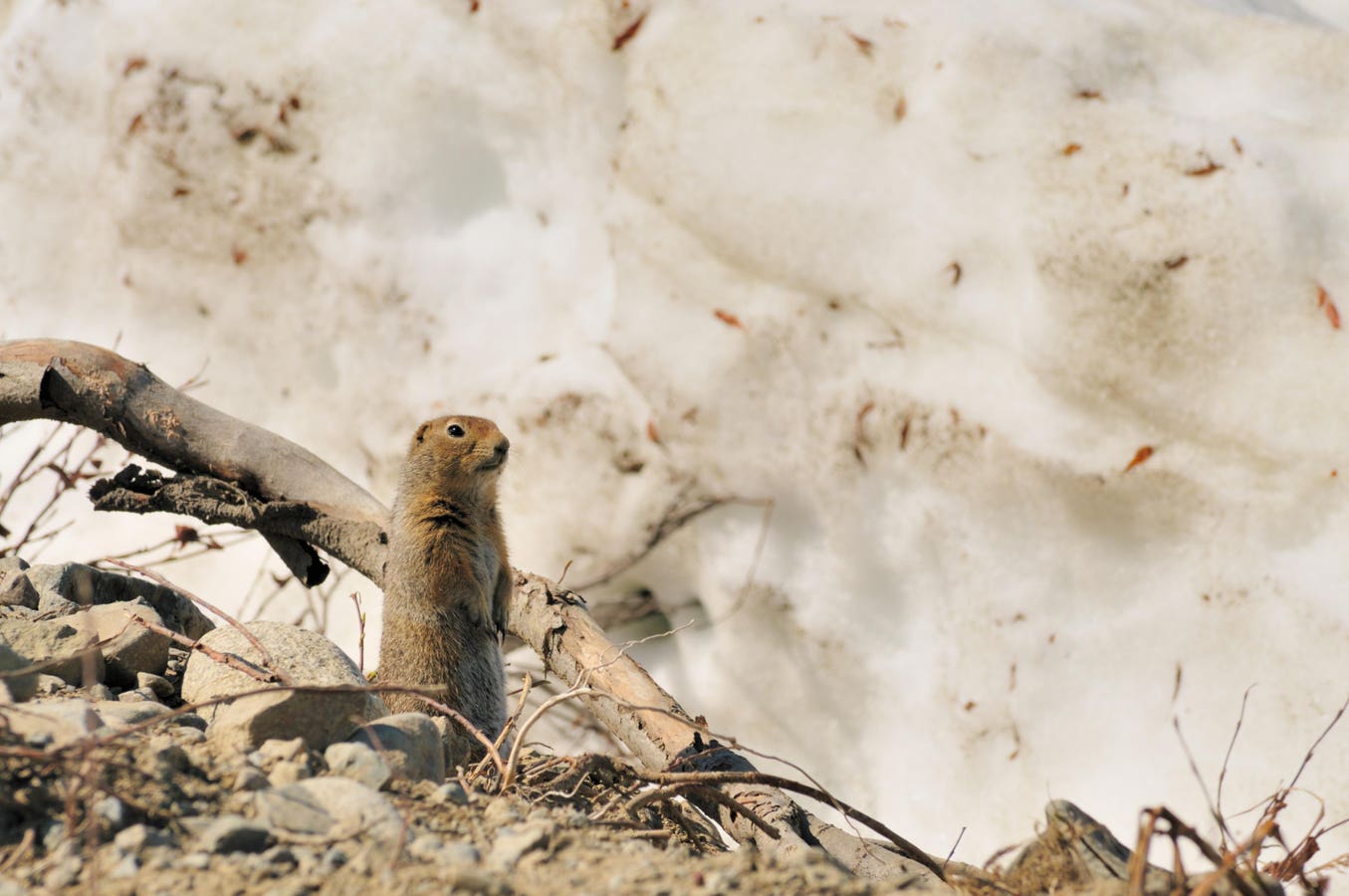
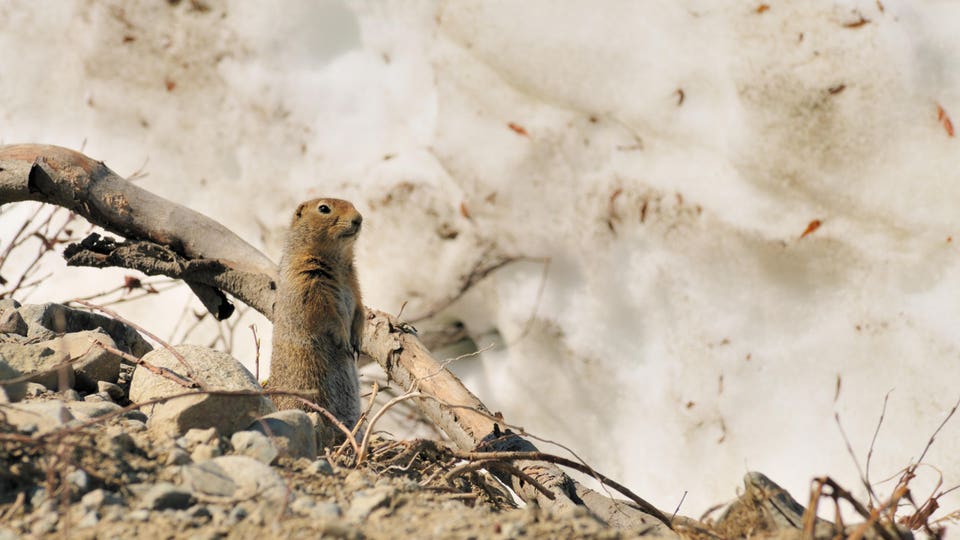
The Arctic ground squirrel survives conditions that would cause irreparable brain damage in almost any other mammal on the planet. Here’s how, according to research.
getty
If you cool a human brain by even just a few degrees, its neurons will soon start to fail. Should oxygen levels drop low enough for even a few minutes, cells will die. And if you were to lower body temperature toward freezing, electrical activity within the brain would cease entirely. Yet, somehow, every winter, the Arctic ground squirrel (Urocitellus parryii) deliberately lets its brain temperature fall below 0°C.
It cuts down its cerebral blood flow to just a trickle, and it remains in that state for weeks at a time. Then, when spring arrives, it wakes up as though nothing happened; its memories stay intact, and it suffers no detectable brain injuries whatsoever. Here’s a breakdown of how this small mammal evolved one of the most extreme hibernation strategies on the planet: reversible brain shutdown.
The Arctic Ground Squirrel’s Extreme Winter Strategy
Arctic ground squirrels live in Alaska and northern Canada, where winter can last up to eight months, and where ambient temperatures frequently drop below −30°C (−22°F). Unlike many hibernators, which usually retreat to insulated dens, these squirrels remain exposed to subzero soil temperatures.
As research from the American Journal of Physiology describes, during hibernation, its core body temperature can fall to −2.9°C (26.8°F), which is the lowest recorded for any mammal to date. Soon after, its heart rate slows from around 200 beats per minute to fewer than ten. In turn, breathing nearly stops, and its brain activity becomes barely detectable. Yet, unbelievably, the brain does not die.
At the cellular level, the squirrel’s brain enters a state that’s known as “torpor,” in which:
- Neuronal firing is massively reduced
- Synaptic transmission is suppressed
- Energy consumption drops to less than 5% of normal levels
It’s important to note that these neurons aren’t inactive by accident. The torpor phase enables the squirrel to suppress activity within ion channels, reduce the release of glutamate and stabilize its cell membranes. As a result, excitotoxicity — the process that normally kills neurons during oxygen deprivation or hypothermia in humans — is mitigated entirely. This process can be understood as the Arctic ground squirrel switching its brain into low-power mode during winter hibernation.
How This Squirrel Survives Without Oxygen
One of the most striking features of Arctic ground squirrel hibernation is how well the brain tolerates ischemia: a lack of blood and oxygen. As 2006 research from Stroke explains, for humans, even brief ischemia can give rise to serious consequences, such as calcium influx, mitochondrial failure and cell death. But, fascinatingly, Arctic ground squirrels’ neurons can resist this cascade.
As the study notes, their brain cells maintain mitochondrial integrity and avoid oxidative stress during torpor. Antioxidant pathways are upregulated, which catalyze metabolic reactions that result in the suppression of damaging free radicals. In simpler terms, this ability can be likened to preemptive cellular engineering.
Yet perhaps the most counterintuitive discovery is what happens to its synapses. Specifically, during deep torpor, synaptic connections in the squirrel’s brain are partially dismantled. Dendritic spines retract, which leads to communication between neurons decreasing dramatically.
This would be a medical emergency for most animals, as synapse loss is strongly associated with neurodegenerative disease and cognitive decline. Yet this is somehow a reversible process for the Arctic ground squirrel: it periodically rewarms itself during brief arousal phases, and, during this time, synapses are rapidly rebuilt.
This means that by the time the squirrel may emerge in spring, its neural architecture will be functionally normal.
How This Squirrel Avoids Freezing Damage
Hibernation is not a continuous process for mammals, and the Arctic ground squirrel is no exception to this. Every few weeks, it briefly rewarms to normal body temperature for less than a day. These arousals are energetically expensive, as they account for most of the energy that is spent during hibernation.
So, if they’re so costly, why do these occasional rewarmings happen at all? As a 2009 study from the Journal of Comparative Physiology B explains, this is because it’s essential for brain maintenance. Rewarming allows repair of DNA, restoration of protein function and rebalancing of neurotransmitter systems. Torpor pauses damage, and the periodic arousals help the squirrel’s body fix what little damage has accumulated.
For any other animal, allowing body temperature to drop below freezing should result in the formation of ice crystals, which can cause dangerous ruptures to cells. Pioneering research from Science describes that Arctic ground squirrels avoid this by means of both supercooling and controlled ice formation in peripheral tissues.
Fascinatingly, this mechanism can prevent ice formation in the brain entirely. Specialized proteins, altered membrane compositions and precise control of extracellular fluid chemistry keep neurons in a liquid state, even below 0°C (32°F). Notably, this level of control is incredibly rare among mammals; it more closely resembles the strategies observed among freeze-tolerant amphibians and reptiles.
Why This Matters Beyond Squirrels
Arctic ground squirrels have become a model for studying neuroprotection. Our understanding of how their brains tolerate hypothermia and ischemia has informed research efforts, as well as life-saving treatments, for stroke, cardiac arrest and traumatic brain injury. Inducing torpor-like states in humans is an active area of research, especially in relation to emergency medicine and long-duration spaceflight.
What the squirrel demonstrates is that mammalian brains are not as inherently fragile as we might believe. Under the right molecular conditions, they can actually survive extremes that we would otherwise believe to be impossible.
This ability did not arise by accident: Arctic ground squirrels evolved under intense selective pressure where failure to endure winter meant extinction. Instead of avoiding the cold, they adapted to it at one of the deepest biological levels possible. Their brains became flexible systems capable of reversible shutdown.
From an evolutionary biology standpoint, this is a reminder that intelligence and survival do not always require constant neural activity. Sometimes, the smartest strategy is knowing when to rest.
The Arctic squirrel thrives by staying in sync with nature’s extremes. Discover how connected you are to the natural world with this science-backed test: Connectedness to Nature Scale
Across cultures, animals like the squirrel symbolize survival and adaptability. Discover which guardian animal reflects your strengths with this two-minute test: Guardian Animal Test