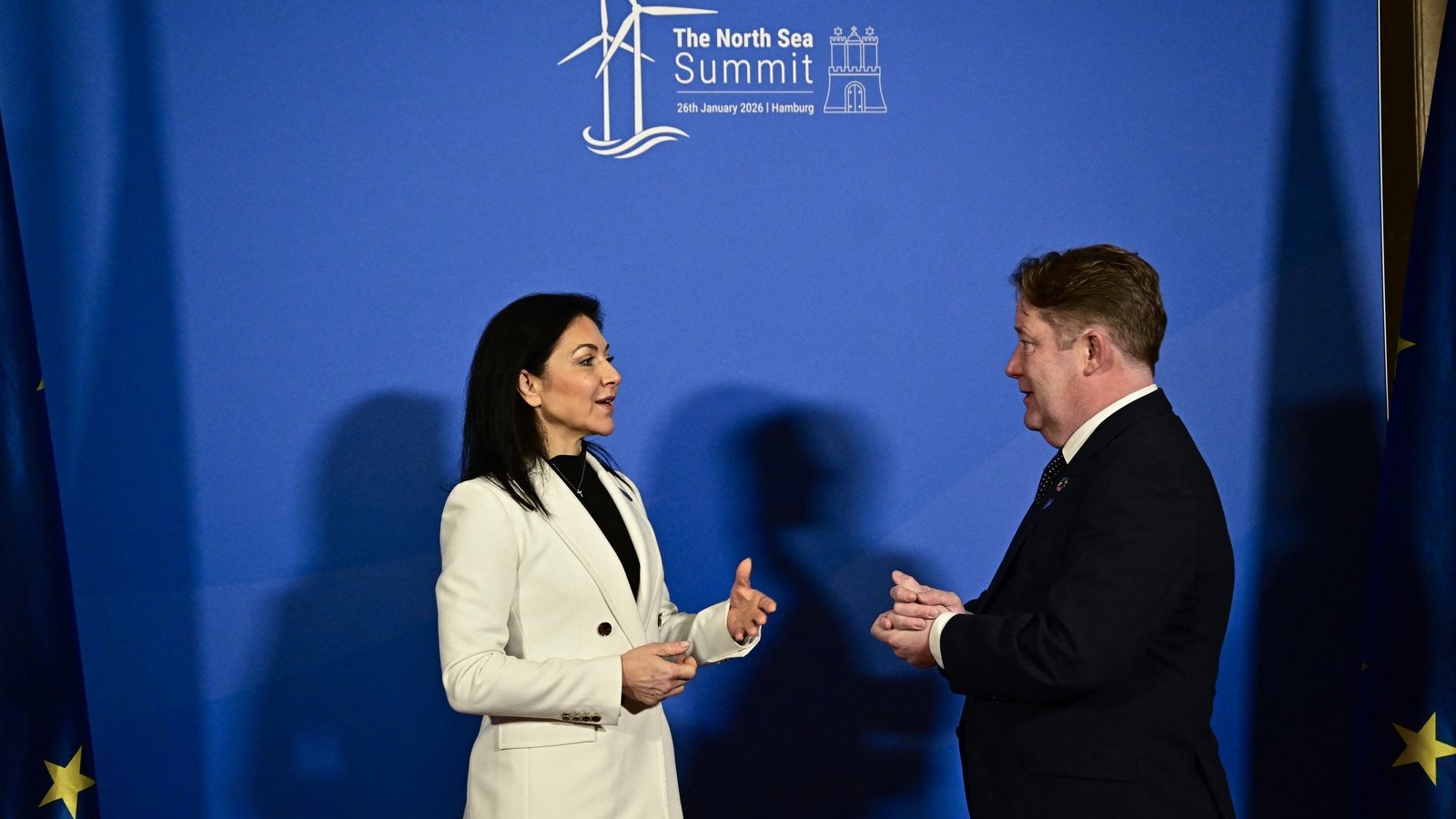
Minister for Climate, Energy and the Environment Darragh O’Brien was one of nine European energy ministers to sign the Hamburg Declaration of Energy Ministers at the North Sea Summit.
The declaration sets out commitments to improve cooperation on planned cross-border construction and the protection of offshore energy infrastructure in the wider North Sea region.
Belgium, Denmark, France, Germany, Luxembourg, the Netherlands, Norway and the United Kingdom were the other signatories alongside Ireland.
The declaration pledges to deliver 100 gigawatts (GW) of offshore wind power through large-scale joint projects in the coming years while participating countries will remain committed to installing up to 300GW of offshore wind capacity in the region by 2050.
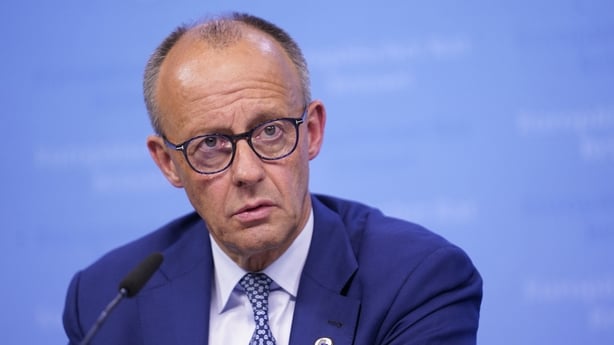
Germany’s Chancellor Friedrich Merz hosted the summit
To put that into context, one gigawatt generated by a power plant can power a medium-sized European city of approximately 500,000 residents, according to energy experts.
Ireland’s electrical grid is due to be connected to the European Union’s internal energy market for the first time in 2028 via the Celtic Interconnector.
The Government has set a target of generating 5GW of capacity in offshore wind energy by 2030.
It said it is actively exploring further interconnection with other European partners.
The summit was the third edition of the format and the first one to be held in Germany.
The first North Sea Summit was held in Denmark in 2022 following Russia’s full-scale invasion of Ukraine as European governments looked to reduce their dependence on fossil fuel imports, particularly from Russia, and improve energy security within their own markets.
A second summit was held in 2023 in Belgium.
At the conclusion of the meetings, the leaders of Belgium, Denmark, Germany, Luxembourg, the Netherlands and Norway signed also signed a Hamburg Declaration, a list of pledges reaffirming their governments’ commitment to help transform the North Sea region into “the largest clean energy hub in the world”.
German Chancellor Friedrich Merz said the participating governments had agreed on comprehensive, cross-border planning for energy projects in the North Sea.
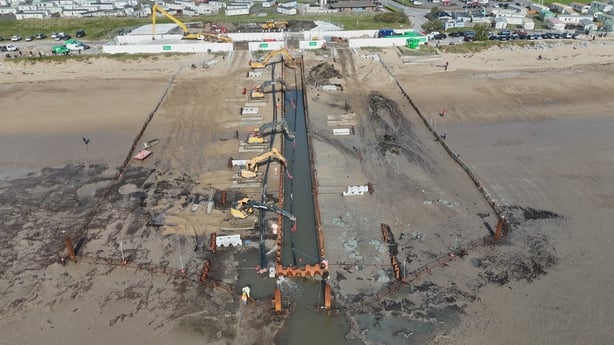
The Celtic Interconnector will link Irish and French grids
“Offshore energy is to become more efficient. To this end, we will cooperate and coordinate more closely, both in the planning of energy networks,” he said.
Leaders also pledged their support to securing the region’s maritime space and its interconnected offshore energy infrastructure against growing threats of hybrid attacks and sabotage.
Speaking ahead of the summit, Mr O’Brien said: “As a small, windy island at the edge of Europe, the offshore energy potential of Ireland is huge.
“Increasing our cross-border electricity interconnection will enhance European energy security, increase our economic competitiveness and critically reduce consumer prices.”
Speaking to RTÉ News this morning, Mr O’Brien said that Ireland can play “a significant role” to deliver offshore wind energy at scale.
“We’ve shown how we can do that onshore. We’re actually a European leader with regard to the integration of renewables into our grid, and we’re in the process of constructing our first interconnected continental Europe https://news.google.com/rss/articles/CBMid0FVX3lxTE5pa1NEMGFZaE15WFZqM2VKZWNUUkdFRjlaUkRubll3TFd3Uk5VNGw4OEx1NnRxTXBWM2VsZDhwZlJBTWQxeURwMkFHUTY3X1FERjZpT1JrZnoxQVpjckxWeG9tX1JyUTZXOFdYS0dCY2dZc1ZGUVln?oc=5,” said Mr O’Brien, referring to the Celtic Interconnector, an underwater cable that will link Ireland’s grid with France by 2028.
Asked if had plans to discuss further grid connections to link Ireland with other European countries, Mr O’Brien said he has already held discussions with “another significant European state” on the matter and intends to bring forward a memorandum of understanding in April.
He added: “Interconnection is going to be very important for Ireland, but not just islanded states, for Europe in general, that we can share energy across the union.”
Mr O’Brien said that close to 7GW has already been consented for offshore wind farms in Irish waters.
“Our focus now is getting that into construction, but private sector finance is critically important,” he said.
In December, 44% of Ireland’s electricity was generated through renewables, according to EirGrid, the operator and developer of the country’s electricity grid.
The Government has set an ambitious target for renewables to account for 80% of the country’s grid by 2030.
During the signing ceremony, summit organisers announced that Taoiseach Micheál Martin, UK Prime Minister Keir Starmer and French President Emmanuel Macron had signed the leaders’ declaration virtually ahead of the meeting.
Mr Merz, who hosted the summit, has previously talked about developing the North Sea into “the largest reservoir of clean energy in the world”.
NATO representatives were also invited to the talks, reflecting a growing conversation in European capitals over the need to protect the continent’s critical energy infrastructure against hybrid threats and sabotage.
Mr Martin had been scheduled to attend the summit but did not travel to Germany in order to attend the funeral in Co Cork of former Fianna Fáil MEP Brian Crowley, who died last Friday.
Neither Mr Starmer nor Mr Macron attended the summit.
Iceland participated as an observer to the leaders’ declaration.
Danish Prime Minister Mette Frederiksen said that she hoped Europeans understood that it was “a huge mistake” to be dependent on Russian fossil fuel imports.
“Now we have to make sure that we will have no dependencies on other countries outside Europe, not only on energy, on everything. And that is why I think nobody can discuss energy without discussing security,” Ms Frederiksen said.
Arctic tensions overshadow talks
Fears over US designs on the Arctic island of Greenland may have overshadowed the talks, which came just days after US President Trump backed away from his threat to seize Greenland by force and level punitive tariffs against European NATO allies who stand in his way.
Mr Trump said he had reached a “framework” agreement with NATO Secretary General Mark Rutte, but this sparked both relief and confusion as the details have not been disclosed.
“We will have to pay increased attention to all parts of NATO’s European territory,” Mr Merz said on Thursday after an extraordinary European Council meeting.
“This concerns the North above all.”
Also on the guest list today was Danish Prime Minister Mette Frederiksen, who visited Greenland on Friday, and representatives of NATO and the European Commission as well as Iceland.
“Given the make-up of the meeting, I am certain that security in the High North will also be of interest to the participants,” said Steffen Meyer, spokesperson for Mr Merz.