A newly confirmed vertebrate species has drawn international attention to the Louisiade Archipelago, a remote island chain in southeastern Papua New Guinea. The discovery occurred during a field survey in Milne Bay Province, a region known for its ecological isolation and biological endemism but rarely studied in depth by international research teams.
The organism was first encountered in an area historically impacted by industrial mining activity. Since then, specimens have been identified in both natural and human-altered landscapes, revealing a level of adaptability that has surprised field researchers.
Rare Island Species Identified in Gold Mining Ruins
The new species, Dendrelaphis atra, is part of the arboreal Dendrelaphis genus of non-venomous colubrid snakes. It was discovered on Misima Island, once the site of a large-scale gold mining operation that ceased in 2004. The species was confirmed in a peer-reviewed study published in Zootaxa in April 2025, authored by herpetologist Fred Kraus of the University of Michigan.
The animal stands out for its nearly uniform black skin and reflective dark eyes. Juveniles are pale but darken as they mature through ontogenetic melanisation, a pigmentation process rarely observed in related species. No ecological role for the pigmentation has been established, but its uniqueness contributed to its formal designation.
Initial sightings took place in a degraded mining corridor, followed by further documentation in highland forests and village-modified landscapes. These varied habitats suggest that D. atra may exhibit higher ecological flexibility than other island-endemic reptiles in the region. Morphological analysis showed consistent differences from known Dendrelaphis species in body shape, scale structure, and coloration. The species name is derived from the Latin ater, meaning black.
Four New Reptiles in One Overlooked Archipelago
The identification of D. atra was part of a broader regional survey led by Kraus that resulted in the classification of four new tree snakes, each restricted to a single island within the Louisiade Archipelago: Misima, Rossel, Sudest, and Woodlark. This pattern reinforces the region’s high level of island endemism, a product of geographic isolation and fragmented ecosystems. The Zootaxa article provides a comparative analysis of all four species, highlighting distinct traits and their distribution across isolated habitats.
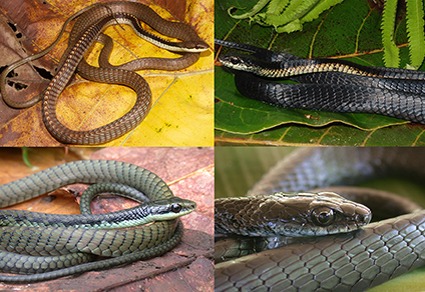 A Dendrelaphis atra, or atra tree snake. Credit: Fred Kraus
A detailed summary of the discovery was published by The Daily Galaxy, which described the animal’s striking black appearance and its unexpected presence in both wild and anthropogenic environments. The piece emphasizes how limited biological surveys in the archipelago have left significant gaps in biodiversity mapping.
Despite its reputation as a global biodiversity hotspot, Milne Bay Province remains underrepresented in international biological databases. Many areas have never undergone formal herpetological surveys. The Louisiade chain, in particular, contains dozens of isolated islands, most of which are still poorly studied or biologically undocumented.
Discovery Raises Stakes for Future Land Use
Misima Island’s past as a major gold extraction site has made it the focus of renewed development proposals over the past two decades. Feasibility studies conducted since 2004 have explored the potential for reopening mining operations. The presence of an undocumented vertebrate species within the former concession area complicates any future land use planning.
The detection of D. atra in both degraded and semi-natural habitats suggests it may persist outside pristine forests, but the long-term implications remain unclear. No population estimates, range projections, or conservation assessments currently exist. The species is not listed in any international conservation registry, including the IUCN Red List, due to its recent classification.
Although Kraus’s study did not include conservation policy recommendations, the discovery could inform future environmental impact assessments, particularly if mining development is reconsidered. Misima’s dual identity as a post-industrial site and a potential biodiversity reservoir positions it at the center of a growing debate over sustainable resource management in Melanesia.
Scientific Blind Spots Hinder Conservation Efforts
The research also highlights broader challenges in biodiversity monitoring across Papua New Guinea. Field studies in the Louisiade Archipelago face logistical constraints, including rugged terrain, poor infrastructure, and limited local capacity. These factors have contributed to a global knowledge gap that affects conservation strategy, ecological modeling, and baseline species inventories.
The identification of D. atra was achieved through classical morphology-based taxonomy. Researchers relied on physical comparison with museum specimens and published records rather than genetic sequencing, which remains difficult to carry out in field settings without specialized equipment or lab access.
Kraus’s findings suggest that even habitats impacted by human activity may continue to harbor species unknown to science. Whether this is due to species resilience or lack of prior exploration remains unconfirmed. The absence of standardized data prevents researchers from assessing habitat quality thresholds or defining critical conservation priorities.