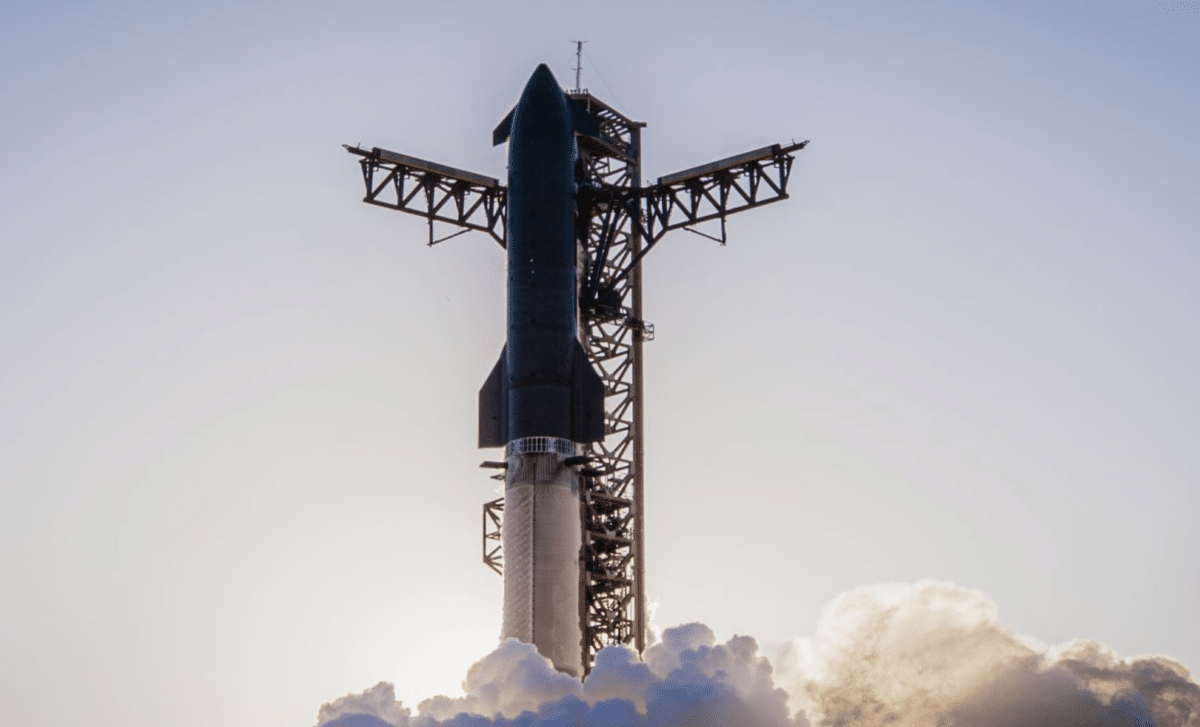
SpaceX is set to push the boundaries of space exploration with the upcoming debut of its most ambitious version of Starship yet. In a recent post on X (formerly Twitter), CEO Elon Musk revealed that the company plans to conduct the 12th test flight of the Starship rocket as soon as early March 2026. This milestone marks a significant leap toward SpaceX’s goal of reaching the Moon, Mars, and beyond. As the world’s most powerful rocket prepares for its first orbital flight, the stakes are high. But SpaceX remains focused on its mission to revolutionize space travel.
Starship Version 3: A Giant Leap Toward Mars
Starship Version 3 (V3) is poised to be the most advanced iteration of SpaceX’s towering rocket. Unlike its predecessors, which only conducted suborbital test flights, V3 will be capable of reaching orbit, a crucial step toward SpaceX’s grand vision of interplanetary missions. Starship V3 is set to be taller, stronger, and more efficient, with a new design that promises to take the company one step closer to fulfilling its Mars ambitions.
The rocket’s upgrades are designed to support long-duration space missions. Starship V3 will feature larger engines, including the third-generation Raptor 3, which will generate a staggering 280 metric tons of thrust, 50 more than the previous generation. Additionally, the rocket will be fitted with new docking adapters, allowing for in-orbit fuel transfer, which is crucial for missions beyond low Earth orbit. SpaceX also aims to enhance Starship’s overall design to make it more resilient and efficient, keeping it in line with the company’s long-term goals of creating a sustainable spacefaring civilization.
The Road to the Test Flight
In his post on X, Elon Musk shared an exciting development with his followers, announcing that SpaceX is targeting the second week of March 2026 for the next major test flight of Starship V3. This test flight will be a pivotal moment in the rocket’s evolution, moving from suborbital tests to a full-fledged orbital mission. The timeline is a hopeful one, although the company still has significant testing to carry out before the launch.
While SpaceX’s ambitious goals might seem daunting, the timeline Musk provided suggests that Starship V3 could soon take to the skies for its first orbital test. However, given the complexity of the rocket’s design and the challenges that come with testing cutting-edge technology, there’s still much work ahead. The rocket’s sheer size and technological advancements demand rigorous testing to ensure its readiness for human space travel.
The Power Behind Starship
One of the key elements that make Starship V3 such a formidable force in the space industry is its massive Super Heavy booster. This booster is responsible for lifting the enormous Starship payload into space, and it is one of the most powerful boosters ever built. In late 2025, SpaceX successfully stacked the Super Heavy booster at its Starbase Facility in South Texas, preparing for the upcoming test flight.
Starship launch in 6 weeks pic.twitter.com/3HFf4H5cc4
— Elon Musk (@elonmusk) January 26, 2026
The Super Heavy booster’s power will be essential for getting Starship off the ground and into orbit. This vehicle’s potential for heavy-lift capabilities will be crucial for future space missions, especially those that involve sending humans to the Moon and Mars. With the Super Heavy booster and Starship V3 working in tandem, SpaceX hopes to create a reusable, cost-effective system for space travel, a system that could pave the way for regular missions to the Moon and even Mars.
The Raptor 3 Engines: Power and Precision
A standout feature of Starship V3 is its upgraded Raptor 3 engines, which will provide significantly more thrust than the previous Raptor 2 engines. The Raptor 3 engines will generate 280 metric tons of thrust, a major increase from the 230 metric tons produced by their predecessors. The new engines will be lighter and more efficient, with fewer parts, which will ultimately lead to reduced costs and greater reliability.
This upgrade is essential for Starship’s long-term success, especially when it comes to supporting missions beyond Earth’s orbit. As SpaceX aims to send crewed missions to Mars, the efficiency and power of the Raptor 3 engines will play a crucial role in ensuring that Starship can safely transport astronauts to the Red Planet and beyond. With these engines, Starship will be better equipped to handle the demands of deep space exploration.
SpaceX’s Long-Term Vision
SpaceX’s ultimate goal is to make humanity a multiplanetary species, with Mars as the primary target for colonization. Starship V3 is a critical part of this vision. With its ability to carry larger payloads, travel longer distances, and withstand the challenges of space travel, Starship is designed with interplanetary missions in mind. The new version of the rocket will be capable of transporting humans and cargo to Mars, where SpaceX plans to establish a self-sustaining colony in the coming decades.
The advancements in Starship V3’s design are directly linked to SpaceX’s goal of making life on Mars a reality. The rocket’s increased size, efficiency, and fuel capacity will be necessary to sustain long-duration space missions. With the ability to refuel in orbit and carry more propellant, Starship V3 will be able to travel to Mars and back, marking a major milestone in humanity’s quest to explore and settle other planets.