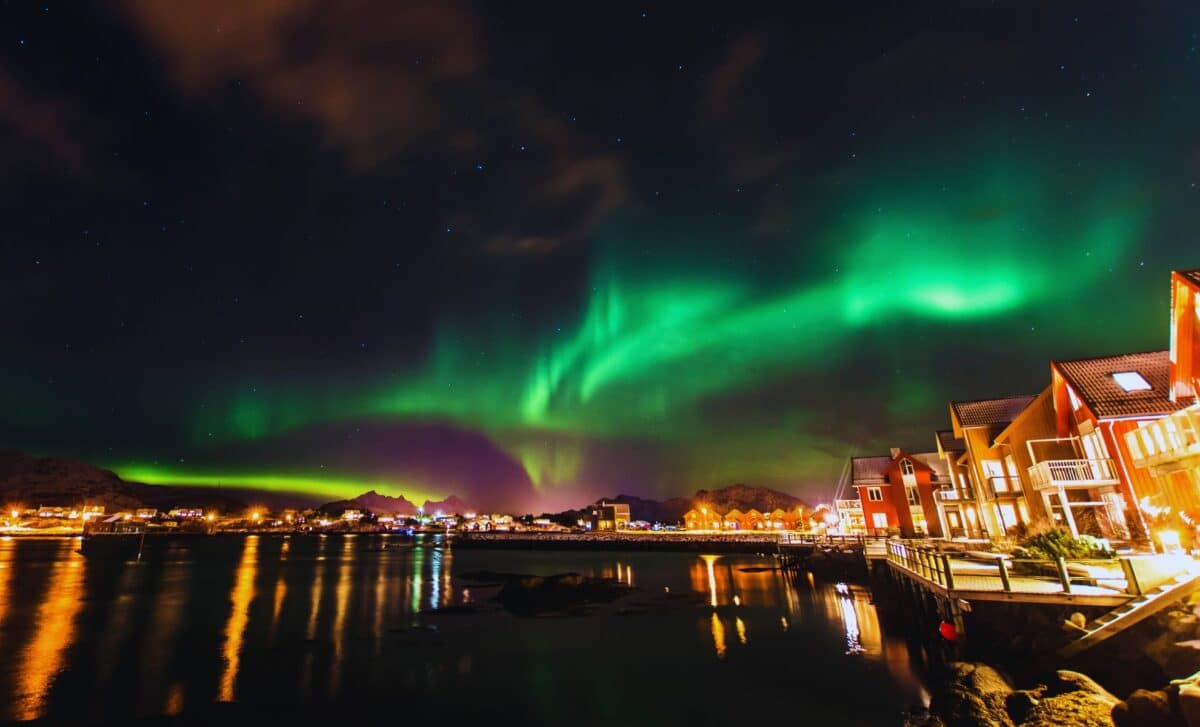
A faint aurora borealis, also known as the northern lights, may be visible across northern parts of the United States overnight from Tuesday, January 27 into Wednesday, January 28, as a minor geomagnetic storm impacts Earth’s atmosphere. According to the NOAA’s Space Weather Prediction Center, a fresh stream of high-speed solar wind is expected to trigger G1-class activity, potentially lighting up skies from Alaska to Maine.
This event follows a powerful solar storm earlier in the month that sparked auroras around the world. While less intense, tonight’s storm could once again push the auroral oval southward, offering a chance for skywatchers across 11 U.S. states to witness one of the planet’s most stunning natural displays.
Where And When To Watch The Skies
The aurora view line published by NOAA suggests the northern lights may be visible in parts of Alaska, Washington, Idaho, Montana, Wyoming, North Dakota, South Dakota, Minnesota, Wisconsin, Michigan, and Maine. This wide corridor mirrors the one observed during previous G1 storms, with the best viewing chances found in darker, rural locations away from urban lighting.
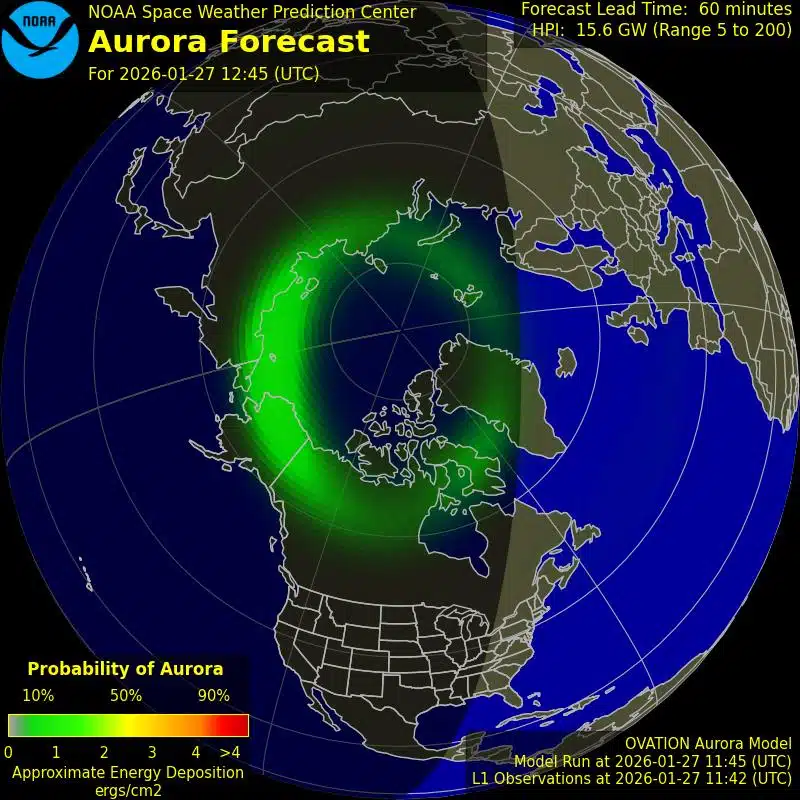 NOAA aurora forecast for January 27, 2026, showing southern lights activity around Antarctica, with higher intensity in green to red zones. Credit: NOAA
Visibility remains difficult to predict due to variations in the solar wind speed and the orientation of the interplanetary magnetic field, particularly its Bz component. As explained by the SpaceWeatherLive, when the Bz turns southward, it connects more effectively with Earth’s magnetic field, allowing solar particles to enter and increase auroral activity. A sustained Bz below -5 nanoteslas (nT) is typically needed for visible auroras.
NOAA and space weather tracking apps like Aurora Now, My Aurora Forecast, and SpaceWeatherLive provide real-time alerts and measurements that can help observers determine the best times and locations to look up.
Lunar Glare Could Reduce Visibility For Skywatchers
One of the main obstacles tonight may be the brightness of the waxing gibbous moon, which is 68 percent illuminated. As reported by Forbes, this lunar phase will cast considerable light across the sky, potentially washing out the more delicate colors of faint auroras. Skywatchers are advised to find spots with clear views of the northern horizon and minimal ambient lighting to improve their chances.
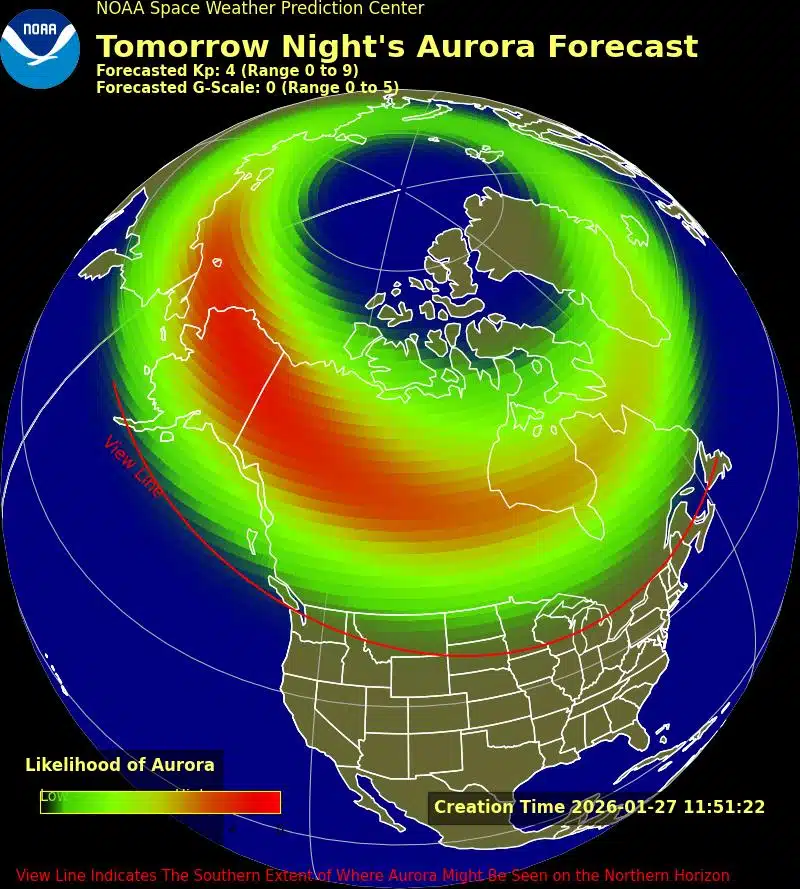 NOAA forecast for Jan 27, 2026, showing likely northern lights visibility with the red line marking the southern viewing limit. Credit: NOAA
Despite this challenge, the moon will offer an additional celestial treat, appearing just left of the Pleiades star cluster in the constellation Taurus, according to the same source. Even if the aurora remains elusive to the naked eye, photography may capture what the human eye cannot. Modern smartphone cameras, when used in Night Mode or Pro Mode, can reveal faint auroral glows, particularly if stabilized on a tripod or flat surface.
Solar Cycle 25 Continues To Fuel Activity
Although the solar maximum, the peak of the Sun’s 11-year cycle, is believed to have occurred in late 2024, activity has remained high well into 2026. According to the same source, the declining phase of the cycle is known for triggering extreme solar events, and this period has already produced several notable aurora sightings beyond typical latitudes.
One of the most significant events in recent years took place on May 10 and 11, 2024, when a G5-class geomagnetic storm, the strongest since 2003, caused auroral displays visible far outside the polar regions. That storm highlighted the unpredictable nature of space weather, and tonight’s G1 event, while much weaker, is part of the same pattern of increased solar activity.
The northern lights, generated by solar particles colliding with oxygen and nitrogen atoms in Earth’s upper atmosphere, remain one of the most striking consequences of our planet’s interaction with the sun.