“Mother of all” agreements is how the now-announced trade deal between India and the European Union (EU) is being branded, bringing international attention to the same which is expected to create a market of two billion people and account for nearly a fourth of global GDP (GDP) gross domestic product.
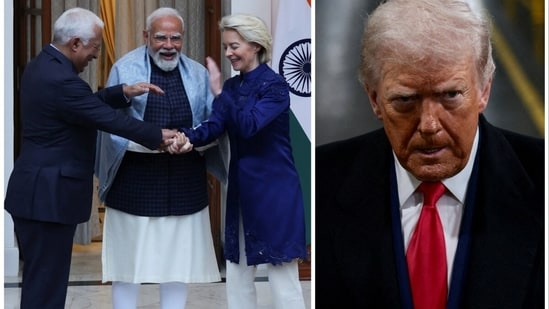
 L: European Council President Antonio Costa, European Commission President Ursula von der Leyen and Prime Minister Narendra Modi | R: US President Donald Trump (AFP and Reuters)
The trade deal slashes tariffs on almost 97 per cent of EU exports entering India. Benefitting the Indian exporters, the FTA allows preferential access to 97 per cent of tariff lines for goods from India in the EU markets, covering 99.5 per cent of the trade value. Read full report here
The signing of India-EU free trade agreement (FTA) was confirmed by Prime Minister Narendra Modi on Tuesday. The development appeared to have rattled the US, whose treasury secretary Scott Bessent on Monday doubled down on allegations that India’s oil trade with Russia finances the war in EU-backed Ukraine. Track latest developments in India-EU trade deal here
This is the largest trade agreement that both the EU and India have ever concluded.
Why is the India-EU trade deal important
The announcement on Tuesday, ending negotiations that were relaunched in June 2022 after a hiatus of almost nine years, paves way for an FTA which has been described as the “mother of all deals” as it would represent 25 per cent of the world’s gross domestic product and integrate a market of over 1.9 billion consumers, HT reported earlier.
The EU is India’s biggest trade partner, with trade in goods worth $135 billion in 2023-24. The FTA will significantly boost trade between India and EU member states at a time when countries are focused on derisking amid trade disruptions caused by the policies of the President Donald Trump administration in the US.
According to the details of the agreement released by the European Union, tariffs on 96.6 per cent of EU goods exports will be eliminated or reduced, saving up to €4 billion per year in duties on European products.
Key benefits for EU exporters under this agreement include:
-Competitive advantage for EU exporters, with biggest trade opening India has given to any trade partner.
-Privileged access to India for EU service providers in key areas financial services and maritime services.
-Simplification of customs procedures to make exports quicker and easier.
-Protection of EU intellectual property such as trademarks.
-A dedicated chapter for small EU businesses.
Wines to chocolates: What gets cheaper for Indians?
The giant free trade deal will gradually lower India tariffs on EU cars from a top rate of 110 percent to as low as 10 percent, while duties on wines progressively go down from 150 per cent to as low as 20 per cent.
Currently at 50 per cent, tariffs on processed foods including pasta and chocolate will be completely eliminated, according to the European Union. Check full list of goods that could get cheaper for Indians after India-EU FTA
How India-EU FTA will reportedly benefit Indian exporters:
Operationalisation of the deal, which is expected early 2027 after regulatory approvals with respective governments, will see immediate duty elimination for 70.4 per cent tariff lines covering 90.7 per cent of India’s exports. More benefits include:
– Zero tariffs to be extended to 93 per cent of Indian goods within seven years.
– Partial cuts and quotas for about six per cent of Indian goods.
– 99.5 per cent of bilateral trade receives some form of tariff concession.
– India to keep autos and agriculture out of full tariff elimination.
– EU’s average tariff rate falls from 3.8 per cent to 0.1 per cent.
– Tariffs cut to zero on key Indian exports to the EU, including marine products (currently at up to 26 per cent), chemicals (12.8 per cent), plastics/rubber (6.5 per cent), leather/footwear (17 per cent), textiles (12 per cent), apparel (four per cent), base metals (10 per cent), and gems and jewellery (four per cent), among a few others, according to a Reuters report.
The signing of the India-EU trade deal was announced amid European Council President Antonio Costa and EU Commission President Von der Leyen’s two-day India visit. They were the chief guests at the Republic Day celebrations and later held a summit with Prime Minister Narendra Modi.
The trade agreement is expected benefit the most labour-intensive sectors such as textiles, leather, chemicals, electronics and jewellery as they do not compete with European manufacturers, HT had reported on January 25.
India’s exporters currently face tough competition from duty-free and quota-free shipments from least developed countries such as Bangladesh. “Once the proposed FTA is implemented, this duty disadvantage will end,” the earlier report quoted one person familiar with the matter as saying.
A counterweight to Trump tariffs
Announcing the signing of the trade deal, Prime Minister Narendra Modi said on Tuesday this agreement will bring major opportunities for the public in India and Europe.
“This is a perfect example of a partnership between two major economies of the world…This agreement represents 25 per cent of the global GDP and 1/3rd of global trade,” he said.
PM Modi said this agreement empowers our shared commitment towards democracy and rule of law.
“This Free Trade Agreement with the European Union will also complement Britain and EFTA’s agreements…I congratulate the people of the nation for this,” he said.
The India-EU trade deal can be read as a strategic counterweight to Donald Trump’s tariff-heavy approach that has left many nations affected, including India and the European Union countries.
Donald Trump in August last year announced 25 per cent tariffs on Indian imports to the US and an additional “penalty” of the same amount over Russian oil purchase, taking the total duties to 50 per cent.
For the EU, Trump imposed 25 per cent tariffs on steel and aluminum imports.
In mid-2025, the US and EU agreed on a trade framework with a 15 per cent tariff on most EU goods entering the US, which was a compromise to avert a full-scale trade war and reduce the threat of even higher rates.
EU Commission President Ursula von der Leyen hailed the signing of the “mother of all” trade agreement, saying history has been made today.
“We have concluded the mother of all deals. We have created a free trade zone of two billion people, with both sides set to benefit,” she said on X, adding that this is only the beginning.
We will grow our strategic relationship to be even stronger, she said.