Demand for skills related to artificial intelligence (AI) more than doubled across sectors in Singapore from 2022 to 2025, driven by the fastest growth in demand for generative AI skills.
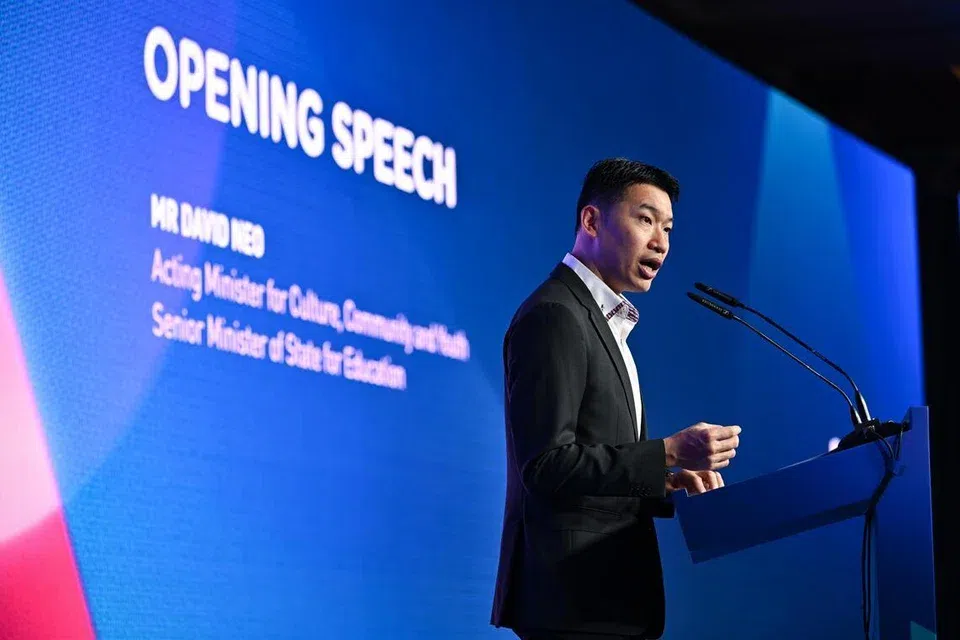
These are among the findings of SkillsFuture Singapore’s (SSG) latest job skills analysis, Senior Minister of State for Education David Neo, who is also Acting Minister for Culture, Community and Youth, said on Jan 27.
Another SSG study of 2,000 job roles found that AI tools can now automate almost a quarter of work tasks, he said, emphasising the need to help all workers learn to use AI, and learn beyond AI.
“This means strengthening skills like critical thinking and decision-making, and other skills that only humans can do,” said Mr Neo, who was speaking at SSG’s Training and Adult Education Conference 2026 at the Sands Expo and Convention Centre.
Around 450 industry leaders, training providers, human resource professionals, educators and policymakers attended the event, which is held annually.
SSG said in a statement that it has started studying trends on the impact of AI tools on job tasks, in addition to regularly surveying the labour market. The agency conducted two pilot studies to understand the AI potential on jobs and work tasks.
The first study analysed about 37,000 key work tasks across 2,000 job roles in the skills frameworks for 38 sectors that map job roles and required skills across industries in Singapore. It found that about 24 per cent, or close to a quarter, of tasks today can be significantly aided by the application of AI. This presents opportunities to improve work productivity across many industries through the adoption of AI tools, SSG said.
At the same time, the study also found a wide range of tasks that are far less automatable and more enduring, where decision-making, self-management and learning agility will become more valued as processes get automated, the agency added.
SSG has published a new dashboard, “AI Potential on Tasks”, on its Jobs-Skills Portal at https://jobsandskills.skillsfuture.gov.sg/data-and-tools/dashboards/ai-potential-on-tasks, showing the potential for AI to automate tasks across job roles. The aim is to enable more informed decisions on training development, job redesign and workforce planning, said the agency.
The second pilot study looked at six sectors – accountancy, built environment, financial services, infocomm technology, retail and tourism – analysing how skills are learnt over time at the workplace and the key skill types needed for entry job roles.
Roles were grouped into three archetypes.
“Mastery builders”, such as accounting executives, are roles where expertise deepens progressively over time. SSG noted that as AI automates foundational tasks, entry-level workers may have fewer opportunities to learn and master foundational skills needed for career progression.
“Analytical specialists”, such as e-commerce associates, have more front-loaded learning, with most skills acquired early in their careers and learning becoming more incremental later. As AI increasingly supports analysis, greater emphasis is placed on judgment and interpretation, said SSG.
“Human connectors”, such as customer service executives, are roles where interpersonal skills are essential. While AI can streamline routine tasks, human interaction and relationship-building remain critical, SSG said.
Note: This article was written by Shermaine Ang and first appeared in The Straits Times on 27 January 2026.
Source: The Straits Times