Holding both ancient craft and modern tech tools in her hands gave graphic novelist Hannah McCann an idea that landed her in a “whirlwind” last week.
The Leeds-based artist, who was born in Northern Ireland, was awarded the 2025 First Graphic Novel Award for St Brigid & Me at a ceremony in London.
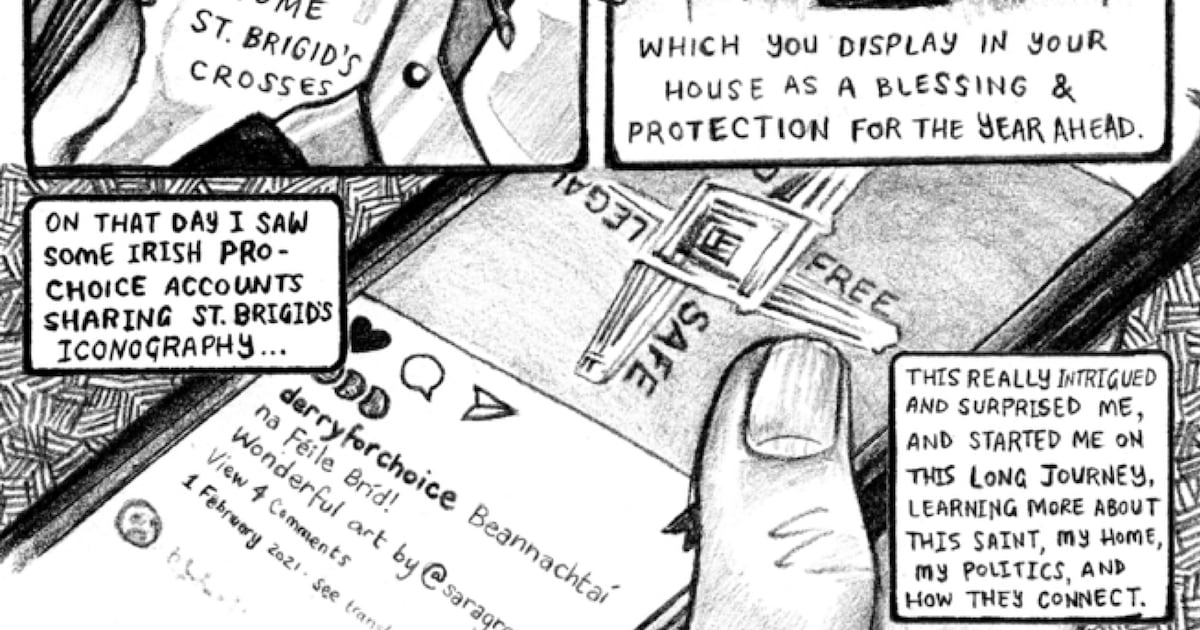
She began the book during the pandemic when visiting her childhood home in rural Co Tyrone. “It was the first time I was home for spring in a decade, I decided I’d really like to make a St Brigid’s cross.”
As she interlaced the reeds, McCann was “mindlessly scrolling on Instagram” where she follows several Northern Irish pro-choice accounts. “I noticed a lot of these account were sharing St Brigid’s iconography,” says McCann. This left her “quite excited by it but confused; in my head they didn’t really go together”.
McCann looked further into Ireland’s female patron saint and her connection with abortion. At the time she was doing an online course in drawing graphic narratives, having honed in on hand-drawn animation and comics in her visual communications degree. And through this course she began work on the first few pages of what has become her book.
Like many Irish schoolchildren, McCann had been taught much about St Brigid of Kildare. “I loved her character, her magical cloak”, which she now sees as a “very anti-landlord and anticolonial story”. But the saint’s “magical” abortion miracle was one she had not learned about, guessing it wasn’t “something which the Catholic Church is a fan of”.
McCann found the idea intriguing. She learned more about how Brigid’s full story was recorded in the seventh-century Irish hagiography. In it an Irish monk wrote about how a pregnant nun went to Brigid in fear and Brigid blessed her, causing the pregnancy to disappear and restoring the woman’s health without childbirth or pain. It left McCann wanting to tell a story that focused on how St Brigid was such a caring figure and to show this miracle as healthcare.
Nonfiction graphic novels are a “really important form of journalism”, she says. It’s a “helpful way of communicating areas which are often stigmatised” particularly in the health sphere. “There is something very immediate about comics,” she says.
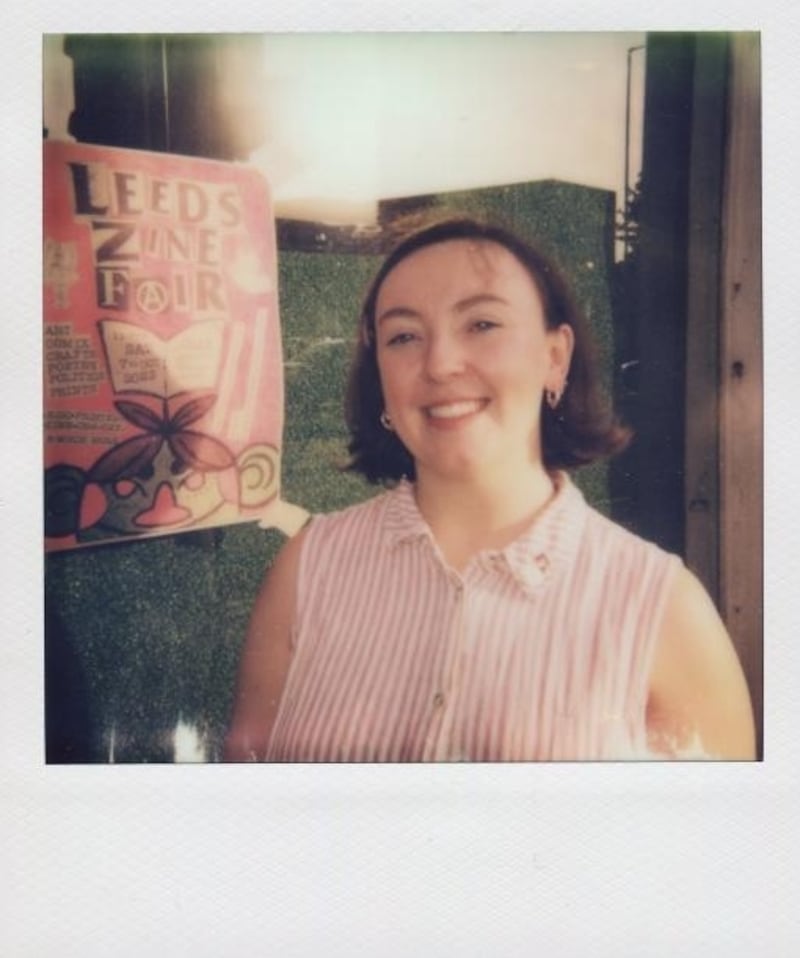 Hannah McCann. Photograph: Theo Rumsby
Much of her early exposure to comics and graphic novels was in Omagh library as a teenager. But she grew up in a house where her parents and siblings all drew. “It was encouraged. Mummy always wanted us to make cards rather than buying them.”
After doing a foundation course in Belfast, McCann “wanted to leave” Ireland and “see a wider range of people, to do something different and go somewhere new”.
In 2011 she moved to the north Yorkshire city to study, attracted by the underlying ethos of the broad art course: “Making the world a better place.”
“We were taught to investigate things and to weigh up the effect.”
At a job in a print co-operative after college, her colleagues encouraged her to work on the Brigid & Me project and to print the graphic novel.
McCann is working as a reprographics teacher in a secondary school. No doubt many of her students read graphic novels, a booming area in children’s fiction. But the graphic novels written for adults category has also risen strongly in recent years, with a spend of more than £50 million (€57 million) in Britain in 2022 compared with just £5 million in 2005, according to Bookseller.
[ Time to restore Brigit’s distaff as a symbol of peace and healingOpens in new window ]
“Maybe it was sniffed at in the past as not serious or not really reading, but it’s a very important literary device,” she says.
McCann, who says she entered the contest just to get industry feedback, seems taken aback by her success. But with the prize win has come a flurry of phone calls and meetings about publishing her graphic novel. “I feel floored at the idea that I will soon have a graphic novel behind me. This is huge.”
Hannah McCann is from Co Tyrone and has lived in Leeds since 2011.