
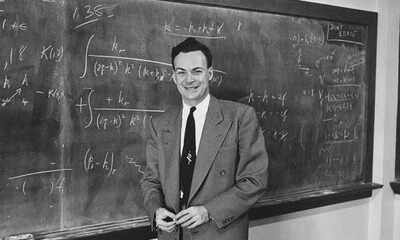
 Richard Feynman | Image source: Caltech Digital Collections The night before an exam is rarely about learning. It is about survival—highlighted notes, half-remembered formulas, and the quiet hope that memory will last just long enough. Generations of students have relied on this ritual. Richard Feynman, the Nobel Prize–winning physicist, thought it was the wrong place to begin. His advice was disarmingly simple: “Understand. Don’t memorise. Learn principles, not formulas.”What sounds like common sense now has strong evidence behind it. Research in education and cognitive science shows that students who invest time in understanding ideas, rather than memorising information, remember more, solve problems better, and cope more calmly when questions take an unfamiliar turn.A 2019 study published in Science—one of the world’s most respected peer-reviewed research journals—put numbers to that insight. Students who explained concepts in their own words scored between 20 and 30 per cent higher than those who relied mainly on memorisation. In that sense, Feynman wasn’t offering motivation. He was describing how learning actually works.
Cramming works short-term, understanding lasts
Rote learning has always had one clear advantage: it feels efficient. You memorise today, reproduce tomorrow, and move on. The problem, research suggests, is that very little stays behind. Studies published in the Journal of Educational Psychology show that students who actively engage with what they are learning—by questioning it, explaining it, or teaching it—retain information far longer than those who simply memorise it.For students, the difference is tangible. Understanding reduces the need for frantic late-night revision and cuts down the anxiety that builds when exams approach. Feynman’s own approach, now widely known as the Feynman Technique, was built on this idea. If you can explain a topic in plain language, without hiding behind jargon, you probably understand it. And that understanding shows up when it matters.
When you know the “why,” unfamiliar questions lose their power
One of the biggest sources of exam fear is the unfamiliar question—the one that doesn’t look like anything in the textbook. Students who rely on memorised steps often freeze at this point. Those who understand underlying principles usually don’t. They may not see the answer immediately, but they know how to start.A 2020 study in Cognitive Science found that students trained to focus on principles solved new problems about 40 per cent more accurately than those who depended on memorised procedures. This matters most in entrance and competitive exams, where repetition is rare and thinking on your feet is the point. Understanding gives students room to adapt, and the confidence to stay calm when the question shifts.
Better scores, less stress, skills that travel beyond exams
Many students assume that understanding takes more time than memorisation. Research suggests the opposite. A study from the University of California, San Diego, found that students who learned conceptually revised more efficiently and performed better under exam pressure. More importantly, they reported feeling less overwhelmed by the process.The benefits extend well beyond marks. Learning this way builds habits that matter later—analytical thinking, flexibility, and the ability to deal with uncertainty. In college, at work, and in life, problems rarely arrive neatly packaged. Knowing how to think through them matters far more than recalling a formula.
The payoff of learning the right way
Feynman’s advice endures because it speaks to something students experience firsthand. Memorisation may get you through an exam, but understanding carries you further. It brings steadier confidence, calmer preparation, and knowledge that doesn’t vanish once the paper is handed in.Decades after Feynman said it, research continues to echo the same message: learning principles makes knowledge last and work harder. When students are taught to think, not just to remember, education finally begins to deliver on its promise.